The $1.9 Billion Pill That Replaced a Needle
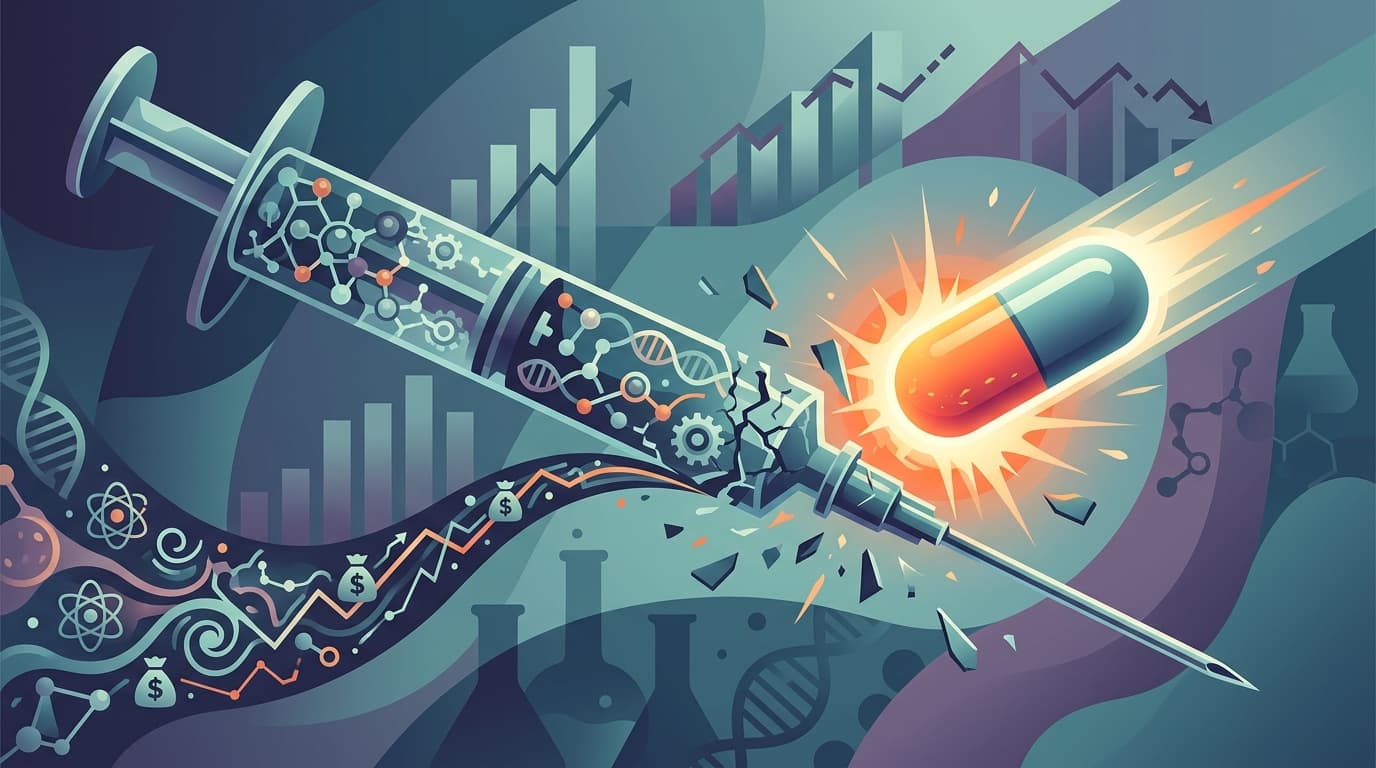
Every on-demand treatment for hereditary angioedema required a needle, until KalVista built a pill. Now Chiesi has paid $1.9 billion to own it, and the deal reshapes the rare disease landscape.

Original reporting and analysis on the stories shaping biotech.

Every on-demand treatment for hereditary angioedema required a needle, until KalVista built a pill. Now Chiesi has paid $1.9 billion to own it, and the deal reshapes the rare disease landscape.

UCB just dropped $2 billion on Candid Therapeutics, a two-year-old startup repurposing cancer drugs for autoimmune disease. It's the biggest bet yet in the autoimmune T-cell engager gold rush, and the pivotal data haven't even arrived.

Eli Lilly's Jaypirca was built as a last-resort cancer drug. New Phase 3 data showing an 80% reduction in disease progression for untreated CLL patients just turned it into a frontline contender, threatening a multi-billion dollar market owned by AbbVie, AstraZeneca, and BeiGene.

Merck is paying $6.7 billion for a company whose stock traded at $2.65 just thirteen months ago. The reason: one CML drug with eye-popping early data and a Keytruda-sized hole that needs filling before 2028.

Allogene's off-the-shelf CAR-T therapy cleared hidden cancer traces at triple the rate of observation in a pivotal trial, sending shares up 55%. The data could reshape a $6 billion market where every treatment is still custom-built and costs over $400,000.

Pfizer's mRNA flu vaccine just beat the standard flu shot by 34.5% in a Phase 3 trial. But a nagging weak spot and a neck-and-neck race with Moderna could determine whether that win actually matters.

Legend Biotech just showed that cancer-killing immune cells can be built inside a patient's body with a single infusion, no factory required. The early data from their dual-target in vivo CAR-T therapy is turning heads, but can it really replace the most complex supply chain in medicine?

Bayer's asundexian just became the first FXIa inhibitor to deliver clean phase 3 results, cutting stroke risk by 26% without extra bleeding. After years of class-wide failures, this could rewrite the rules of anticoagulation.

Revolution Medicines' oral RAS inhibitor nearly doubled overall survival in advanced pancreatic cancer, sending shares up 40%. In a disease where survival gains are measured in weeks, this could redefine the standard of care for one of the deadliest cancers in medicine.

Biogen is paying a 140% premium to acquire Apellis Pharmaceuticals and its blockbuster eye drug Syfovre. The $5.6 billion bet catapults Biogen into ophthalmology and rare kidney disease, but Wall Street wants to see the growth before it believes the price.

Gilead just dropped $7.8 billion on Arcellx and its tiny, synthetic D-Domain protein that could upend the CAR-T therapy market. The clinical data behind the deal is borderline absurd, and the competitive implications for J&J and Bristol Myers Squibb are massive.

Sun Pharma just agreed to buy Organon for $11.75 billion, making it the largest overseas acquisition ever by an Indian pharma company. The deal is either a masterclass in disciplined dealmaking or a high-wire act with $8.6 billion in inherited debt.

J&J's anti-tau antibody posdinemab just failed its Phase 2b Alzheimer's trial, wiping out a projected $5 billion revenue opportunity. It's the fifth major tau antibody to flop, and the implications for the entire field are hard to ignore.

Illumina just axed 300+ jobs as part of a $100 million cost-cutting plan, bringing total layoffs since 2022 to roughly 1,000. But the real story isn't one company's restructuring; it's a sequencing industry where competitors like Ultima Genomics are delivering $80 genomes and Element Biosciences is undercutting Illumina's reagent prices by two-thirds.

J&J's Talvey-Darzalex combo cut the risk of myeloma progression or death by up to 72% in a pivotal phase 3 trial presented at EHA 2026. The data cements J&J's strategy of stacking novel bispecifics onto its blockbuster Darzalex backbone, and the competition may already be a step behind.

Survodutide won't win the obesity weight-loss wars, but its new Phase 3 data on visceral and liver fat reduction reveal a different kind of edge. Boehringer and Zealand Pharma might be playing a smarter game than the scoreboard suggests.

Lilly's triple-agonist retatrutide posted 30% weight loss at two years, rivaling bariatric surgery and leaving Pfizer and Roche scrambling to differentiate at ADA 2026. The competitive hierarchy in obesity drugs just got a whole lot clearer.

Five biotech companies raised over $1.6 billion in a single week, headlined by Parabilis Medicines' record-shattering $670M IPO. The blockbuster stretch signals that public markets are genuinely back for biotech, but only for companies that bring real clinical data to the table.

Novartis just released the first major clinical data from its $12 billion Avidity acquisition, and the results in muscular dystrophy are strong enough to start regulatory conversations. For a disease with zero approved treatments, this could be a game-changer.

Eli Lilly paid up to $2.3 billion for Ajax Therapeutics before its JAK2 inhibitor had ever proven it worked in humans. The first clinical data just landed, and the early numbers are turning heads in the myelofibrosis world.

The FDA just approved the first targeted therapy for a specific genetic subtype of prostate cancer, turning PTEN loss from a bad prognosis into an actionable target. It's the same precision oncology playbook that transformed breast cancer, and it could reshape how we treat the most common male cancer.

Incyte quadrupled its bet on Genesis Molecular AI, expanding their drug discovery pact to $120 million upfront with over $1 billion in potential milestones. What happened in 15 months to convince a major pharma company to go this big on an AI partnership?

Join thousands of biotech professionals who start their day with our free, daily briefing.