
Revolution Medicines' oral RAS inhibitor nearly doubled overall survival in advanced pancreatic cancer, sending shares up 40%. In a disease where survival gains are measured in weeks, this could redefine the standard of care for one of the deadliest cancers in medicine.
Pancreatic cancer doesn't negotiate. It's the honey badger of oncology: relentless, aggressive, and famously resistant to everything doctors throw at it. For decades, the best available chemotherapy bought patients with advanced disease about 6 to 11 months. The five-year survival rate across all stages? A grim 13%.
So when Revolution Medicines announced that a single pill nearly doubled overall survival in a pivotal late-stage trial, the biotech world collectively lost its mind. The stock jumped roughly 40% in a single session, closing around $136. Analysts scrambled to raise price targets. And for the first time in a long time, there's genuine hope for the deadliest major cancer in medicine.
The trial is called RASolute 302, and the results are striking in their simplicity. Patients with previously treated metastatic pancreatic cancer who took Revolution's oral drug, daraxonrasib, lived a median of 13.2 months. Patients on standard chemotherapy? Just 6.7 months.
That translates to roughly a 60% reduction in the risk of death. In a disease where incremental gains are measured in weeks, not months, this is seismic.
The trial hit every target it aimed for. Progression-free survival (how long tumors stayed in check) was statistically significant. Overall survival was statistically significant. Response rates tripled compared to chemo. The Pancreatic Cancer Action Network called the results "unprecedented," and for once, that word doesn't feel like hyperbole.
To appreciate how remarkable these results are, you need to understand the playing field. Pancreatic ductal adenocarcinoma (PDAC) is the most common form of pancreatic cancer, and it's been a wall that drug developers have slammed into for decades.
The standard first-line treatment, a brutal chemo cocktail called FOLFIRINOX, delivers a median survival of about 11 months in metastatic disease. For patients who can't tolerate it, gemcitabine-based regimens offer roughly 8.5 months. Second-line options? Even worse, with most patients getting recycled chemo regimens that barely move the needle.

Allogene's off-the-shelf CAR-T therapy cleared hidden cancer traces at triple the rate of observation in a pivotal trial, sending shares up 55%. The data could reshape a $6 billion market where every treatment is still custom-built and costs over $400,000.


Join thousands of biotech professionals who start their day with our free, daily briefing.
Only about 3% of patients with metastatic pancreatic cancer survive five years. That's not a typo. Three percent.
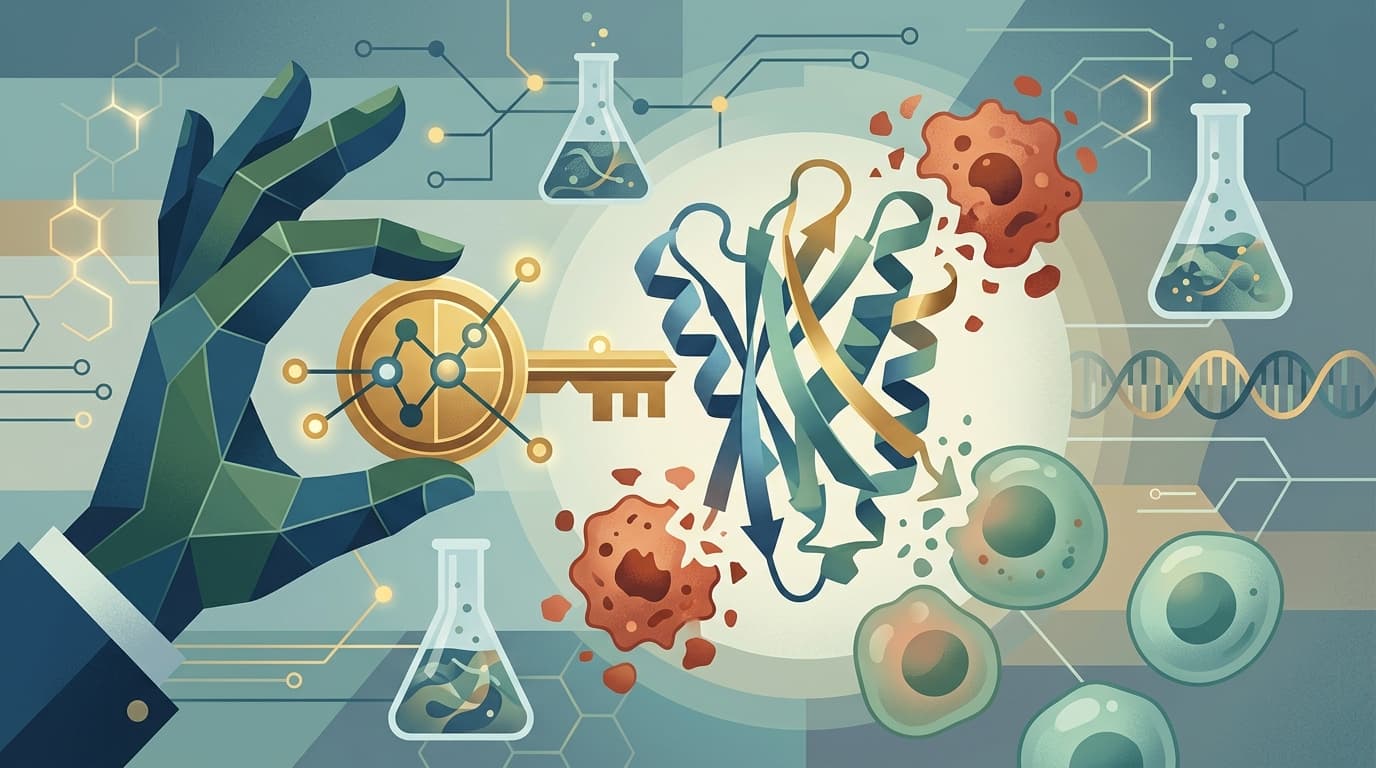
The fundamental problem is biology. About 90% of pancreatic cancers are driven by mutations in a protein called KRAS, which acts like a stuck accelerator pedal for cell growth. Scientists have known about KRAS since the 1980s, but it was considered "undruggable" for most of that time. The protein is small, smooth, and lacks the obvious pockets where drugs typically latch on. Trying to design a drug against KRAS was like trying to hang a picture on a bowling ball.
Revolution Medicines took a different approach. Instead of targeting KRAS when it's inactive (the strategy used by first-generation drugs like Amgen's sotorasib and BMS's adagrasib), they went after KRAS in its active, "ON" state: the form that's actually causing damage.
Their trick involves a molecular chaperone called cyclophilin A. Daraxonrasib first binds to cyclophilin A, forming a two-part complex. That complex then docks onto active KRAS, creating a three-part "tri-complex" that blocks KRAS from signaling to downstream cancer-promoting pathways. Think of it like jamming a folded napkin into a door hinge; the door (KRAS) is stuck open, but now it can't swing to hit anything.
Critically, daraxonrasib isn't picky about which KRAS mutation it targets. While earlier drugs only worked on the G12C mutation (which accounts for a tiny 1-2% of pancreatic cancers), daraxonrasib hits G12D, G12V, G12R, G13, and Q61 mutations. The G12D mutation alone shows up in about 40% of pancreatic tumors. This broader coverage is why the drug can serve a much larger patient population.
The market reaction was swift and emphatic. Revolution's shares surged approximately 40% following the data release.
Analysts across the board raised their price targets:
The consensus view? This data substantially de-risks the company and opens the door to a large commercial opportunity. Revolution plans to file for FDA approval based on these results, with the interim analysis declared final because the survival benefit was so large that continuing felt unnecessary.
Revolution's success doesn't exist in a vacuum. It fundamentally changes the pecking order in KRAS-targeted oncology.
First-generation KRAS G12C drugs from Amgen and BMS remain important in lung and colorectal cancer, but they were always peripheral to pancreatic cancer because of that pesky 1-2% mutation frequency. BMS's G12D-specific drug, MRTX1133, was supposed to be their answer for pancreatic cancer, but the program was terminated earlier this year. That stumble effectively handed Revolution the keys to the kingdom.
The main competitive threats now come from Astellas, whose G12D-targeting degrader setidegrasib is entering Phase 3, and Verastem Oncology, whose G12D inhibitor VS-7375 received FDA Fast Track designation in mid-2025. But neither has Phase 3 survival data in hand. Revolution is first across the finish line with the kind of data that changes treatment guidelines.
Let's be clear about something: 13.2 months is not a cure. But in a disease where second-line treatment has barely budged the survival curve in 20 years, nearly doubling it with a once-daily pill (instead of IV chemo) is transformative.
Revolution isn't stopping here. They're running additional Phase 3 trials in pancreatic cancer, a Phase 3 in lung cancer (RASolve 301), and developing mutation-specific companions like zoldonrasib (targeting G12D) and elironrasib (targeting G12C) that could eventually be layered on top of daraxonrasib for combination strategies.
The company has signaled it plans to commercialize in the U.S. on its own while remaining open to partnerships for markets outside the country. Given these results, expect the phone to be ringing.
For decades, pancreatic cancer has been the disease where hope went to die. A single pill just rewrote the opening chapter of a very different story. The ending is still unwritten, but for the first time, it doesn't feel predetermined.
Sun Pharma just agreed to buy Organon for $11.75 billion, making it the largest overseas acquisition ever by an Indian pharma company. The deal is either a masterclass in disciplined dealmaking or a high-wire act with $8.6 billion in inherited debt.