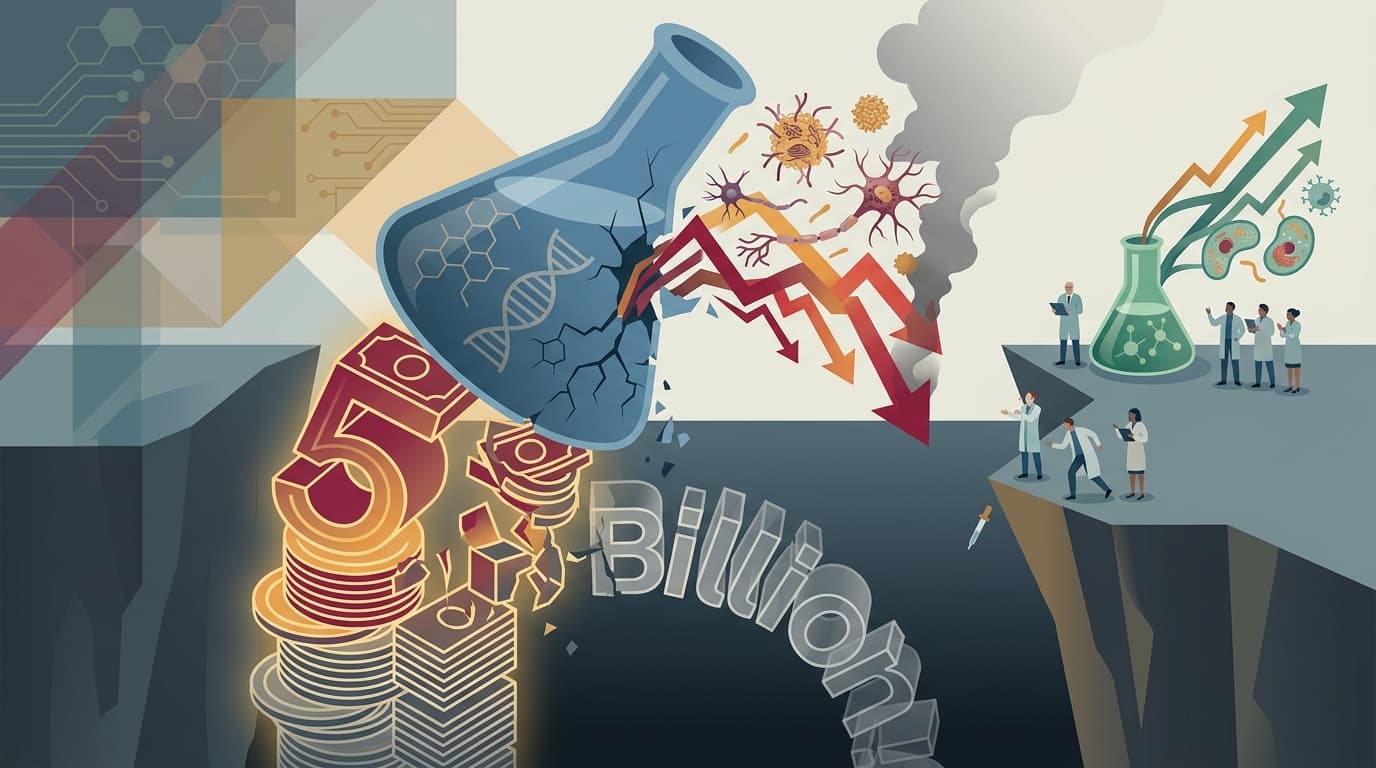
The $5 Billion Alzheimer's Bet That Just Went to Zero
J&J's anti-tau antibody posdinemab just failed its Phase 2b Alzheimer's trial, wiping out a projected $5 billion revenue opportunity. It's the fifth major tau antibody to flop, and the implications for the entire field are hard to ignore.
Another Headstone in the Tau Graveyard
Somewhere inside Johnson & Johnson's neuroscience division, someone once projected $5 billion in peak annual sales for posdinemab. That number was supposed to represent a new era of Alzheimer's treatment: a drug that attacks tau, the protein most tightly linked to cognitive decline. As of this week, that $5 billion figure is worth exactly nothing.
J&J's anti-tau antibody posdinemab failed its Phase 2b trial in early Alzheimer's disease. Neither the low dose nor the high dose slowed clinical decline compared to placebo. Not on the primary endpoint. Not on any of the secondary ones, either. The company pulled the plug on the study and walked away from Alzheimer's development for this drug entirely.
If this feels like déjà vu, that's because it is. Posdinemab is now the latest name on a very long list of tau-targeting antibodies that looked promising in theory but couldn't deliver where it mattered: in patients' brains.
What the Trial Actually Showed (and Didn't)
The trial was called AuTonomy, and it was designed to test posdinemab in people with early-stage Alzheimer's. Think prodromal disease and mild cognitive impairment; patients who were just starting to slip. J&J enrolled 523 participants across 141 sites and gave them either low-dose posdinemab, high-dose posdinemab, or placebo every four weeks for up to two years.
The primary endpoint was change in a cognitive and functional scale called iADRS-MCI at week 104. The idea was simple: if posdinemab works, treated patients should decline more slowly than those on placebo. But when a scheduled interim data review came back, the drug showed no statistically significant benefit on that measure.
It wasn't just the primary endpoint that came up empty. The trial also tracked three key secondary measures: CDR-SB (a clinical dementia rating), ADAS-Cog13 (a cognitive test), and ADCS-ADL-MCI (a daily functioning scale). Posdinemab failed on all of them. Across every dose and every way of measuring, the drug was indistinguishable from a sugar pill.
Get tomorrow's biotech intelligence before your competitors.
Join thousands of biotech professionals who start their day with our free, daily briefing.
A Clever Idea That Biology Wouldn't Cooperate With
To understand why this hurts, you need to understand why people were excited about posdinemab in the first place. It wasn't just another tau antibody. It was supposed to be a smarter tau antibody.
Most of the previous tau antibodies (semorinemab, tilavonemab, zagotenemab, gosuranemab) targeted the N-terminal region of the tau protein, essentially the tip of the molecule. They all failed, one after another, between 2020 and 2022. Four straight whiffs.
Posdinemab was designed differently. It targets the mid-domain region of tau, specifically a phosphorylated form called pT217. The theory: catch pathological tau after it's released from dying neurons but before it can seed and spread to neighboring cells. Think of it like intercepting a rumor before it goes viral. If you can grab the toxic tau in the space between neurons and neutralize it, maybe you can stop the cascade.
J&J even used a biomarker-enriched enrollment strategy, selecting patients based on elevated plasma p-tau217 levels and intermediate tau burden on PET scans. They picked patients who, in theory, were the perfect candidates for this drug.
It still didn't work.
The Tau Antibody Graveyard Is Getting Crowded
Let's take a quick tour through the wreckage.
Semorinemab (Genentech/Roche) was arguably the first major casualty. Its Phase 2 TAURIEL trial in prodromal-to-mild Alzheimer's showed no benefit on CDR-SB or tau PET in 2020. Roche eventually handed the rights back to its partner, AC Immune.
Tilavonemab (AbbVie) failed in both progressive supranuclear palsy (a different tau-driven brain disease) and Alzheimer's. No effect on clinical decline, brain atrophy, or neurodegeneration markers. Program discontinued.
Zagotenemab (Eli Lilly) failed its Phase 2 PERISCOPE-ALZ trial in early symptomatic Alzheimer's in 2021. Development stopped.
Gosuranemab actually made things worse in one trial, accelerating cognitive decline on a key test in early Alzheimer's.
Now add posdinemab to the list. That's five major anti-tau antibodies, all swinging at the same basic idea, all missing. The mid-domain targeting strategy was supposed to be the plot twist that saved the franchise. Instead, it's just a different angle on the same disappointment.
So Is Tau the Wrong Target?
This is where it gets complicated, because the science behind tau is actually stronger than it's ever been.
Tau pathology correlates more closely with cognitive decline and disease progression than amyloid plaques do. A large Mayo Clinic study of more than 3,600 brains found that the progression of dysfunctional tau drives cognitive decline, while amyloid accumulates but isn't the primary culprit behind symptoms. When researchers account for tau severity, the relationship between amyloid and cognition largely disappears.
In other words, tau is almost certainly the right molecule to go after. The problem is that nobody has figured out how to go after it effectively. It's like knowing the fire is in the kitchen but not being able to find the right extinguisher.
Several questions remain unanswered. Are antibodies even the right format for hitting tau? Do we need to intervene much earlier, before symptoms appear? Are we targeting the wrong form of tau (tangles versus soluble oligomers versus phosphorylated species)? Does the drug even reach the right compartment in the brain in sufficient concentrations?
Reviews of the field are blunt: numerous tau-targeting drugs have been tested, but none has shown clear, significant clinical benefit in large trials. The target looks right; the weapons keep failing.
What's Left in J&J's Alzheimer's Playbook
Despite torching $5 billion in theoretical revenue, J&J says it's not walking away from Alzheimer's entirely. The company is still advancing JNJ-2056, a tau-targeted active immunotherapy (basically a vaccine approach) in Phase 2. This program targets pre-symptomatic or very early Alzheimer's, betting that intervention needs to start before the disease gains momentum.
For J&J's stock, the damage is manageable. Posdinemab was still in Phase 2, which means most analysts hadn't baked huge revenue expectations into their models. For a company with J&J's diversified earnings base, this registers as lost optionality rather than an earnings crisis. The $5 billion peak-sales bull case simply gets removed from the spreadsheet.
But the reputational hit is real. J&J had positioned itself as a serious player in next-generation Alzheimer's therapies. That narrative just took a significant blow.
Meanwhile, the Amyloid Drugs Quietly Keep Winning
While tau antibodies keep failing, the amyloid-targeting drugs have established themselves as the first real disease-modifying therapies for Alzheimer's. Lecanemab (from Eisai and Biogen) slowed cognitive decline by roughly 27% over 18 months in its Phase 3 trial. Donanemab (Eli Lilly) showed approximately 35% slowing overall, with up to 40% in patients who had lower baseline tau.
Both drugs have FDA approval. Neither is a cure; patients still decline, just more slowly. But they represent the clearest evidence yet that you can meaningfully alter the course of Alzheimer's disease with a drug.
Here's what's particularly interesting: lecanemab-treated patients showed reductions in tau-related biomarkers and slower tau accumulation on PET scans, suggesting that clearing amyloid has downstream effects on tau biology. This has sparked a new theory. Maybe the play isn't amyloid or tau, but amyloid then tau. Clear the upstream trigger first, then hit tau before it spirals.
That idea is being tested right now. Eisai is running a combination trial pairing lecanemab with etalanetug (E2814), an anti-tau antibody, in Phase 2/3. If combination therapy works, it could rewrite the Alzheimer's treatment playbook entirely, borrowing a page from oncology and HIV, where multi-drug regimens transformed outcomes.
The Uncomfortable Truth About Alzheimer's Drug Development
Alzheimer's disease has humbled the pharmaceutical industry like few other diseases. More than 200 drug candidates have failed in clinical trials over the past two decades. The approval rate for Alzheimer's drugs between 2002 and 2012 was a staggering 0.4%, making it one of the hardest indications in medicine.
Posdinemab's failure is painful, but it's not surprising if you understand the statistics. Phase 2 trials in Alzheimer's fail at extraordinarily high rates, and tau antibodies specifically have a perfect record of futility in the clinic.
The field isn't giving up. There are approximately 15 tau-targeting agents in various stages of development, including antisense oligonucleotides (drugs that dial down tau production at the genetic level), vaccines, and small molecules. The scientific rationale for targeting tau remains strong. What's missing is the pharmacological know-how to translate that rationale into something that actually helps patients.
For now, the $5 billion dream goes into the same filing cabinet as every other Alzheimer's moonshot that couldn't survive contact with reality. J&J will regroup. The tau field will regroup. And somewhere, a scientist is already designing the next experiment to crack the code.
The question isn't whether tau matters. It's whether we're clever enough to do something about it.
Deals & M&A
5 min read
The $11.75 Billion Bet That Rewrites Indian Pharma's Playbook
Sun Pharma just agreed to buy Organon for $11.75 billion, making it the largest overseas acquisition ever by an Indian pharma company. The deal is either a masterclass in disciplined dealmaking or a high-wire act with $8.6 billion in inherited debt.