
A personalized cancer vaccine just posted 100% disease-free survival at three years in one of oncology's toughest cancers. Sixteen patients, zero relapses, and a field watching very closely.
Sixteen cancer patients got an experimental vaccine after surgery. Three years later, not a single one has relapsed.
That's the headline from Transgene and NEC's TG4050 program, a personalized cancer vaccine tested in one of oncology's toughest neighborhoods: HPV-negative head and neck cancer. The Phase I/II trial results, just published in Nature Communications, show 100% disease-free survival in the vaccinated group after a median follow-up of 41 months. In the control group of 16 patients who didn't get the vaccine? Three relapses.
For a field that's been promising personalized cancer vaccines for over a decade, this is the kind of data that makes people sit up straight.
Head and neck cancer that isn't driven by HPV is, to put it bluntly, a nightmare. About half of patients show up with advanced disease. Real-world data show local progression in 37% of inoperable cases, and in one multicenter study, 79% of patients eventually died from their disease.
The standard playbook is surgery, then radiation or chemoradiation depending on how bad things look under the microscope. For patients whose cancer comes back, the options are limited: checkpoint immunotherapy plus chemo, with a median survival of roughly a year. After that fails, you're looking at about six months.
So when a small trial posts three years of zero relapses in this population, it gets attention. Lots of it.
TG4050 isn't your typical shot. It's a bespoke product, built from scratch for each patient. Think of it like a custom-tailored suit, except instead of measuring your shoulders, scientists are sequencing your tumor.
The process works like this. First, doctors sequence both the tumor and healthy tissue to find mutations unique to the cancer. Then NEC's AI platform, informed by more than two decades of AI expertise, ranks those mutations by how likely they are to trigger an immune response. The top picks get encoded into a harmless viral vector called MVA (Modified Vaccinia Ankara), which is basically a delivery truck for the immune system.

Ultragenyx's Angelman syndrome drug showed zero benefit over sham treatment in a 129-patient Phase 3 trial, sending shares down over 40%. For families who'd pinned their hopes on the most advanced therapy in development, the fallout is devastating.


Join thousands of biotech professionals who start their day with our free, daily briefing.
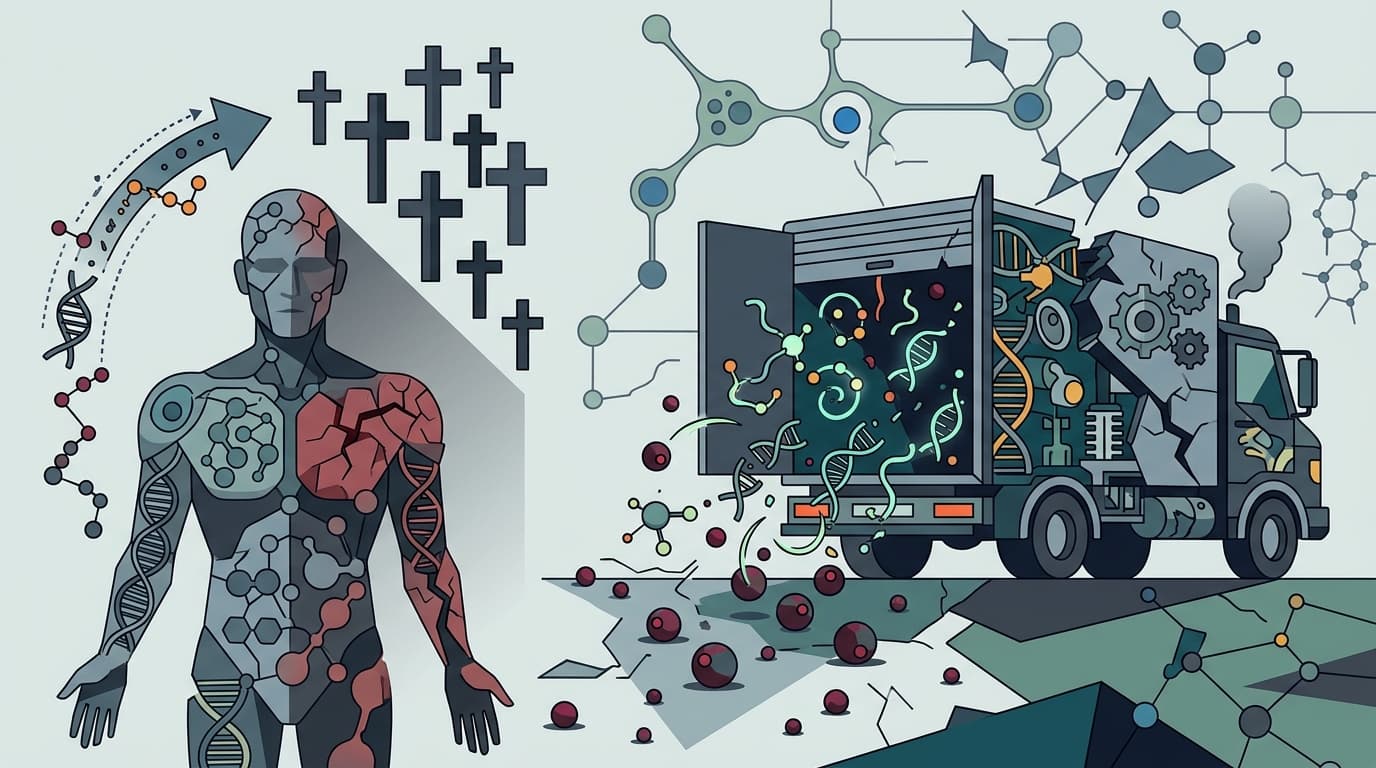
Once injected, the MVA vector carries those tumor-specific sequences into the patient's immune cells. Those cells display the mutations like a wanted poster, teaching killer T cells exactly what to hunt. The result: CD8+ T cells (the immune system's assassins) and CD4+ helper T cells that can find and destroy any remaining cancer cells carrying those mutations.
In the Phase 1 data, 73.3% of patients mounted these neoantigen-specific T-cell responses. Patients responded to a median of three different neoantigens each. And here's the kicker: those responses persisted for more than a year after the last vaccination. The immune system didn't just learn the target; it remembered it.
Let's be honest about the limitations before we get too excited. Sixteen patients per arm is tiny. The study authors themselves acknowledged that the small number of patients and events "is insufficient to establish a statistically significant benefit." Kempen analyst Chiara Montironi called the longer follow-up a "robust dataset" supporting TG4050's relapse-prevention potential, but robust and definitive are two very different words.
Still, the signal is hard to ignore. Zero relapses versus three in the control arm, sustained over three years, with a clean safety profile and no unexpected findings. In the adjuvant setting (where you're treating patients who are technically cancer-free after surgery), safety matters enormously. You're asking healthy-feeling people to take a treatment that prevents something that might happen. If that treatment makes them miserable, they won't stick with it.
TG4050 passed that test with flying colors.
Personalized cancer vaccines are having a moment, and TG4050 isn't the only horse on the track. Moderna and Merck's mRNA-4157 (V940) is the clear frontrunner in terms of clinical maturity. Their KEYNOTE-942 trial in high-risk melanoma showed 18-month relapse-free survival of 78.6% versus 62.2% for pembrolizumab alone, with a hazard ratio of 0.56. That program has already moved into a Phase 3 trial aiming to enroll over 1,000 patients, with results expected around 2029.
BioNTech is running its own individualized neoantigen platform (BNT122/autogene cevumeran) with strong immunogenicity data but no Phase 3 efficacy readout yet. Gritstone bio rounds out the competitive set but sits at an earlier stage.
What separates TG4050 is the platform. While Moderna and BioNTech use mRNA, Transgene uses an MVA viral vector. Different delivery truck, same destination. Whether one approach proves superior to the others is still anyone's guess, but TG4050's three-year data in a notoriously difficult cancer type gives the viral vector approach real credibility.
Transgene isn't sitting on its hands. The Phase 2 portion of the trial finished patient randomization in April 2026, with 38 patients enrolled. The full Phase 1/2 program is expected to include roughly 80 patients across sites in the U.S. and France. Initial immunogenicity data from Phase 2 should arrive in the second half of 2026, with the big moment (two-year disease-free survival data) expected by the end of Q1 2028.
Behind the scenes, Transgene expanded its partnership with NEC through a 2026 license agreement for TG4050 development and commercialization using NEC's AI neoantigen prediction platform. They've also brought in BostonGene for tumor molecular profiling and sequencing support, which should speed up the process of building each patient's custom vaccine.
TG4050's three-year data won't change the standard of care tomorrow. The trial is too small for that, and the field knows it. But in the story of personalized cancer vaccines, this is a chapter worth reading carefully.
The concept has always been elegant: teach each patient's immune system to recognize their specific cancer. The hard part has been proving it works in humans, with durable responses, in a tough cancer, with manageable side effects. On all four counts, TG4050 just delivered.
Now comes the real test. Phase 2 data will tell us whether this holds up in a larger group. If it does, Transgene and NEC won't just have a promising vaccine; they'll have proof that AI-designed, patient-specific immunotherapy can keep cancer from coming back. And in HPV-negative head and neck cancer, where options are scarce and outcomes are grim, that would be something worth celebrating.
Teva's experimental antibody just aced a mid-stage celiac disease trial, posting the best data anyone has seen in the IL-15 space. With zero approved targeted therapies and a market approaching $1 billion, the race to deliver the first real celiac drug is officially on.