Sarepta's Worst Week: A Black Box, 500 Pink Slips, and a Gene Therapy in Crisis
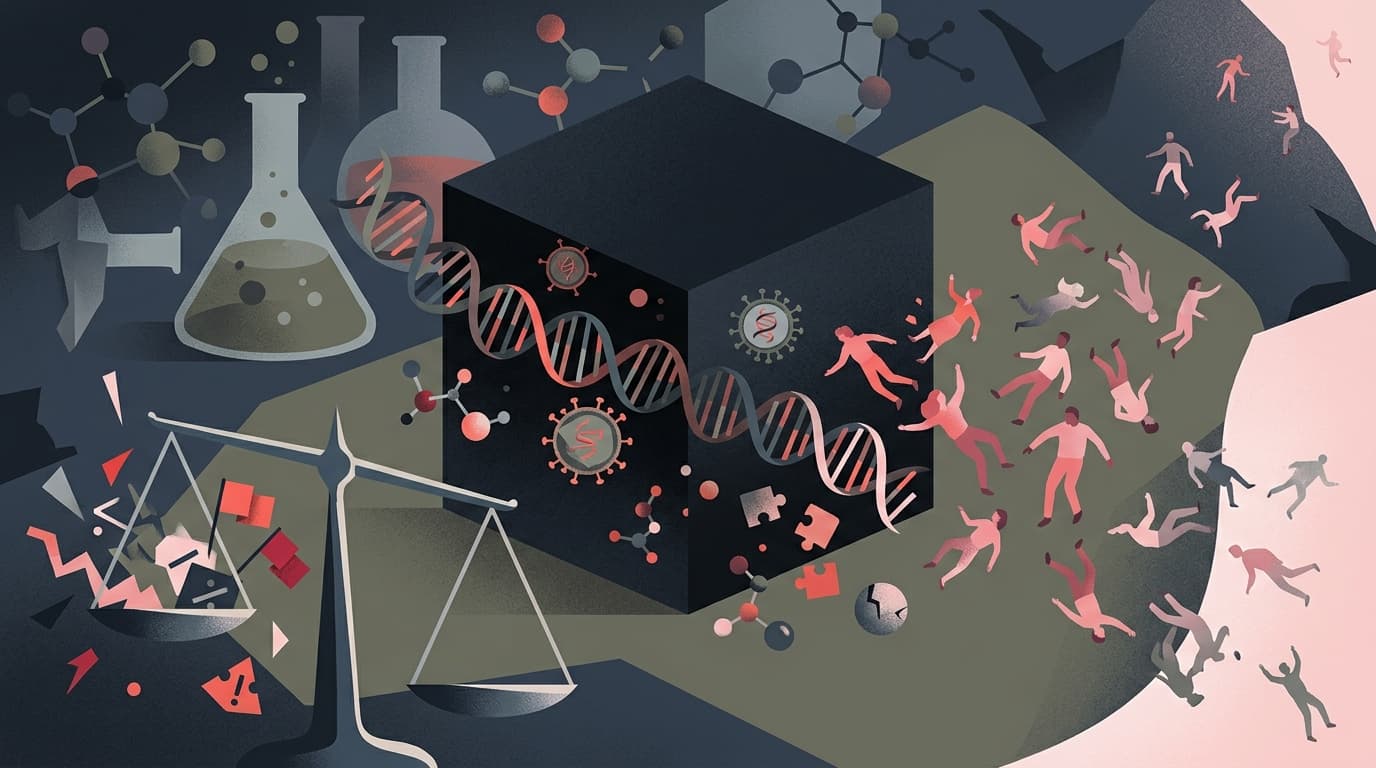
Sarepta hit its Duchenne gene therapy Elevidys with the FDA's most serious safety warning after fatal liver failures, then cut 36% of its workforce in the same week. It's the biggest crisis yet for one of gene therapy's most prominent companies.
Two years ago, Sarepta Therapeutics was the poster child for gene therapy's golden age. Its Duchenne muscular dystrophy treatment, Elevidys, was generating nearly $900 million a year in sales and giving hope to families watching their sons lose the ability to walk. Now, in the span of a single week, the company slapped the most serious safety warning possible on that same drug and told roughly 500 employees they no longer have jobs.
That's not a rough patch. That's a company fighting for survival.
The Scarlet Letter of Drug Labels
If you've ever seen a prescription drug commercial, you know the part at the end where someone speed-reads a terrifying list of side effects. A black box warning (formally called a "boxed warning") sits above all of that. It's the FDA's equivalent of a flashing neon sign that says: "Prescriber, read this before you do anything else."
Elevidys now carries one for acute serious liver injury and acute liver failure, including fatal outcomes. The FDA pushed for the change after reports of two deaths from acute liver failure in non-ambulatory pediatric patients (boys who had already lost the ability to walk). Both cases were devastating, and both involved the very population Sarepta had been trying to help.
The label didn't just get scarier; it also got narrower. The FDA removed non-ambulatory patients entirely from the approved indication. Elevidys is now restricted to ambulatory Duchenne patients aged four and older with a confirmed genetic mutation. If you can't walk, you can't get the drug. For families who saw gene therapy as a last resort, that door just closed.
When the Warning Signs Were Already There
This wasn't a bolt from the blue. Back in June 2025, the FDA issued a safety communication about Elevidys and hepatotoxicity (liver damage that can be severe enough to kill). Sarepta paused U.S. distribution for non-ambulatory patients around the same time. The writing was on the wall; it just took over a year for it to become official.
Get tomorrow's biotech intelligence before your competitors.
Join thousands of biotech professionals who start their day with our free, daily briefing.
Beyond liver toxicity, the safety profile has other red flags. The drug's label now warns about myocarditis (inflammation of the heart muscle), with cases popping up anywhere from 24 hours to more than a year after infusion. There are also reports of immune-mediated myositis and rhabdomyolysis, both of which involve muscle breakdown. For a therapy designed to save muscles, that's a painful irony.
Patients who do receive Elevidys now face weekly liver function tests for at least three months after their infusion. The typical window for liver injury onset is about eight weeks, so doctors need to watch closely during that critical stretch.
500 Jobs and a Pipeline Pivot
The layoffs are the other half of this one-two punch, and they're massive. Cutting 500 positions wipes out roughly 36% of Sarepta's entire workforce. Think of it this way: if your company has ten people at a conference table, almost four of them just got told to leave.
Sarepta is framing this as a "strategic restructuring" aimed at saving more than $400 million annually. About $120 million of that comes from headcount reductions. The rest comes from pausing or killing research programs and other non-personnel cuts.
The most notable casualty: Sarepta is pulling back from most of its limb-girdle muscular dystrophy gene therapy programs, which were supposed to be the next wave after Duchenne. Instead, the company is pivoting toward siRNA programs (a different technology that silences disease-causing genes rather than replacing them). It's a tacit admission that the AAV gene therapy platform, once Sarepta's crown jewel, has become a liability.
The Revenue Cliff Nobody Wanted
Elevidys generated $898.7 million in net product revenue during 2025, making it one of the most commercially successful gene therapies ever launched. But the trajectory turned ugly in a hurry.
Q4 2025 revenue dropped to $110.4 million, partially blamed on a bad flu season and rescheduled patient infusions. Both Q1 and Q2 of 2026 came in below the prior year's levels, driven by lower patient volume after the label narrowed to ambulatory-only. When you eliminate an entire patient population from your approved use, the revenue math changes fast.
Sarepta is still guiding to $1.2 billion to $1.3 billion in total company net product revenue for 2026, but the confidence behind those numbers is fraying. Analysts have responded with a lukewarm consensus Hold rating and a price target around $25, with a notable cluster of Sell ratings mixed in. The stock was bouncing between roughly $21 and $23 in early September, a far cry from the optimism that once surrounded the company.
Competitors Smell Blood
Sarepta's stumble is creating an opening for rivals. Solid Biosciences launched its Phase 3 IMPACT DUCHENNE trial for SGT-003 in May 2026, making it the most advanced next-generation AAV competitor. REGENXBIO is working toward a potential 2026 BLA submission for RGX-202, another micro-dystrophin gene therapy. And Precision BioSciences is taking a completely different approach with PBGENE-DMD, an in vivo gene editing program that could sidestep some of the risks inherent in traditional AAV delivery.
Pfizer, once considered a major Duchenne gene therapy contender, has scaled back its broader AAV efforts, leaving the field to smaller, more focused players. The competitive hierarchy is reshuffling in real time, and Sarepta's position at the top is no longer guaranteed.
What This Means for Gene Therapy's Reputation
Sarepta's crisis extends beyond one company and one drug. Elevidys was supposed to prove that gene therapy could work at commercial scale: that you could charge a premium price, treat thousands of patients, and build a sustainable business around a single-dose cure. Instead, it's become a cautionary tale about what happens when safety signals catch up with commercial ambition.
The fundamental promise of gene therapy (fix the broken gene, fix the disease) remains scientifically compelling. But the delivery mechanism, AAV vectors, keeps running into the same problems: liver toxicity, immune reactions, and unpredictable inflammation. Every company in the space is watching Sarepta right now and asking the same uncomfortable question: could this happen to us?
For families living with Duchenne muscular dystrophy, the stakes are simpler and more heartbreaking. There are roughly 10,000 boys and young men in the U.S. with the condition. Many of them, especially those who've already lost mobility, just lost access to the only approved gene therapy that was designed for them. The science isn't dead, but for the patients who needed it most, the timeline just got a lot longer.
Clinical & Regulatory
4 min read
A CAR-T for Patients Who Already Failed CAR-T
A tiny California biotech just published Lancet data showing its CAR-T therapy worked in patients who'd already failed the standard CAR-T approach. Nine patients, seven complete responses, zero relapses so far. The catch? It's Phase 1, and nine patients is barely a dataset.