A $20 Blood Draw Could Replace a $5,000 Brain Scan for Alzheimer's
Roche just got FDA clearance for a blood test that detects Alzheimer's-related amyloid pathology with roughly 90% accuracy. It could replace expensive PET scans and spinal taps as the first step in screening, and potentially unlock treatment access for millions of patients stuck in diagnostic limbo.
Imagine you're 62 years old, and your memory has been slipping. You keep forgetting where you parked. Your spouse noticed you told the same story three times at dinner. Your doctor suspects early Alzheimer's, but to find out for sure, you need either a PET scan (think: thousands of dollars, limited availability, long wait times) or a spinal tap (think: a needle in your spine). Most people never get either one.
That bottleneck just got a whole lot smaller.
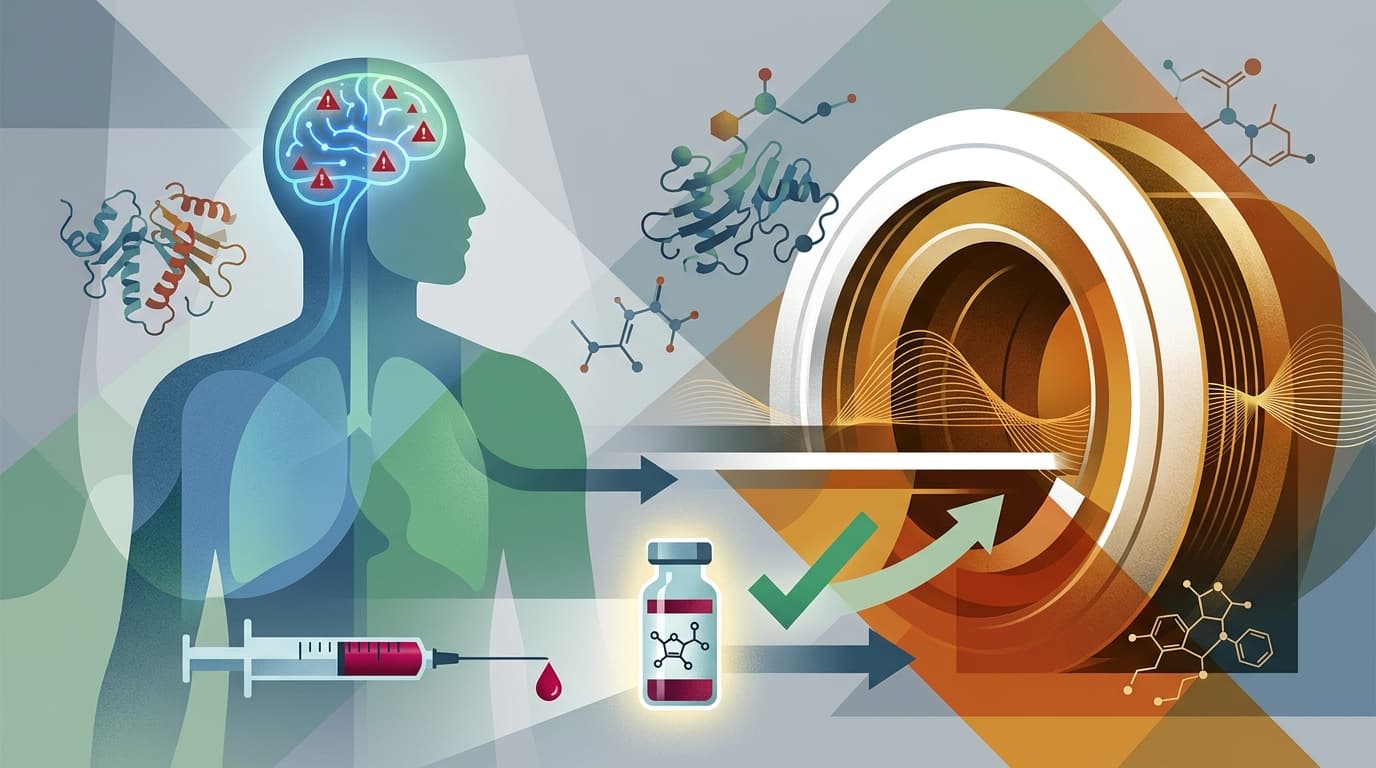
On August 24, Roche received FDA clearance for Elecsys pTau217, a blood test that can help identify whether someone's brain is accumulating amyloid plaques, the hallmark protein clumps associated with Alzheimer's disease. One blood draw. Run on machines that already sit in thousands of U.S. labs. Results that tell a doctor whether amyloid pathology is likely, unlikely, or somewhere in between.
This isn't a cure. It's not even a diagnosis on its own. But it might be the single biggest unlock for getting Alzheimer's patients into treatment faster.
Why a Blood Test Changes Everything
Right now, confirming Alzheimer's-related amyloid pathology typically requires one of two things: an amyloid PET scan or a cerebrospinal fluid (CSF) test, which involves collecting fluid from the spinal canal. PET scans are expensive and scarce. Spinal taps are, well, spinal taps. Neither option scales well for the roughly 7 million Americans living with Alzheimer's, let alone the millions more in the early stages who haven't been diagnosed yet.
Blood-based testing flips that equation. Instead of sending patients to specialized imaging centers or scheduling invasive procedures, a primary care doctor can order a standard blood draw. The sample goes to a lab, gets processed on equipment that's already there, and comes back with a result that helps guide next steps.
Roche's test measures phosphorylated tau 217 (pTau217), a protein fragment that rises in the blood when amyloid plaques are building up in the brain. Think of it like a smoke detector: it doesn't tell you exactly where the fire is or how big it's gotten, but it reliably tells you something is burning. Clinical studies have shown the test matches up well with amyloid PET scans.
Get tomorrow's biotech intelligence before your competitors.
Join thousands of biotech professionals who start their day with our free, daily briefing.
That's remarkably good for something that costs a fraction of a PET scan and doesn't require a single appointment at a specialized center.
Not a Standalone, But a Game-Changing Filter
Roche is careful to note that Elecsys pTau217 is not meant to be used alone. It's an aid, not an oracle. Doctors still need to interpret results alongside clinical evaluations, patient history, and potentially confirmatory PET or CSF testing in ambiguous cases.
The test returns one of three categories: positive, intermediate, or negative. A negative result can help rule out amyloid pathology with strong confidence; studies have shown very high negative predictive value, meaning if the test says "no," it's almost certainly right. A positive result points toward amyloid buildup and can help rule it in. The intermediate zone is where things get murkier, and that's where doctors may still reach for traditional methods.
But even as a triage tool, the math is compelling. Research suggests that using a two-threshold blood test strategy (one cutoff for ruling out, another for ruling in) could reduce the need for PET and CSF testing by 80–85%. That's not trimming around the edges. That's eliminating most of the diagnostic bottleneck in one move.
The Real Prize: Unlocking Treatment Access
If this were just about diagnosis, it would still be important. But the stakes are higher now than they were even two years ago, because there are finally Alzheimer's drugs that actually work on the underlying disease.
Lecanemab (sold as Leqembi) and donanemab are anti-amyloid therapies that target and clear the same plaques this blood test detects. Both drugs require patients to prove they have amyloid pathology before starting treatment. That means every patient who wants access to these therapies first needs to clear the diagnostic hurdle.
And that hurdle has been brutal. Real-world programs have reported that many referred patients never make it to treatment because they can't complete the biomarker testing, can't access a PET scanner, or get lost in referral queues. It's like having a ticket to a concert but no way to get to the venue.
A widely available blood test changes the logistics dramatically. Primary care doctors (who see the vast majority of patients with early cognitive complaints) can now order a screening test in their own office. Positive results can be fast-tracked to specialists. Negative results can spare patients unnecessary anxiety and the healthcare system unnecessary costs.
There's a catch, though. Current treatment guidelines for both lecanemab and donanemab still require confirmatory amyloid PET or CSF testing before starting therapy. A positive blood test alone isn't enough to write the prescription. So the blood test is more like a fast pass than a golden ticket: it gets you to the front of the line, but you still need to go through the gate.
Roche's Built-In Advantage
This is where Roche's position gets interesting from a business perspective. The company says Elecsys pTau217 can run on more than 4,500 Roche analyzers already installed across the United States. That's an enormous installed base. Labs don't need to buy new machines or build new infrastructure; they can add this test to equipment they're already using.
Labcorp has already announced it will offer the test as part of an expanded Alzheimer's testing portfolio, giving Roche immediate distribution through one of the country's largest lab networks. The combination of FDA clearance, existing hardware, and a major lab partner creates a rollout advantage that's hard to replicate.
Roche is also positioning the test with a single set of validated cutoffs that work across both primary care and specialty care settings. That matters because it simplifies adoption. A family doctor in rural Kansas and a neurologist at an academic medical center can interpret the same result using the same framework.
The Competition Is Already Here
Roche isn't the first to market. Fujirebio earned FDA clearance for its Lumipulse G pTau217/β-Amyloid 1-42 plasma ratio test back in May 2025, making it the first blood-based Alzheimer's diagnostic to get the FDA's stamp. Fujirebio's test uses a two-biomarker ratio approach, while Roche's is a single-biomarker test.
Other players are circling too. ALZpath has been licensing its pTau217 antibody technology to major platform partners, including Siemens Healthineers, though it doesn't appear to have its own FDA-cleared diagnostic yet. C2N Diagnostics is another established name in the blood-based Alzheimer's biomarker space, though similarly without a confirmed FDA clearance for a pTau217-specific test in the sources available.
The market is shifting from "does anyone have a blood test?" to "which blood test should we use?" That's a sign of maturation, and it's happening fast. In the span of about 15 months, the U.S. went from zero FDA-cleared Alzheimer's blood tests to at least two, with more likely on the way.
The Big Questions That Remain
FDA clearance is a milestone, not a finish line. Several critical unknowns will determine how quickly this test reshapes Alzheimer's care in practice.
Pricing and reimbursement are the obvious ones. Roche hasn't disclosed a list price. Academic estimates have pegged the cost-neutral price for a triage blood test somewhere around $290–$450, depending on the care setting, but those are models, not contracts. Until Medicare and commercial insurers issue coverage decisions, out-of-pocket costs could slow adoption.
Physician behavior is another variable. Primary care doctors are not accustomed to ordering Alzheimer's biomarker tests. Changing clinical workflows takes time, education, and trust. The test might be available in the lab down the street, but that doesn't mean doctors will order it tomorrow.
And then there's the guideline question. If treatment protocols eventually accept a validated blood test as sufficient for confirming amyloid status (without requiring PET or CSF confirmation), the floodgates truly open. We're not there yet, but the pressure to update guidelines is building as the evidence accumulates.
The Bottom Line
Roche's Elecsys pTau217 clearance won't cure Alzheimer's. It won't even diagnose it on its own. But it addresses one of the most stubborn practical problems in Alzheimer's care: the gap between knowing treatments exist and actually getting patients evaluated for them.
For years, the Alzheimer's field has had a front-door problem. Drugs were arriving, but the diagnostic pathway was too narrow, too expensive, and too slow to handle the volume of patients who needed screening. A blood test that runs on existing lab equipment, works in primary care, and matches up well with PET scans is the kind of infrastructure shift that changes how medicine gets practiced.
The test is cleared. The machines are installed. The lab partnerships are in place. Now we find out if the healthcare system is ready to use it.
Clinical & Regulatory
4 min read
A Robot Just Drew Blood for the First Time in U.S. History
The FDA just authorized the first-ever robotic blood-draw device in the U.S., and it nails hard-to-find veins better than most humans. Vitestro's Aletta could reshape everything from clinical trials to your next lab visit.