
The FDA just authorized the first-ever robotic blood-draw device in the U.S., and it nails hard-to-find veins better than most humans. Vitestro's Aletta could reshape everything from clinical trials to your next lab visit.
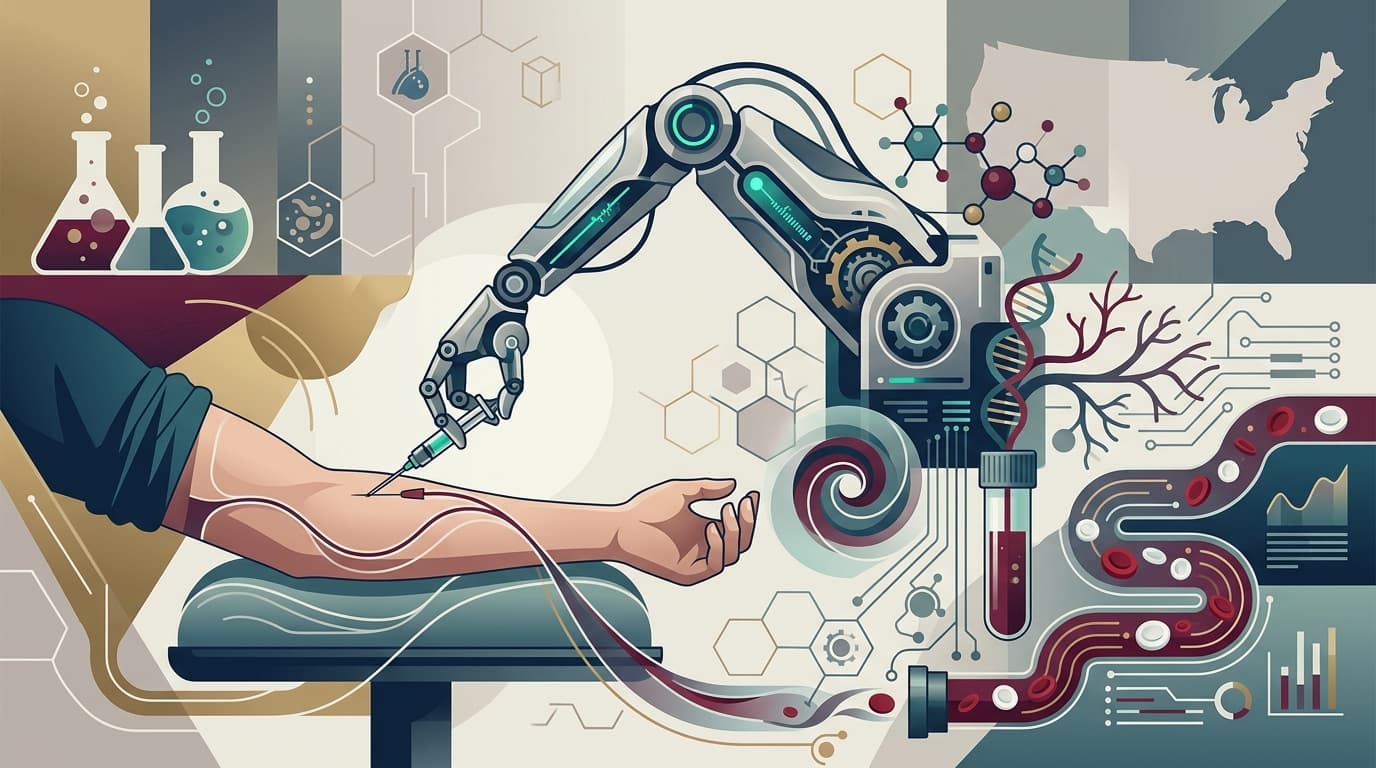
Imagine sitting down for a blood draw and the person holding the needle isn't a person at all. It's a machine: a compact robot that scans your arm with ultrasound, picks a vein using AI, and slides the needle in on its own.
That's not a sci-fi pitch. It just got FDA authorization.
Vitestro's Aletta is now the first standalone robotic blood-draw device cleared for use in the United States. The FDA authorized it through the De Novo pathway, a regulatory route reserved for genuinely novel devices that don't fit into any existing category. In plain English: the agency had to invent a whole new classification just to approve this thing.
And that classification is the real story here. Because it doesn't just open the door for Vitestro. It builds the door frame for everyone who comes next.
Vitestro was founded in 2017 in the Netherlands by Toon Overbeeke and Brian Joseph. The origin story is almost comically relatable: both had family members who'd been stuck (literally) by difficult blood draws, and they figured robotics could do better.
Aletta combines three technologies into one system: multimodal imaging (including ultrasound) to find veins, AI to pick the best target, and robotics to guide the needle and collect the sample. Think of it like a self-driving car for your forearm. It sees the road, chooses the lane, and executes the turn, all without a human hand on the wheel.
The company has raised serious money to get here. A 2024 round brought total funding to $50 million, co-led by Sonder Capital and NYBC Ventures. Then in 2026, Vitestro closed a $70 million Series B with a roster that reads like a healthcare all-star team: Labcorp Venture Fund, Mayo Clinic, Sutter Health, and several others.
When Mayo Clinic and Labcorp both write checks for the same startup, that's not a coincidence. That's conviction.

Takeda's oveporexton just became the first drug to target the root cause of narcolepsy type 1, earning Japanese approval after hitting every endpoint in two pivotal trials. It's not just a new pill; it could validate an entire class of brain-chemistry drugs.


Join thousands of biotech professionals who start their day with our free, daily briefing.
Skeptical? Fair. Let's talk data.
In clinical studies, Aletta posted a 94.5% first-stick success rate. For context, trained human phlebotomists typically land in the 93–97% range. So the robot is competitive with the best humans on a good day.
But where Aletta really shines is with patients who have difficult veins, the ones phlebotomists dread. In that subgroup, the device hit a 92.7% first-stick rate. Manual phlebotomists? They often hover around 75–80% for those same patients. That's a meaningful gap, and it's the kind of improvement that turns a novelty into a necessity.
On the pain front, 90% of patients rated the robotic draw as less painful or comparable to the human version. Hemolysis (when red blood cells get damaged during collection, potentially ruining the sample) came in at just 0.3%. The FDA noted that adverse events were "uncommon and mild."
Before you picture robots replacing every phlebotomist in America, pump the brakes. The FDA drew (yes, another pun) some clear boundaries.
Aletta is authorized for adults only, in outpatient settings, and it must operate under the supervision of someone trained in phlebotomy. One supervisor can monitor up to three devices at once, which is where the throughput math starts to get interesting. Instead of one phlebotomist doing one draw at a time, a single trained professional could oversee three simultaneous robotic draws.
This isn't "robots take your job." It's closer to "robots become your coworkers, and you become the manager."
The De Novo pathway didn't just approve a product; it created a new regulatory category with special controls covering labeling, performance testing, and clinical requirements. That's significant because it gives future competitors a defined path to follow. Think of it like the FDA building a highway: the first car through had to pave the road, but everyone after gets to drive on asphalt.
China-based Magic Nurse already has approval in its home market. Others like BHealthCare and VeniBot are earlier stage but watching closely. This clearance tells all of them: the FDA is willing to authorize autonomous, patient-facing robots when the evidence is solid and the use case is tightly controlled.
The timing here isn't accidental. The healthcare industry is facing a growing phlebotomist shortage, and the rise of decentralized clinical trials (studies where patients participate from home or local clinics instead of traveling to big research centers) is making it worse. The DCT market is estimated at $9–11.3 billion in 2026, and all those distributed trial sites need blood collection capabilities.
More collection sites, fewer trained staff, and rising patient expectations: that equation doesn't balance without automation entering the picture. Aletta won't solve the whole problem overnight, but it addresses the bottleneck where it matters most, at the point of the needle.
Vitestro says it will use its Series B funding to scale manufacturing and pursue a U.S. commercial rollout, though additional clinical work and infrastructure buildout are still needed. Adoption will be gradual, not overnight.
But the precedent is set. The FDA has officially said: a robot can draw your blood in America. For Vitestro, that's a massive win. For the broader medical robotics sector, it's a signal that autonomous devices can clear regulatory hurdles when they prove their case with data.
The next time you sit down for a blood draw, you might still see a human face. But the future just got a lot more mechanical. And honestly? Your veins might prefer it that way.
Lady Gaga and fiancé Michael Polansky just emerged from stealth with Outer Biosciences, a $23 million startup that keeps human skin alive in a lab for weeks to discover skincare ingredients with AI. It's weirder (and more legit) than it sounds.