
A stealth biotech just raised $77.5 million to replace the chalky, metallic pills that dialysis patients choke down 10 times a day. The investors fighting to get in include some of the biggest names in kidney care, and the science behind AP306 is unlike anything currently on the market.
Dialysis patients take roughly 19 pills a day. About half of those are for a single problem: too much phosphate in their blood.
The pills are big, chalky, and taste like metal. They have to be chewed with every meal. And after all that misery, most patients still can't get their phosphate levels under control. It's one of the most frustrating loops in medicine: a treatment that's both brutal and inadequate.
R1 Therapeutics just raised $77.5 million to try a completely different approach. The company emerged from stealth on March 17 with an oversubscribed Series A, which means investors were literally fighting for the chance to write bigger checks. In a biotech funding environment where deal volume has hit a five-year low, that kind of demand says something.
When your kidneys work properly, they filter excess phosphate out of your blood. Simple plumbing. But for the millions of people on dialysis, that plumbing is broken. Phosphate builds up, a condition called hyperphosphatemia, and it wreaks havoc: weakening bones, calcifying blood vessels, and raising the risk of cardiovascular death.
The standard fix? Oral phosphate binders. These are drugs that sit in your gut and grab onto phosphate from food before it can enter your bloodstream. Think of them like tiny sponges you swallow with every meal. The problem is that they work like a leaky bucket. Approximately 43% of dialysis patients still have elevated phosphate despite being on binders.
Patients hate them. Doctors know they're inadequate. And yet, the global market for these imperfect pills is worth an estimated $4.265 billion today, projected to reach $6.112 billion by 2033. That's a lot of money flowing into a solution everyone agrees is subpar.
R1's drug candidate, AP306, doesn't bind phosphate in the gut. Instead, it blocks the transporters that actively pull phosphate from your intestines into your bloodstream. If binders are sponges trying to soak up a flood, AP306 is more like turning off the faucet.

For decades, patients with primary biliary cholangitis had treatments for their failing livers but nothing approved for the relentless itch that ruined their sleep and quality of life. The FDA just changed that with a first-of-its-kind approval that validates an entirely new mechanism of action.


Join thousands of biotech professionals who start their day with our free, daily briefing.
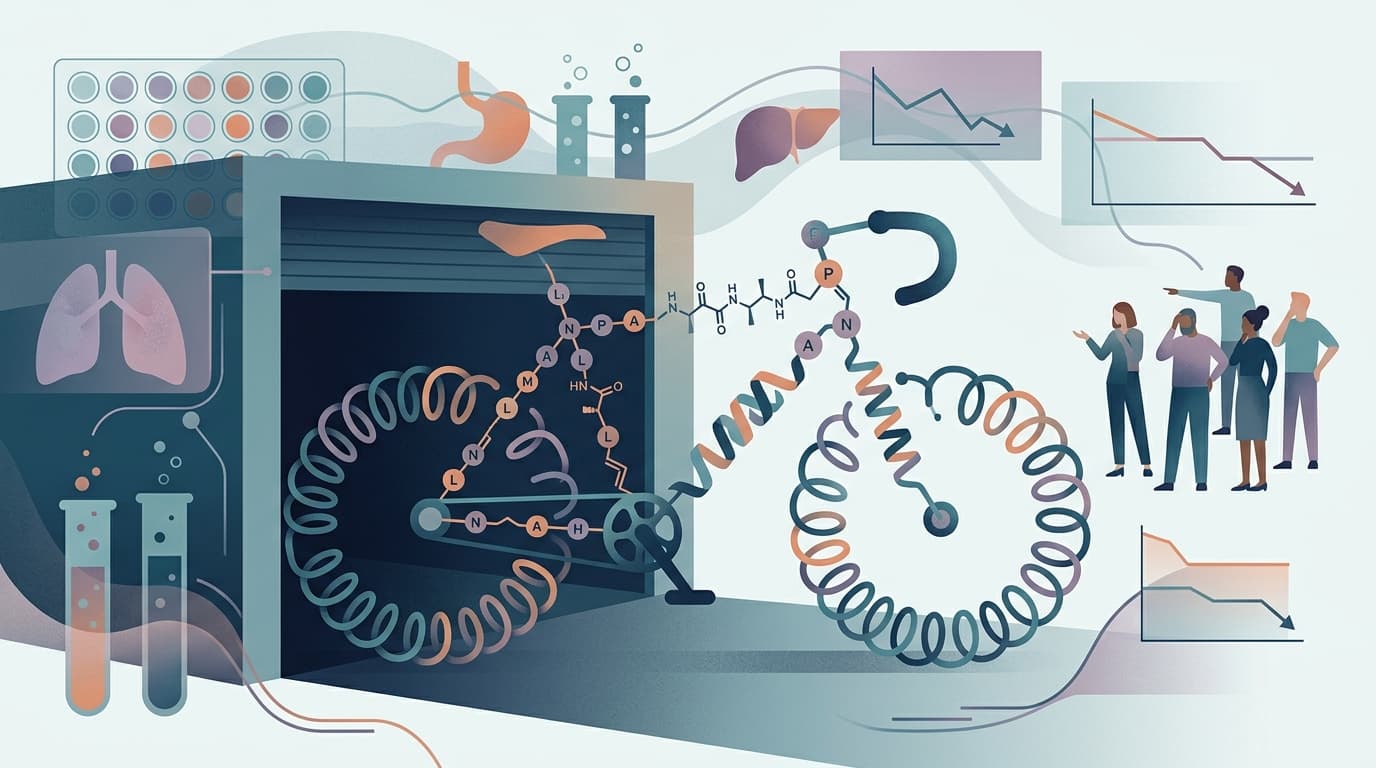
Specifically, AP306 inhibits three sodium-dependent phosphate transporters (NaPi-IIb, PiT-1, and PiT-2) responsible for shuttling phosphate across the intestinal wall. It's what scientists call a "pan-phosphate transporter inhibitor," and it's first-in-class, meaning nothing else approved works quite this way.
Why does that matter? Current binders only block passive absorption, the phosphate that kind of drifts across. But the body compensates by cranking up active transport through those very transporters AP306 targets. It's like plugging one hole only to watch three new ones open. AP306 goes after the holes themselves.
Early Phase 2 data from trials run in China (where the drug was originally discovered by Japan's Chugai Pharmaceutical and later licensed to Alebund Pharmaceuticals) showed AP306 monotherapy significantly lowered serum phosphate. More patients hit the target range recommended by kidney disease guidelines compared to sevelamer carbonate, one of the most widely used binders. Side effects were mostly mild GI issues like diarrhea.
The $77.5 million round was co-led by Abingworth, DaVita Venture Group, and F-Prime, with participation from Curie.Bio, SymBiosis, and U.S. Renal Care. That investor list isn't random; it's a thesis statement.
DaVita is one of the largest dialysis providers in the world. U.S. Renal Care operates hundreds of dialysis clinics. Having them at the cap table isn't just about money. It's about access to patients, clinical trial infrastructure, and real-world validation that the people closest to the problem believe this solution has legs.
R1 licensed exclusive global rights to AP306 (outside Greater China) from Alebund, which originally got the compound from Japan's Chugai Pharmaceutical. The proceeds will fund a global Phase 2b trial as monotherapy, set to begin later this year, along with Phase 3 planning.
The company was co-founded by Krishna Polu, M.D., a nephrologist (kidney specialist) with over 20 years in biopharma, and L. Mary Smith, Ph.D., a biotech veteran who previously served as Chief Development Officer at SpringWorks Therapeutics. Polu isn't just an executive who read a book about kidneys; he's a doctor who built his career in this exact space, having previously helped form Mineralys Therapeutics and Renalys Pharma (which was acquired by Chugai).
Smith brings the operational muscle needed to actually run clinical programs and navigate the regulatory maze. Together, they've assembled a board that reads like a who's who of nephrology investing, including directors from all three lead investors.
R1's launch doesn't exist in a vacuum. The FDA approved six major kidney disease medications in 2025 alone, spanning conditions from IgA nephropathy to lupus nephritis to CKD progression. Semaglutide (yes, the Ozempic molecule) became the first GLP-1 drug approved for a kidney indication in January 2025, reducing major kidney disease events by roughly 24% in diabetic CKD patients.
Complement pathway inhibitors, endothelin receptor antagonists, B-cell targeted therapies: the kidney drug toolkit expanded more in the past 18 months than in the prior decade. Investors have noticed. When an entire therapeutic area goes from "nothing works" to "multiple novel mechanisms are getting approved," capital follows.
Hyperphosphatemia, though, has been largely left out of this renaissance. The binder market is huge but stagnant, dominated by decades-old approaches with known compliance problems. That gap between market size and innovation is exactly what venture investors salivate over.
R1 still has to prove AP306 works well enough in a larger, more rigorous trial to warrant Phase 3 and, eventually, an FDA filing. Phase 2 data from China is encouraging but not conclusive. The Phase 2b trial will need to show that blocking phosphate transporters delivers clinically meaningful reductions in serum phosphate, ideally with fewer pills and fewer side effects than what's currently available.
The oversubscription of this round is notable because biotech Series A activity has been sluggish. U.S. biotech funding rounds hit a five-year low in early 2026, with investors placing fewer but more concentrated bets on clinical-stage assets with clear paths forward. R1 checks that box: a defined patient population, an existing (if imperfect) standard of care to beat, and Phase 2 data already in hand.
For the millions of dialysis patients choking down handfuls of chalky tablets three times a day, a drug that works differently isn't just a nice-to-have. It's the kind of thing that could meaningfully change what mealtimes look like. And if R1 can pull it off, that $4.265 billion binder market is ripe for disruption.
No pressure.
Gossamer Bio's lead PAH drug missed its Phase 3 goal by the thinnest statistical margin imaginable. Now 77 employees are out, the stock is down 80%, and the company is fighting for survival with $137 million and a prayer.