
Bicycle Therapeutics just axed 30% of its staff and shelved its most promising cancer drug after the FDA rejected the trial as an approval path. The pivot to radioconjugates is bold, but can a company rebuild its identity around earlier-stage assets?
Imagine training for the Tour de France for years, then right before the big stage, your coach tells you your bike doesn't meet the rules. That's roughly what just happened to Bicycle Therapeutics.
The Cambridge-based biotech announced on March 17 that it's shelving internal development of its lead cancer program, zelenectide pevedotin, and cutting roughly 30% of its workforce (about 86 people). The goal: slash annual operating costs in half. The reason: the FDA basically told them their fastest path to approval was a dead end.
For a company that built its identity around a novel drug platform, this isn't a trim. It's a strategic retreat.
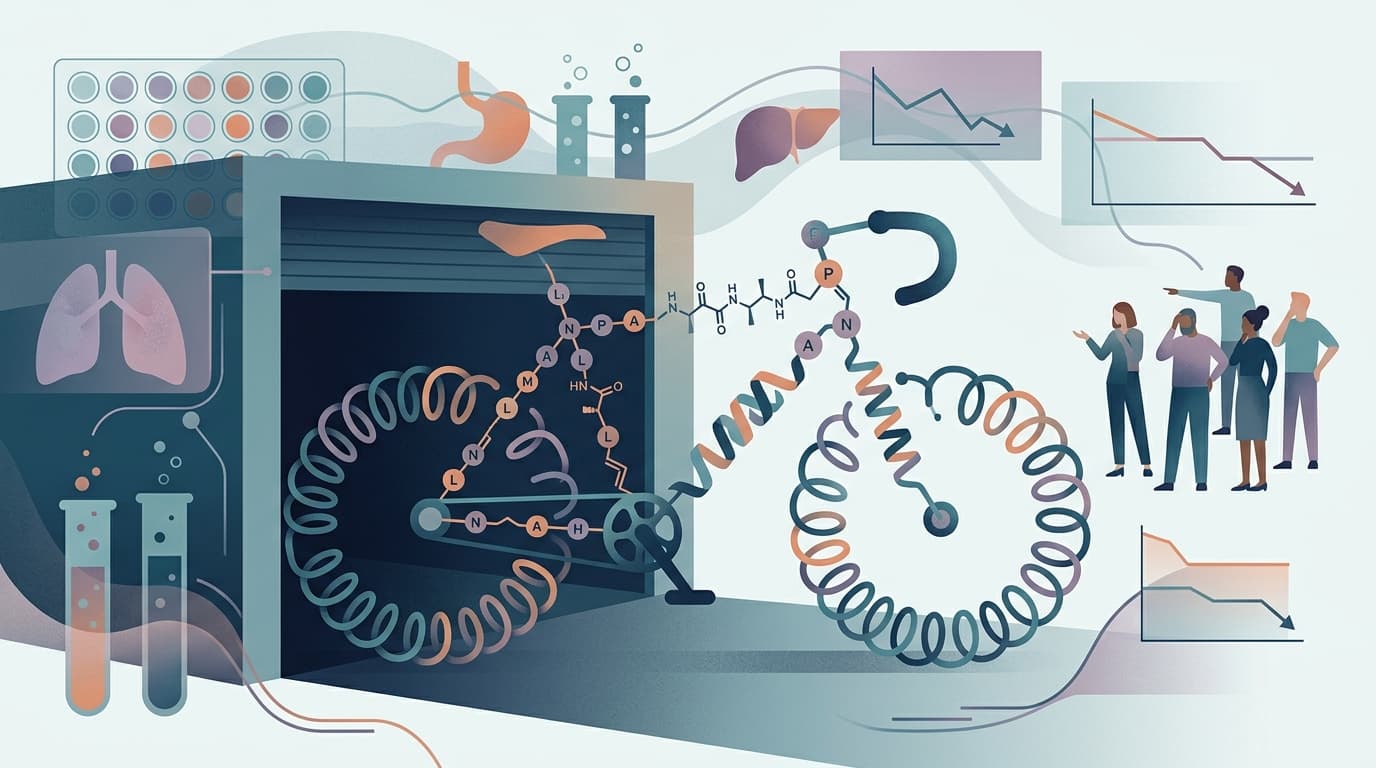
Bicycle Therapeutics isn't your typical biotech. The company built a platform around something called Bicycle Toxin Conjugates (BTCs), which are essentially tiny guided missiles for cancer. Think of antibody-drug conjugates (ADCs), the blockbuster class of drugs that attach a toxic payload to an antibody so it only kills cancer cells. BTCs do something similar, but instead of using a bulky antibody as the delivery vehicle, they use a much smaller synthetic peptide.
How much smaller? A typical ADC weighs in at over 150,000 daltons. A BTC is around 4,000 to 4,500. That's like comparing a freight truck to a motorcycle. The small size lets BTCs penetrate tumors faster and clear the body more quickly, which (in theory) means better efficacy and fewer side effects.
The lead candidate, zelenectide pevedotin (also known as BT8009), targeted a protein called Nectin-4 in metastatic urothelial cancer (advanced bladder cancer). And the early clinical data looked genuinely promising: a 38% response rate in bladder cancer patients, with responses lasting a median of 11.1 months.
Those are real numbers. Not "squint and you'll see a signal" numbers. Real, compelling, this-could-be-a-drug numbers.
So what went wrong?

For decades, patients with primary biliary cholangitis had treatments for their failing livers but nothing approved for the relentless itch that ruined their sleep and quality of life. The FDA just changed that with a first-of-its-kind approval that validates an entirely new mechanism of action.


Join thousands of biotech professionals who start their day with our free, daily briefing.

Bicycle had been running a Phase 2 trial called Duravelo-2, hoping to use it as a springboard for accelerated approval. Accelerated approval is the FDA's fast lane: if your drug shows strong early signals in a serious disease, the agency can approve it based on Phase 2 data while you finish larger trials.
But after reviewing the trial design, the FDA delivered a gut punch. Regulators determined that the Duravelo-2 trial, even after dose selection was completed, was no longer acceptable as an approval path. The single-arm design (no comparison group) wasn't going to cut it. The FDA wanted a randomized Phase 2, which means more patients, more time, and a lot more money.
For a company burning through $319.65 million in operating expenses last year while posting a $218.96 million net loss, that's not just a setback. It's a forcing function.
Bicycle ended 2025 with $628 million in cash. That sounds like a lot, but at the rate they were spending, the runway only stretched into late 2027. The restructuring changes that math dramatically.
By cutting half of its annual operating costs and reducing headcount from 288 to roughly 200, Bicycle expects to extend its cash runway into 2030. The layoffs will result in one-time restructuring costs, a relatively small price for three extra years of survival.
There's also a bright spot in the financials that's easy to miss. Collaboration revenue nearly doubled in 2025, hitting $72.59 million compared to $35.28 million the year before. Partners are still interested in the platform, even if Bicycle's own lead program hit a wall.
Bicycle isn't shutting down. It's pivoting, and the new direction is radioactive (literally).
The company is redirecting resources toward Bicycle Radio Conjugates (BRCs), which swap the chemical toxin payload for a radioactive isotope. Radiopharmaceuticals are one of the hottest areas in oncology right now, and Bicycle's small peptide platform could be a natural fit: the rapid tumor penetration that makes BTCs interesting for toxin delivery could be even more valuable for delivering radiation directly to tumors.
The pipeline now centers on a few key programs:
Zelenectide pevedotin isn't dead, exactly. Bicycle is converting Duravelo-2 into the randomized Phase 2 the FDA wants. But internal investment is being deprioritized, which in biotech-speak usually means "we'll get back to this if we can afford to."
The company also appointed Jennifer Perry as its new COO, effective March 17, signaling that the restructuring comes with fresh operational leadership.
Bicycle's retreat raises uncomfortable questions about the next-generation ADC space. The whole thesis behind BTCs, peptide-drug conjugates, and similar platforms is that smaller, nimbler delivery vehicles could outperform the bulky antibodies that dominate the market. But when your best clinical asset gets stalled by regulatory hurdles, investors start wondering whether "better in theory" translates to "better in practice."
The timing is notable, too. Oncology biotech funding has actually been fairly robust; venture rounds are getting larger, and the FDA approved more oncology drugs than any other category in 2025. Radiopharmaceuticals in particular are attracting serious capital. Bicycle's pivot toward radioconjugates is a bet that it can ride that wave.
But pivots are risky. The company went from having a lead program with compelling Phase 2 data to essentially starting over with earlier-stage assets. The cash runway extension into 2030 buys time, but time without a clear path to revenue is just a slower clock.
For Bicycle's remaining 200 employees, the next 12 months will tell the story. BT5528 data and early radioconjugate results could validate the pivot. Or they could confirm that the bicycle, however elegantly engineered, still needs a road to ride on.
Gossamer Bio's lead PAH drug missed its Phase 3 goal by the thinnest statistical margin imaginable. Now 77 employees are out, the stock is down 80%, and the company is fighting for survival with $137 million and a prayer.