
GSK's antibody-drug conjugate just posted 18.5 months of median overall survival in relapsed small cell lung cancer, nearly doubling the standard of care. The result puts GSK on a collision course with Amgen and Merck in one of oncology's toughest markets.
Small cell lung cancer is one of the cruelest diagnoses in oncology. It grows fast, spreads faster, and has a nasty habit of coming back after first-line treatment. Once it does, the options have historically been grim: standard second-line therapy with topotecan delivers a median overall survival of roughly 5 to 8 months. That's not a typo. Patients who relapse after platinum-based chemo are essentially running out of road.
So when GSK stood up at a Presidential Symposium at the 2026 World Conference on Lung Cancer in Seoul and presented phase 3 data showing 18.5 months of median overall survival, the room had good reason to pay attention.
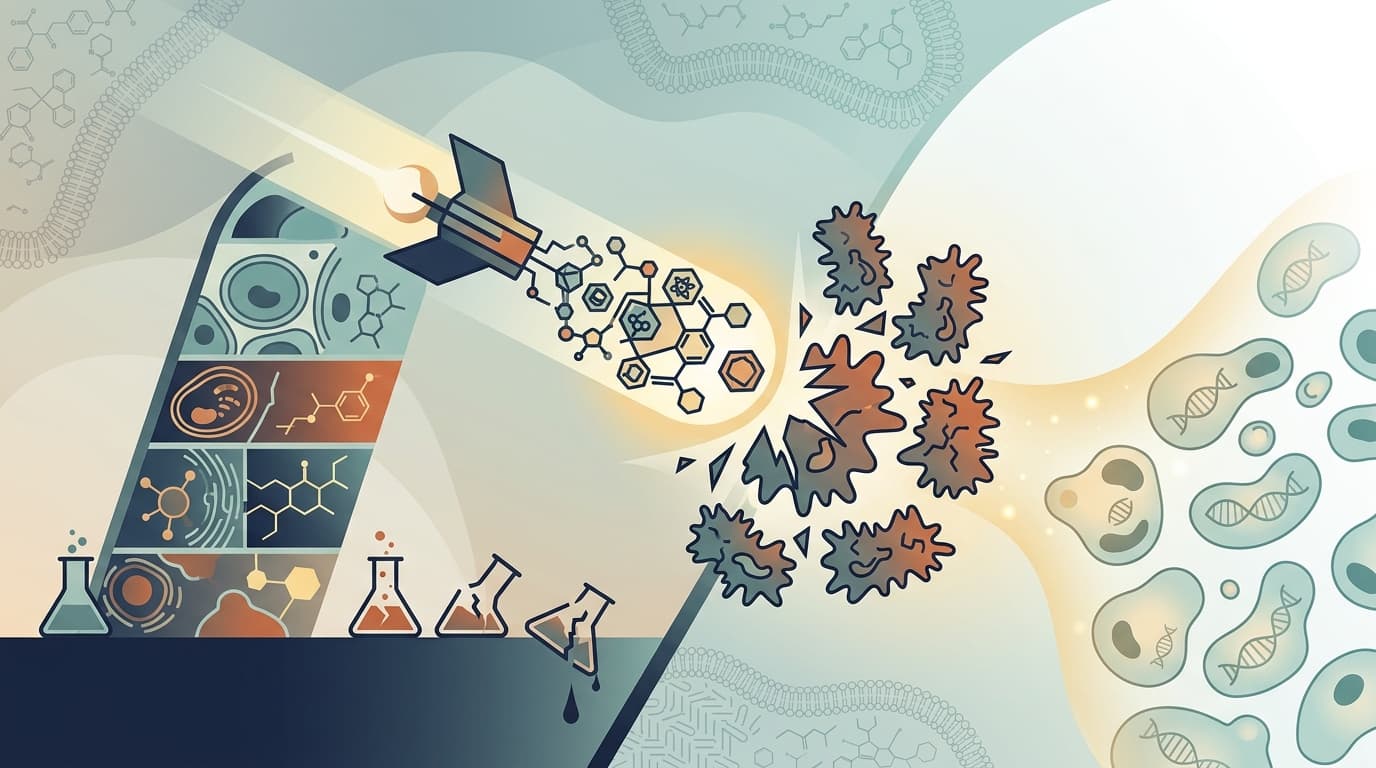
The trial is called ARTEMIS-008, and it tested GSK's antibody-drug conjugate (ADC) risvutatug rezetecan (let's call it Ris-Rez, because life's too short) against topotecan in patients with relapsed small cell lung cancer. ADCs are essentially guided missiles: they attach an antibody to a toxic drug payload, so the poison gets delivered directly to cancer cells instead of carpet-bombing the whole body.
Ris-Rez targets a protein called B7-H3 on the surface of cancer cells and delivers a topoisomerase inhibitor straight to them. Think of it like a postal service that only delivers explosives to one specific address.
The results were striking. Patients on Ris-Rez lived a median of 18.5 months, compared to 10.3 months on topotecan. That translates to a 54% reduction in the risk of death (hazard ratio of 0.46, p<0.0001 for the stats nerds). The trial enrolled about 461 patients across two arms, making it a properly powered study, not some tiny early-phase signal.
For a disease where second-line survival has been stuck in single digits for years, nearly doubling that number is the kind of result that reshapes treatment guidelines.
GSK isn't walking into an empty room, though. Two pharma heavyweights are already fighting over this space, and neither one plans to move aside.

Takeda's oveporexton just swept every endpoint in two Phase 3 narcolepsy trials by replacing the brain signal that's actually missing. It's the first time anyone has proven orexin receptor agonism works in late-stage testing, and it could reshape how we think about sleep disorders.


Join thousands of biotech professionals who start their day with our free, daily briefing.

Amgen has tarlatamab (Imdelltra), a bispecific antibody (a drug that grabs onto both cancer cells and immune cells, forcing them together like an awkward introduction at a party). Tarlatamab targets DLL3, a different protein found on small cell lung cancer. It's already FDA-approved for relapsed extensive-stage SCLC, and in September 2026, Amgen reported positive phase 3 data showing an overall survival benefit when tarlatamab was combined with durvalumab as first-line maintenance therapy. Amgen is trying to move upstream, locking in patients before they even get to the second-line setting where GSK is competing.
Merck, meanwhile, is playing the broadest game in lung cancer. Keytruda remains the backbone of its franchise across multiple types of lung cancer. But Merck is also pushing into the ADC space through a partnership with Daiichi Sankyo on ifinatamab deruxtecan (I-DXd), another B7-H3 ADC. That drug is under FDA priority review for extensive-stage SCLC with a decision expected by October 10, 2026. If approved, Merck would have a direct ADC competitor to GSK's Ris-Rez targeting the exact same protein.
So the competitive map looks something like this: Amgen owns the bispecific lane, Merck is defending its PD-1 empire while building an ADC flank, and GSK is the insurgent with a clean survival win.
Before anyone gets too excited, there's an important asterisk on these results. The ARTEMIS-008 trial was conducted in China, and while the data are genuinely impressive, global investors and regulators will want to see confirmatory results from international patient populations. GSK has said its global phase 3 program began in August 2025, so that data should follow, but it's not here yet.
The phase 3 win changes the narrative, but it doesn't close the book.
There's also the question of safety. ADCs that carry topoisomerase inhibitor payloads (a class that includes several Daiichi Sankyo drugs) are watched closely for interstitial lung disease, or ILD, a potentially serious inflammatory condition in the lungs. GSK's partner Hansoh reported no new safety signals in the trial, which is reassuring but not a final answer. Long-term safety data will matter for both prescribers and payers.
The broader context here is that ADCs are having a moment across all of oncology, and lung cancer is the biggest battlefield. As of mid-2025, there were 546 registered clinical trials testing ADCs in lung cancer globally. The space is crowded, competitive, and moving fast.
The best survival benchmarks in lung cancer ADCs right now cluster around 17 to 19 months in biomarker-selected populations. GSK's 18.5-month result in relapsed SCLC slots right into that elite tier, alongside drugs like trastuzumab deruxtecan in HER2-mutant non-small cell lung cancer (which showed about 17.8 months in its pivotal study).
What makes Ris-Rez's data particularly noteworthy is the comparator arm. Topotecan is a weak standard of care; everyone knows that. But the magnitude of the gap (18.5 versus 10.3 months, nearly an 80% improvement) suggests this isn't just a drug that looks good against a soft opponent. Beating a low bar by a wide margin still means patients are living substantially longer.
GSK has a genuine weapon in Ris-Rez. The 18.5-month survival figure in relapsed small cell lung cancer is the kind of number that makes oncologists rethink treatment algorithms and makes competitors recalculate their market models. But the drug's commercial future hinges on confirming these results globally, navigating a safety profile that regulators will scrutinize, and competing against Amgen and Merck in a market where both are spending heavily to win.
The SCLC treatment landscape has been frustratingly stagnant for decades. Three companies are now racing to change that with three different approaches: bispecifics, broad immunotherapy franchises, and targeted ADCs. For patients who have been waiting for better options after relapse, this is exactly the kind of competition you want to see.
Sarepta hit its Duchenne gene therapy Elevidys with the FDA's most serious safety warning after fatal liver failures, then cut 36% of its workforce in the same week. It's the biggest crisis yet for one of gene therapy's most prominent companies.