
ARPA-H just gave $54.5 million to a six-company team trying to squeeze an entire mRNA factory onto a lab bench. If their continuous-flow system works, it could unlock personalized medicines that today's batch manufacturing can't touch.
Imagine replacing an entire pharmaceutical manufacturing plant with something that fits on a lab bench. That's the pitch behind a new federal investment that could reshape how mRNA medicines get made.
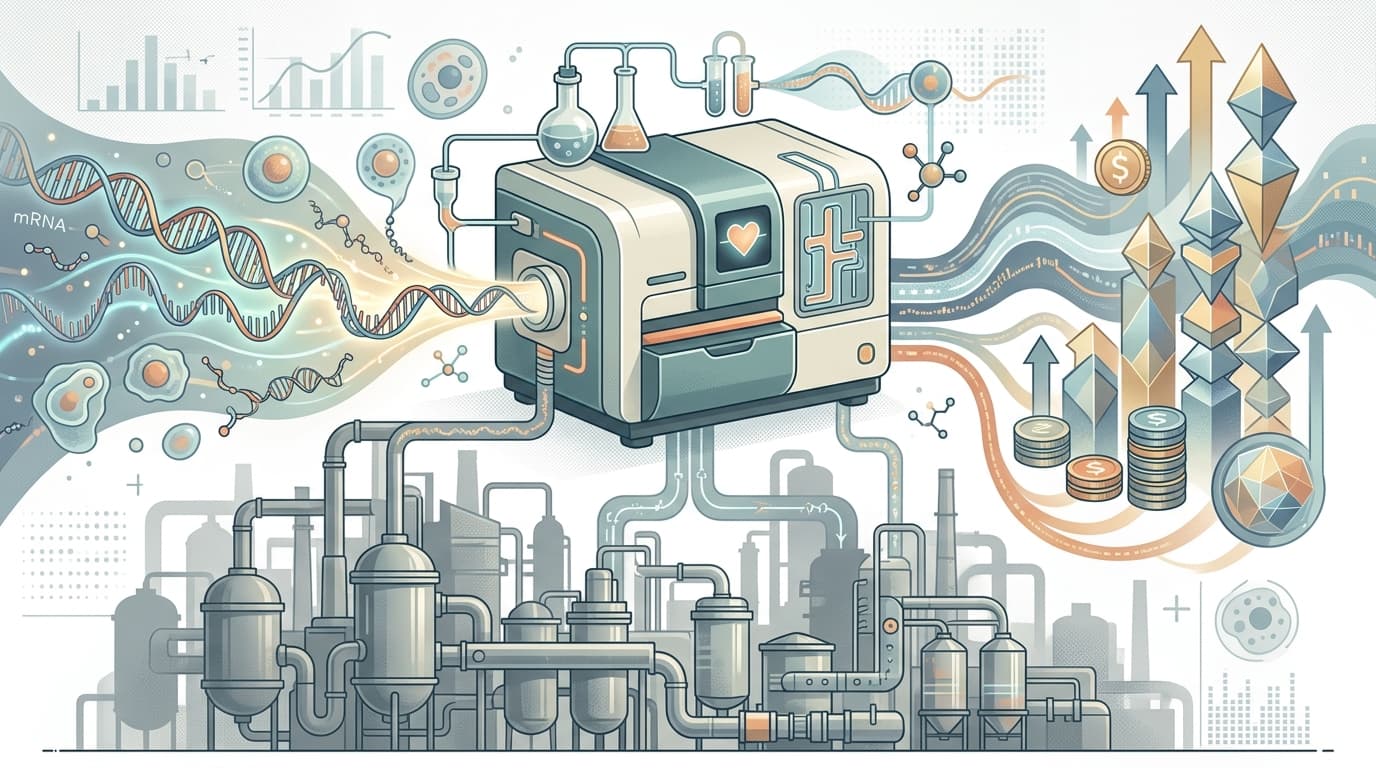
ARPA-H, the government's moonshot health research agency, just handed up to $54.5 million to a six-company consortium led by Waterfall Scientific. Their mission: build a fully automated, benchtop-sized system that can produce mRNA drugs from start to finish, on demand. No giant factories. No weeks-long batch cycles. Just a continuous stream of medicine flowing out of a compact machine.
If that sounds ambitious, well, that's kind of ARPA-H's whole thing.
To understand why this matters, think about how mRNA medicines (like the COVID vaccines) are currently made. Traditional manufacturing works in batches, similar to how a brewery operates. You mix your ingredients, let the reaction run, stop everything, clean up, test the product, and start again. It works, but it's slow, wasteful, and requires massive facilities.
What Waterfall Scientific wants to build is more like a high-tech espresso machine: ingredients go in one end, finished medicine comes out the other, and the process never stops. This is called continuous-flow manufacturing, and it's a fundamentally different approach. Instead of making mRNA in big discrete batches, the system synthesizes it in a steady, uninterrupted stream.
The advantages are significant. Continuous systems can produce higher output per unit of time, generate less waste, and fit into a fraction of the space. They're also easier to automate, which means fewer human errors and more consistent quality. For personalized medicines (think: custom cancer vaccines tailored to your specific tumor), the ability to run small, rapid, patient-specific batches without firing up an entire factory is a game-changer.
The project has a delightfully bureaucratic acronym: ESCALATOR, which stands for "Engineering a Small-scale, Continuous-flow manufacturing Apparatus to Launch A Transformational Overhaul for RNA medicines." (Government agencies really do love their backronyms.)

Ultragenyx's Angelman syndrome drug showed zero benefit over sham treatment in a 129-patient Phase 3 trial, sending shares down over 40%. For families who'd pinned their hopes on the most advanced therapy in development, the fallout is devastating.


Join thousands of biotech professionals who start their day with our free, daily briefing.

Waterfall Scientific, a Worcester, Massachusetts biotech spun out of the University of Massachusetts Amherst in 2022, is leading the charge. The company's secret weapon is a patented technology called DuoTether, which anchors both the DNA template and the enzyme to a solid surface so mRNA can be synthesized in a continuous stream. Think of it like pinning your recipe card and your mixing bowl to the counter so everything stays in place while ingredients flow through.
But Waterfall isn't doing this alone. The consortium includes five other companies, each bringing a specialized piece of the puzzle:
Six companies. One benchtop system. Every step from raw ingredients to finished, vialed medicine.
This isn't ARPA-H's first rodeo with RNA. The agency previously funded CUREIT, an mRNA program aimed at training the immune system against cancer, autoimmune disorders, and infectious disease. It also backed Kernal Bio's in vivo mRNA-encoded CAR T-cell program through its EMBODY initiative.
But the ESCALATOR project sits inside a broader program called GIVE (Genetic Medicines and Individualized Manufacturing for Everyone), which has up to $125 million to spend across multiple teams. The underlying thesis is straightforward: we've proven mRNA works as medicine. Now we need to fix how it's made.
And the "how it's made" problem is real. During the pandemic, mRNA vaccines were produced at unprecedented scale, but the infrastructure required was enormous. Centralized plants, complex cold chains, long lead times. That model works fine for churning out billions of identical doses. It works terribly for personalized treatments where every patient needs a slightly different product.
Waterfall's project fits into one of the most important trends in biotech manufacturing right now: decentralization. The industry is moving away from the idea that all drugs need to be made in a handful of massive facilities and shipped around the world.
Instead, companies and governments are exploring modular, portable systems that could sit in hospitals, regional centers, or even mobile units. Imagine a future where your oncologist orders a personalized mRNA cancer vaccine, and it gets manufactured on site, in hours, using a system the size of a large printer.
We're not there yet; regulatory validation of continuous and decentralized manufacturing systems is still a work in progress. Supply chains for specialty lipids and enzymes remain fragile. And proving that a benchtop machine in Boston produces the same quality product as one in Berlin is a hard problem.
But the trajectory is clear. Microfluidic systems have already demonstrated mRNA-lipid nanoparticle production at up to 17 liters per hour while maintaining quality. Fully synthetic workflows can go from DNA template to finished mRNA in as little as two days. The pieces are falling into place.
In the near term, this is a manufacturing play, not a drug launch. Nobody's getting treated with an ESCALATOR-produced medicine tomorrow. But the downstream implications are massive.
If continuous-flow benchtop systems work as promised, they could dramatically lower the cost of mRNA medicines by slashing facility size, waste, and production time. They could enable personalized therapies (custom cancer vaccines, rare disease treatments) that are simply impractical with today's batch manufacturing. And they could make pandemic response faster by putting production capacity closer to where it's needed.
The mRNA revolution didn't end with COVID vaccines. It just ran into a manufacturing bottleneck. ARPA-H is betting $54.5 million that Waterfall Scientific and its partners can unclog it.
Now comes the hard part: actually building the thing.
A personalized cancer vaccine just posted 100% disease-free survival at three years in one of oncology's toughest cancers. Sixteen patients, zero relapses, and a field watching very closely.