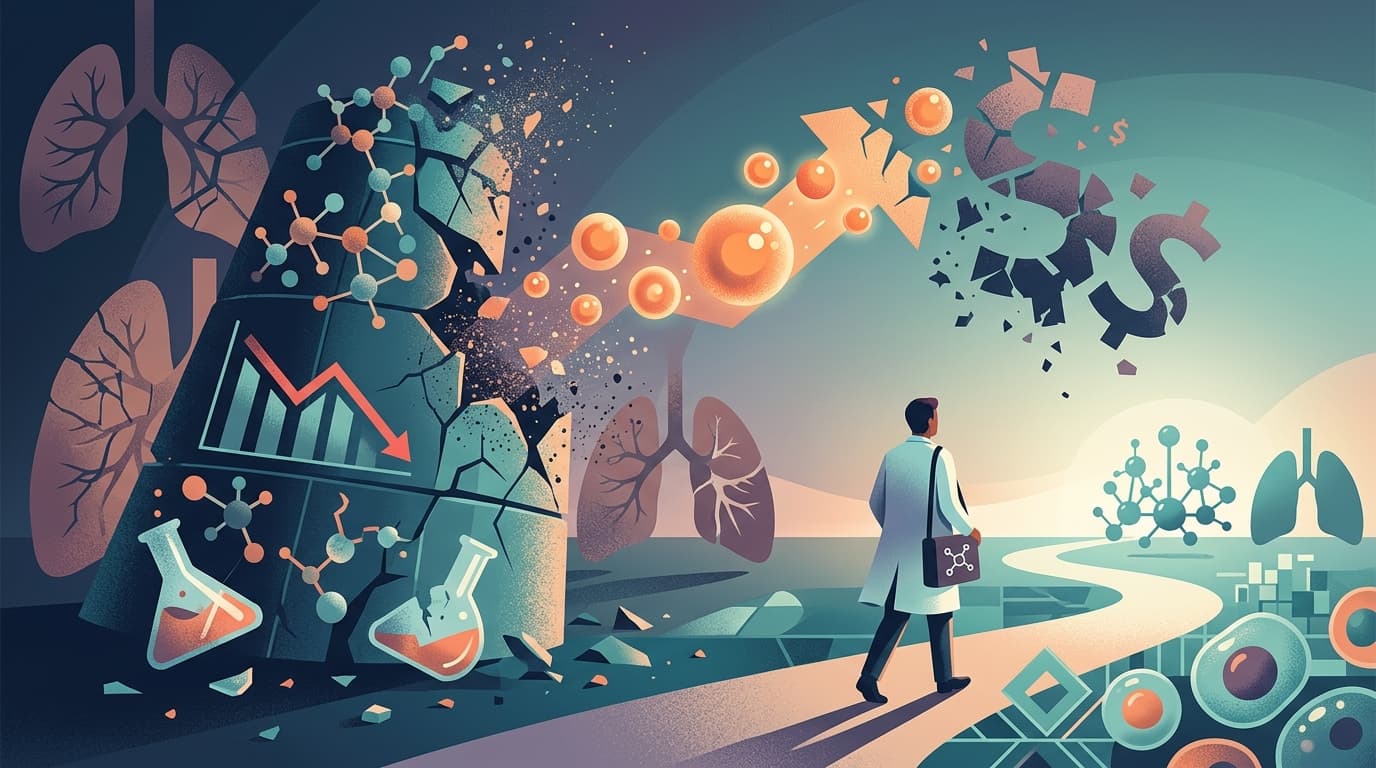

Syndax Pharmaceuticals pulled the plug on its IPF program after a Phase 2 miss, sending shares tumbling 15%. But the real story is what this exit means for the increasingly chaotic race to treat an incurable lung disease.
Imagine training for a marathon for two years, lacing up your shoes on race day, and then pulling out at mile six. That's roughly what Syndax Pharmaceuticals just did with its idiopathic pulmonary fibrosis program.
Syndax announced that its Phase 2 MAXPIRe trial of axatilimab in IPF (a progressive, incurable scarring of the lungs) missed its primary endpoint. Translation: the drug didn't do the one thing the study was designed to prove it could do. Within hours, the company confirmed it won't pursue further IPF development. Stock dropped about 15% after-hours, and investors got a harsh reminder that clinical trials are, at best, educated coin flips.
But this isn't just a story about one company's bad day. It reshapes the entire competitive landscape for a disease that kills roughly as many Americans as breast cancer each year.
The MAXPIRe trial was a 26-week, randomized, placebo-controlled study. Think of it as a tightly controlled experiment: some patients got axatilimab, some got a sugar pill, and nobody (patients or doctors) knew who got what.
The primary endpoint was annualized rate of decline in forced vital capacity, or FVC. In plain English, FVC measures how much air you can forcefully blow out of your lungs. IPF patients lose that capacity over time as scar tissue builds up, so the trial needed to show that axatilimab slowed that decline compared to placebo. It didn't.
The safety data was actually fine. No new safety signals, tolerability looked similar to placebo. The drug wasn't dangerous; it just wasn't effective enough for IPF. That distinction matters, because axatilimab is still very much alive in other indications.
Axatilimab already has an FDA-approved home. It's approved as Niktimvo for chronic graft-versus-host disease (cGVHD), a nasty complication that can occur after bone marrow transplants where donor immune cells attack the patient's body. Syndax pulled in , so this isn't some one-trick pony that just lost its only trick.

Gilead just paid $1.9 billion for access to Vir's cancer drugs that wear molecular disguises, only waking up when they reach a tumor. It's the biggest signal yet that masked T-cell engagers are pharma's next obsession.


Join thousands of biotech professionals who start their day with our free, daily briefing.

The company also has a second approved product, Revuforj (revumenib), targeting acute leukemia with multiple late-stage trials expanding into frontline settings. And its newer pipeline additions, including a mutant-selective EGFR inhibitor for lung cancer (SNDX-4321) and a next-generation menin inhibitor for myelofibrosis (SNDX-62122), suggest management has been quietly diversifying for a while now.
BofA Securities reportedly called the post-announcement selloff "overdone," arguing that the IPF program was more of a nice-to-have than a core pillar. That's a fair point. The strategic center of gravity for Syndax has clearly shifted toward hematology-oncology, with cGVHD revenue keeping the lights on while the leukemia programs scale up. Management has said the company is fully funded through profitability, which gives them runway even without an IPF win.
Still, losing a potential blockbuster indication stings. IPF is a multi-billion-dollar market opportunity, and investors had priced in at least some probability of success. That optionality evaporated overnight.
Syndax's exit doesn't happen in a vacuum. The IPF treatment landscape in 2026 looks like a poker table where several players just went all-in, and nobody's sure who has the best hand.
The two legacy therapies, nintedanib and pirfenidone, have been the standard of care for years. They slow the disease, but patients still decline, and the side effects (think GI problems) aren't exactly a walk in the park. Everyone agrees better options are needed.
The most important new arrival is nerandomilast (from Boehringer Ingelheim), a PDE4B inhibitor that delivered Phase 3 success and earned U.S. approval in 2025. It's the first truly new mechanism to crack into the IPF category in years, and it's quickly becoming the benchmark that every new contender has to beat.
Then there's Bristol Myers Squibb's admilparant, an oral LPA1 receptor antagonist with a Phase 3 readout that can best be described as "half-great." The 60 mg dose hit its primary endpoint, showing a statistically significant improvement in FVC at Week 52. But the 120 mg dose missed statistical significance, even though it did slow decline. It's like acing one exam and getting a C+ on the other; you passed the class, but the transcript looks weird.
BMS likely has enough data to pursue regulatory approval based on the lower dose, but the inconsistent dose-response leaves room for skeptics. Competitors will be quick to label admilparant as "promising but not fully de-risked."
Beyond these, the pipeline includes inhaled treprostinil (positive Phase 3 signals, different mechanism entirely), deupirfenidone (a next-gen pirfenidone aiming to win on tolerability), and rentosertib (a Phase 3 program with a novel TNIK-targeting approach). The field isn't shrinking; it's fragmenting.
For the roughly 100,000 Americans living with IPF, one fewer clinical program is never good news. Every failed trial means one less shot at a breakthrough. But the silver lining is that the remaining pipeline is genuinely diverse. We're no longer stuck in a world where "antifibrotic" means one of two imperfect drugs.
For investors, the Syndax situation is a textbook lesson in platform risk. Axatilimab works through CSF-1R blockade, essentially targeting a specific receptor on immune cells called macrophages. That mechanism clearly does something useful in cGVHD, where aberrant immune activity drives the disease. But IPF is a different beast. Lung scarring involves a tangled web of fibroblasts, immune cells, and structural damage that no single mechanism has been able to untangle.
Syndax bet that its macrophage-targeting approach could translate across diseases. It couldn't, at least not here. The lesson? Biology doesn't care about your corporate strategy.
IPF in late 2026 has three tiers of competition. Tier one is the entrenched old guard: nintedanib and pirfenidone. Tier two is the near-term challengers: nerandomilast (already approved), admilparant (Phase 3, mixed but viable), inhaled treprostinil, and deupirfenidone. Tier three is a crowded bench of Phase 2 and early Phase 3 programs exploring everything from thromboxane receptors to NOX pathways.
Syndax just moved from tier three to the parking lot. The race continues without them, and the patients waiting for better treatments are watching closely.
Novartis just paid $575 million upfront for access to Abogen's RNA technology, in a deal worth up to $7.8 billion. The bet: that your own cells can be programmed to build medicines from scratch, starting with a clever new approach to autoimmune disease.