
The FDA just fast-tracked a new guided-missile cancer drug for small cell lung cancer, one of oncology's most brutal diseases. With a 48% response rate where standard options barely move the needle, Daiichi Sankyo and Merck's $4 billion bet might be about to pay off.
Small cell lung cancer doesn't play fair. It shows up late, spreads early, and laughs at most treatments. Patients who relapse after their first round of chemo are often left choosing between options that buy them, on average, less than two months of progression-free survival.
So when the FDA slaps a Priority Review on a new drug for this disease, it's worth paying very close attention.
The FDA accepted and granted Priority Review to the application for ifinatamab deruxtecan (mercifully shortened to I-DXd), a drug co-developed by Daiichi Sankyo and Merck. The target: adults with extensive-stage small cell lung cancer (ES-SCLC) whose tumors grew back after platinum-based chemotherapy. The FDA's decision deadline is October 10, 2026.
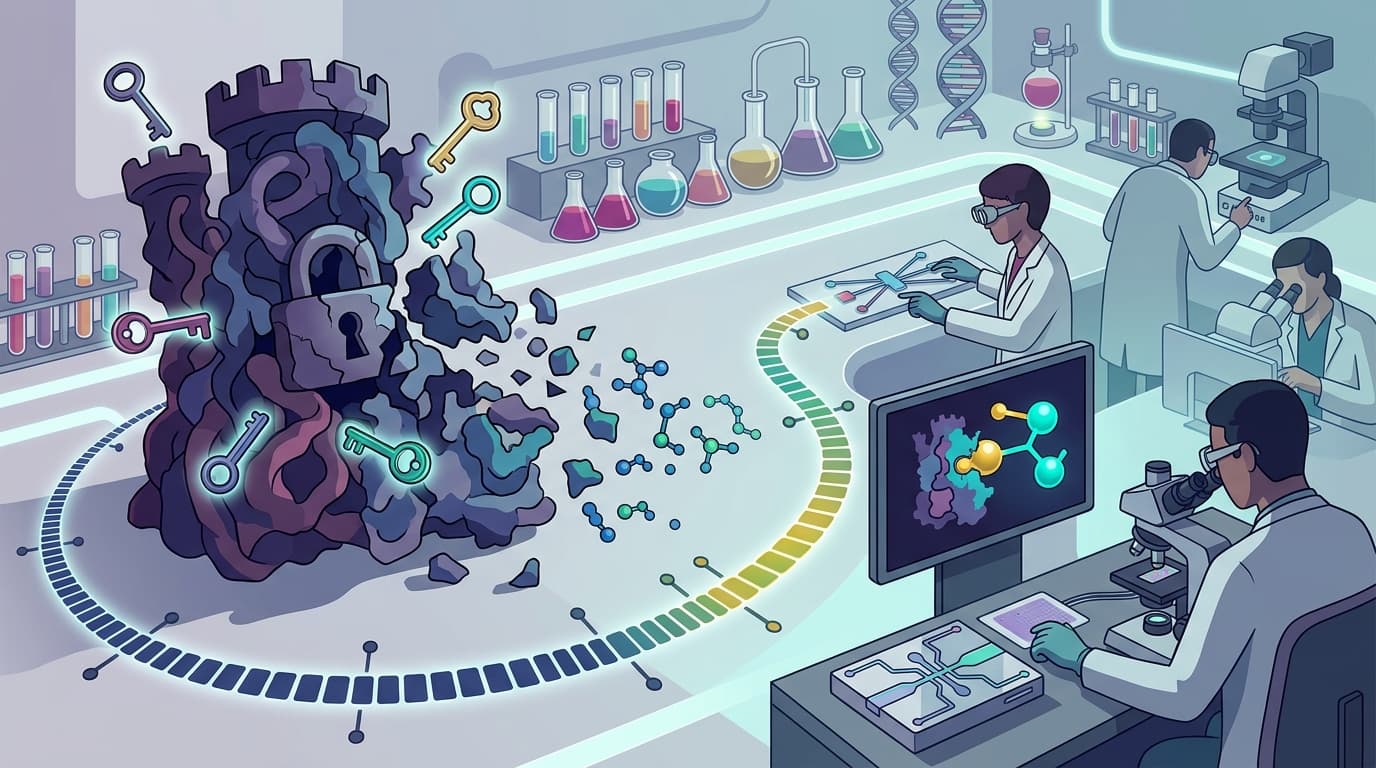
If that name "Daiichi Sankyo" rings a bell, it should. This is the same company behind Enhertu, the blockbuster cancer drug that rewrote the rules for breast cancer treatment. I-DXd uses the same core technology, a type of therapy called an antibody-drug conjugate (ADC). Think of it as a guided missile: the antibody finds the tumor, locks on, and delivers a toxic payload directly inside the cancer cell. Minimal collateral damage to healthy tissue. Maximum firepower where it counts.
The partnership behind this drug isn't small potatoes, either. Merck paid $4 billion upfront in October 2023 for the rights to co-develop three of Daiichi Sankyo's ADCs, with potential milestone payments ballooning to $16.5 billion. I-DXd is one of the crown jewels of that deal.
To understand why this matters, you need to understand ES-SCLC. It accounts for about 15% of all lung cancers, and it's uniquely cruel.
Here's the paradox: small cell lung cancer is actually very sensitive to chemotherapy at first. Tumors shrink. Patients feel better. Doctors cautiously celebrate. Then, almost without fail, the cancer roars back. And when it does, the options get grim fast.
For patients whose cancer returns within 90 days of treatment (called "resistant relapse"), the median progression-free survival on second-line therapy is just . Even patients with a more favorable relapse pattern only get about 4.6 months before the disease starts advancing again. Median overall survival after relapse hovers around 5 to 8 months depending on how the cancer responds to retreatment.

For 40 years, the RAS protein was cancer research's most infamous failure: too smooth, too stubborn, too "undruggable." Revolution Medicines just posted Phase 3 results that nearly doubled survival in pancreatic cancer patients, and the implications go far beyond one drug.


Join thousands of biotech professionals who start their day with our free, daily briefing.

The standard second-line options (topotecan, lurbinectedin, or re-trying platinum chemo) are, to put it bluntly, better than nothing but not by much. This is a disease that desperately needs something new.
I-DXd is different because of what it targets: a protein called B7-H3. If you've never heard of it, don't worry. Most oncologists hadn't spent much time thinking about it until recently.
B7-H3 sits on the surface of tumor cells and plays a sneaky dual role. It helps cancer evade the immune system while also promoting tumor growth, invasion, and metastasis. The kicker? It's widely expressed in SCLC tumors, and its RNA expression is consistent across all molecular subtypes of the disease. That last part is critical. Other targets in SCLC (like DLL3) vary depending on the tumor's molecular profile, which limits who can benefit. B7-H3 doesn't discriminate; it's everywhere the cancer is.
And importantly, B7-H3 expression in normal tissues is low. That's the dream scenario for an ADC: a target that's plastered all over cancer cells but mostly absent from healthy ones.
Once I-DXd locks onto B7-H3, it gets pulled inside the cell and releases its payload, a topoisomerase I inhibitor called deruxtecan (DXd). This compound shreds the cancer cell's DNA, triggering cell death. It can even leak into neighboring tumor cells that don't express the target, a phenomenon called the "bystander effect" that essentially turns each drug delivery into a small area-of-effect weapon.
The application is built on data from two trials: IDeate-Lung01 (the pivotal Phase 2 study) and IDeate-PanTumor01 (a Phase 1/2 trial that provided earlier proof of concept).
In the earlier IDeate-PanTumor01 trial, a small cohort of 21 SCLC patients showed a confirmed response rate of 52.4%, with responses lasting a median of 5.9 months. Promising, but small numbers. The bigger test was IDeate-Lung01.
That trial enrolled 187 patients across Asia, Europe, and North America who had failed at least one prior line of platinum-based chemo. At the optimal dose of 12 mg/kg, the confirmed objective response rate was 48.2%. Nearly half of patients saw their tumors shrink meaningfully. Median progression-free survival hit 4.9 months, and the nine-month overall survival rate was 59.1%.
For context, remember those second-line benchmarks: 1.9 months of PFS for resistant patients on standard therapy. A median PFS of 4.9 months in a mixed population that included resistant patients is a genuine step forward.
The drug also earned Breakthrough Therapy Designation back in August 2025, which, combined with the Priority Review and inclusion in the FDA's Real-Time Oncology Review program, signals the agency sees real urgency here.
No cancer drug comes without trade-offs. In IDeate-Lung01, about 90% of patients experienced treatment-related side effects, with 36.5% hitting grade 3 or higher (the serious stuff). The most common issues were nausea, anemia, and low white blood cell counts.
The bigger concern: interstitial lung disease (ILD), an inflammation of the lungs that's a known class effect of DXd-based ADCs. It showed up in 12.4% of patients, with severe cases in 4.4%. Treatment-related deaths occurred in 4.4% of patients. That's not trivial, but it has to be weighed against a disease where the alternative is often measured in weeks, not months.
I-DXd isn't the only B7-H3 ADC gunning for SCLC. GSK has its own candidate, GSK5764227, which earned Breakthrough Therapy Designation in August 2024 for the same patient population. And tarlatamab, a bispecific T-cell engager from Amgen targeting DLL3, has recently set a new second-line benchmark based on Phase 3 data.
The broader lung cancer treatment market is projected to grow from $31.7 billion in 2026 to $73.7 billion by 2033. SCLC, long neglected because of its grim prognosis, is suddenly one of the hottest battlegrounds in oncology.
If approved by October, I-DXd would become the first-ever B7-H3 targeted therapy to reach patients. That's not just a win for Daiichi Sankyo and Merck; it validates an entirely new target in one of cancer's toughest neighborhoods.
A Phase 3 confirmatory trial (IDeate-Lung02) is already underway. Combinations with immunotherapy and other agents are being explored. The story of I-DXd in SCLC is just getting started, but the opening chapters are promising enough to make oncologists, investors, and (most importantly) patients sit up and take notice.
Seaport Therapeutics and Hemab Therapeutics both filed $100 million IPOs on the exact same day, targeting depression and rare bleeding disorders respectively. Their simultaneous filings say a lot about where the biotech IPO market stands in Q2 2026.