The Protein That Stumped Cancer Researchers for 40 Years Just Lost
For 40 years, the RAS protein was cancer research's most infamous failure: too smooth, too stubborn, too "undruggable." Revolution Medicines just posted Phase 3 results that nearly doubled survival in pancreatic cancer patients, and the implications go far beyond one drug.
For four decades, cancer researchers had a nemesis. Its name was RAS.
This tiny protein, responsible for telling cells when to grow and divide, gets stuck in the "on" position in a staggering number of cancers. Pancreatic, lung, colorectal: RAS mutations show up in roughly a quarter of all human tumors. Scientists knew it was the problem. They just couldn't touch it.
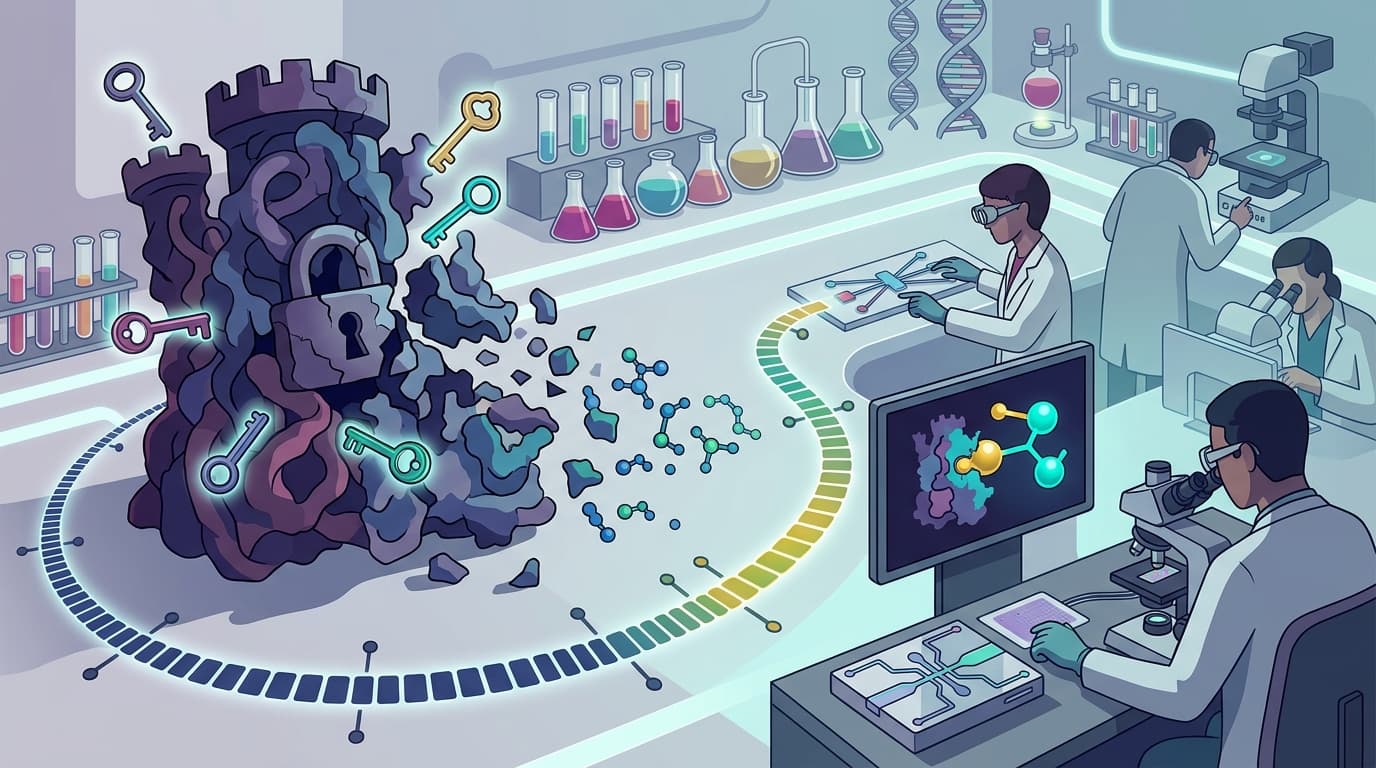
The protein's surface was too smooth, too featureless. There was nowhere for a drug to grab hold. Trying to block RAS was like trying to hang a picture on a bowling ball. By the early 2000s, the scientific community had an unofficial consensus: RAS was "undruggable." Full stop.
Recent data from Revolution Medicines proved them wrong in the most definitive way possible.
The Trial That Rewrites the Playbook
Revolution Medicines announced that daraxonrasib (RMC-6236), its pan-RAS inhibitor, met both primary endpoints in the Phase 3 RASolute 302 trial. The drug hit on overall survival (how long patients lived) and progression-free survival (how long until the cancer got worse) in patients with previously treated metastatic pancreatic cancer carrying RAS G12 mutations.
The numbers are striking. Patients on daraxonrasib had a median overall survival of 13.2 months, compared to just 6.7 months for those on standard chemotherapy. That's a hazard ratio of 0.40 (p < 0.0001), which in plain English means the drug cut the risk of death by 60% versus chemo.
For pancreatic cancer, a disease where progress is often measured in weeks rather than months, nearly doubling survival time is extraordinary. This isn't incremental improvement. It's a seismic shift.
Why RAS Was Oncology's White Whale
To understand why this matters, you need to appreciate just how long and painful this road has been.
KRAS (the most commonly mutated member of the RAS family) was identified as an oncogene back in 1982. That's the same year E.T. hit theaters. Researchers discovered that a single point mutation in this gene could flip a normal cell into a cancerous one. The finding was electrifying; surely a drug would follow.
Get tomorrow's biotech intelligence before your competitors.
Join thousands of biotech professionals who start their day with our free, daily briefing.
It didn't. Not for a very, very long time.
Throughout the 1990s and 2000s, pharma companies tried everything. They went after proteins downstream of RAS, like MEK and ERK, hoping to block the signals RAS was sending. Those approaches flopped in clinical trials, especially in pancreatic cancer, because cancer cells found workarounds through feedback loops. It was like plugging one hole in a dam while three new ones opened.
The breakthrough came in 2013, when a researcher named Kevan Shokat found something nobody expected: a hidden pocket on the KRAS G12C mutant protein that only appeared when the protein was in its inactive state. His team designed molecules that could sneak into this "cryptic" pocket and lock KRAS in the off position.
That discovery eventually led to sotorasib (Amgen's Lumakras), which became the first FDA-approved KRAS drug in May 2021. Adagrasib (from Mirati, now part of Bristol Myers Squibb) followed for the same mutation.
But those drugs had a major limitation: they only worked on one specific mutation, G12C. That mutation is common in lung cancer (about 13% of all NSCLC cases) but rare in pancreatic cancer, where G12D and G12V dominate. For the vast majority of RAS-mutant cancer patients, the "undruggable" label still applied.
Revolution's Different Angle
Revolution Medicines took a fundamentally different approach. Instead of targeting the inactive "off" state of KRAS (like sotorasib and adagrasib do), daraxonrasib goes after the active "on" state. Think of it this way: the first-generation drugs tried to keep a broken light switch from flipping on. Revolution built a drug that tackles the switch while it's already stuck in the on position.
This matters for two reasons. First, it means daraxonrasib can hit multiple RAS mutations, not just G12C. The drug is described as "multi-selective," working across the G12 mutation family that drives most pancreatic cancers. Second, because it targets the active form, it may be harder for cancer cells to develop resistance by simply reactivating RAS, which is a known escape route against the off-state inhibitors.
The trial focused on metastatic pancreatic ductal adenocarcinoma (PDAC), and for good reason. Over 90% of pancreatic cancers carry RAS mutations, making it the most RAS-addicted tumor type in existence. If you're going to prove your pan-RAS drug works, pancreatic cancer is both the hardest test and the biggest opportunity.
The Market Nobody Could Crack
Pancreatic cancer is one of medicine's cruelest diagnoses. It's the third-leading cause of cancer death in the U.S., and most patients are diagnosed after the disease has already spread. Standard chemotherapy extends life, but only modestly. Patients and oncologists have been desperate for something better.
The broader market opportunity is enormous. KRAS mutations drive roughly 153,000 new U.S. cancer diagnoses annually across tumor types. Pancreatic cancer alone accounts for the lion's share, given that 90% of cases are KRAS-mutant. Colorectal cancer (38-45% KRAS-mutant) and lung cancer (20-30% in adenocarcinoma) round out the big three.
First-generation G12C inhibitors, despite their limitations, helped build a KRAS inhibitor market valued at around $526 million in 2025. Analysts project that market could balloon to $7.8 billion by 2034 as drugs like daraxonrasib expand the addressable patient population from one narrow mutation to the full spectrum of RAS-driven cancers.
Wall Street Was Already Paying Attention
Revolution Medicines' stock (RVMD) had been climbing before the data drop, with a unanimous Strong Buy consensus from analysts. Jefferies had set a $140 price target in mid-March. Stifel was even more bullish at $170. Wells Fargo and Needham landed in the $144-145 range.
That kind of analyst unanimity is rare in biotech, where opinions usually scatter like cats at a dog park. The conviction reflected growing confidence in the RAS(ON) approach, but the actual Phase 3 data hadn't been priced in yet. With results this strong, those price targets may need revising upward.
What Comes Next
Revolution Medicines received a National Priority Voucher, and the company is evaluating the impact of the voucher on its regulatory timeline.
But the company isn't stopping at second-line pancreatic cancer. The RASolute 303 trial is now enrolling patients for first-line treatment of metastatic PDAC, comparing daraxonrasib (alone or combined with chemotherapy) against standard chemo. A third Phase 3 trial, RASolute 304, is testing the drug as adjuvant therapy in patients whose pancreatic tumors have been surgically removed. Another Phase 3 in non-small cell lung cancer is planned.
Meanwhile, Revolution has a deep bench of backup programs. Zoldonrasib (RMC-9805) targets G12D mutations specifically, with Phase 1 data presented at AACR 2026. Elironrasib (RMC-6291) goes after G12C. Early response rates across the pipeline range from the mid-20s to over 60%, depending on tumor type.
The Bigger Picture
The significance of this moment extends well beyond one company or one drug. For 40 years, RAS was the protein that made fools of drug developers. It sat at the center of cancer biology, taunting researchers with its importance and its inaccessibility.
Sotorasib cracked the door open in 2021. Daraxonrasib just kicked it down.
A positive Phase 3 trial with a 60% reduction in death risk, in a cancer type that has resisted nearly every therapeutic advance, validates the entire RAS-targeting field. It tells every biotech company working on RAS programs that the biology is real and the clinical bar is clearable. It tells patients with pancreatic cancer, many of whom have been told there are limited options, that the landscape is genuinely changing.
The era of "undruggable" is officially over. And for the roughly 100,000 Americans diagnosed each year with RAS-driven pancreatic, lung, or colorectal cancers, that's not just a scientific milestone. It's hope with actual data behind it.
4 min read
The Eye Cancer That Finally Got a Real Drug
IDEAYA Biosciences just dropped uveal melanoma trial data that more than doubled progression-free survival in patients who had almost no treatment options. Wall Street loved it, an FDA filing is coming, and a half-billion-dollar partnership is fueling what comes next.