
Regeneron's Pasatru just became the second FDA-approved drug for FOP, a brutal rare disease that turns soft tissue into bone. The Phase 3 data showed a 90%+ reduction in new bone lesions, and Ipsen's struggling Sohonos franchise now has a serious fight on its hands.
Imagine your muscles, tendons, and ligaments slowly turning to bone. Not in a metaphor-for-aging kind of way. Literally turning into a second skeleton. That's fibrodysplasia ossificans progressiva, or FOP, and it's one of the cruelest rare diseases on the planet.
For years, patients had exactly one FDA-approved treatment: Ipsen's Sohonos, cleared in 2023. Now Regeneron has crashed the party with Pasatru (garetosmab), and the clinical data suggests it didn't just show up; it showed up ready to fight.
FOP is vanishingly rare. The body misreads normal signals and starts forming bone in places bone should never be: in muscles, in connective tissue, around joints. Over time, patients lose the ability to move. Think of it like your body slowly building a suit of armor you never asked for, one that locks you in place permanently.
The culprit is a protein called Activin A, which hijacks normal bone-formation pathways and triggers rogue bone growth in soft tissues. Regeneron spent nearly 20 years researching FOP before landing on garetosmab, an antibody designed to block Activin A before it can do its damage.
Regenrons's Phase 3 study, called OPTIMA, tested two doses of garetosmab against placebo in adults with FOP. The primary goal: reduce the number of new abnormal bone lesions (called heterotopic ossification, or HO) over 56 weeks.
The results were not subtle. Patients on placebo developed 19 new bone lesions over the study period. The low-dose group? One. The high-dose group? Two. That translates to a 90–94% reduction in new lesion formation, depending on the dose.
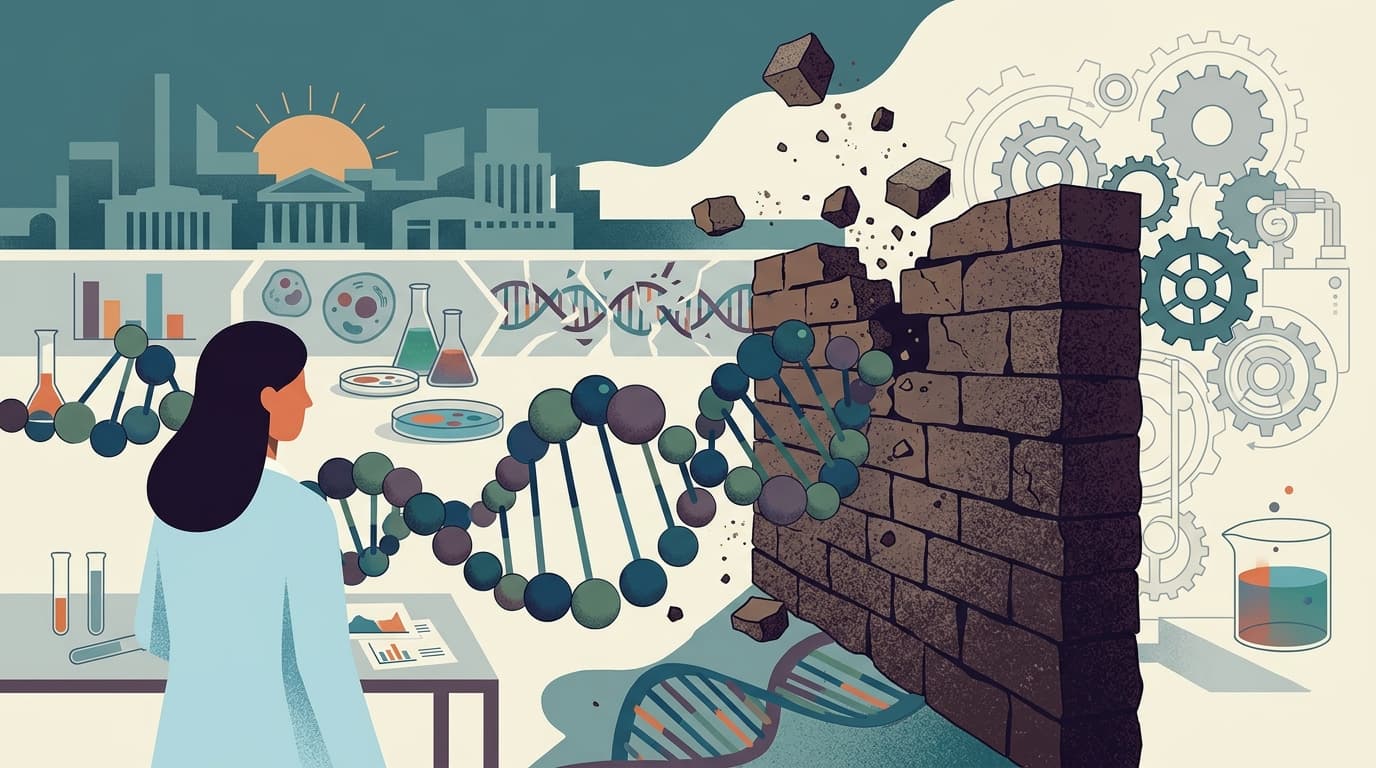
But it gets more striking. When researchers measured the total volume of new rogue bone, both doses showed a greater than 99% reduction compared to placebo. If the placebo group was building a brick wall, the treatment group was barely laying a pebble.

BioNTech and Genentech killed their personalized mRNA cancer vaccine trial in colorectal cancer after a troubling survival signal. The failure raises hard questions about whether mRNA technology can leap from COVID to solid tumors, especially as rival Moderna just scored a Phase 3 win in melanoma.


Join thousands of biotech professionals who start their day with our free, daily briefing.

The drug also tackled flare-ups, those painful inflammatory episodes that often precede new bone formation. At the higher dose (10 mg/kg), clinician-assessed flare-ups dropped by 88–89% versus placebo. The lower dose showed a smaller reduction on that measure, and patient-reported flare-ups didn't reach statistical significance, which gives the picture some nuance. Still, the headline numbers are hard to argue with.
On safety, the trial was reassuring. Serious side effects were uncommon across all groups, with no deaths reported and no serious bleeding events.
Sohonos has been Ipsen's lone entry in FOP since 2023, but its reign hasn't exactly been a victory lap. Sales have been, to put it politely, modest. For context, that's the kind of revenue number that makes investor presentations awkward.
Part of the problem is that Sohonos has faced persistent questions about its benefit-risk profile. When you're the only approved option, patients and doctors will try you out. But once a competitor arrives with cleaner data and eye-popping efficacy numbers, the calculus changes fast.
Regeneron's entrance doesn't just add competition; it reframes the entire conversation around what "good" looks like in FOP treatment. A 90%+ reduction in new bone lesions is a high bar, and Ipsen now has to defend market share against that standard.
Of course, nothing in ultra-rare disease comes cheap. Regeneron's list price for Pasatru lands at approximately $1.4 million per patient per year. The dosing schedule is 10 mg/kg given intravenously every four weeks, with the option to step down to 3 mg/kg if tolerability is an issue.
That price tag sounds astronomical, but it's par for the course in ultra-orphan diseases where the patient population is measured in hundreds, not millions. Payers are used to these numbers in the rare disease world, and the strength of the OPTIMA data gives Regeneron a solid argument for value.
The real question is whether Regeneron can capture meaningful share from Sohonos and pull in treatment-naive patients at the same time. In a market this small, every patient switch matters enormously.
Regenrons is mostly known for Dupixent (the atopic dermatitis and asthma blockbuster) and Eylea (its eye-disease juggernaut). FOP is a much smaller stage, but it fits a deliberate pattern. The company has been steadily building out its rare disease portfolio, positioning itself as a player willing to invest decades of basic science into niche indications.
Garetosmab's journey from Activin A biology to FDA approval represents one of those cases where deep mechanistic understanding actually paid off commercially. Regeneron has even shown preclinical data suggesting that blocking Activin A can prevent rogue bone from regrowing after surgical removal, hinting at future label expansions or combination strategies.
FOP may never be a billion-dollar franchise on its own. But for a company trying to prove it can translate rare-disease biology into real therapies, Pasatru is a compelling proof of concept.
For the FOP community, this approval is genuinely meaningful. Going from one option to two isn't just about market competition; it's about choice. Different patients respond differently to treatments, tolerate different side effects, and have different preferences about dosing and delivery.
Having a second approved therapy with strong Phase 3 data gives doctors a real alternative, and it gives patients leverage. When there's only one drug on the menu, you eat what's served. When there are two, the menu works for you.
Regenrons didn't just get an FDA approval. It gave one of the most underserved patient communities in medicine something they haven't had before: options.
Arsenal Biosciences just fired 99 employees, killed its clinical programs, and bet everything on a technology that barely exists in the clinic. When a company backed by $630 million torches its own playbook, it tells you something important about where cell therapy is headed.