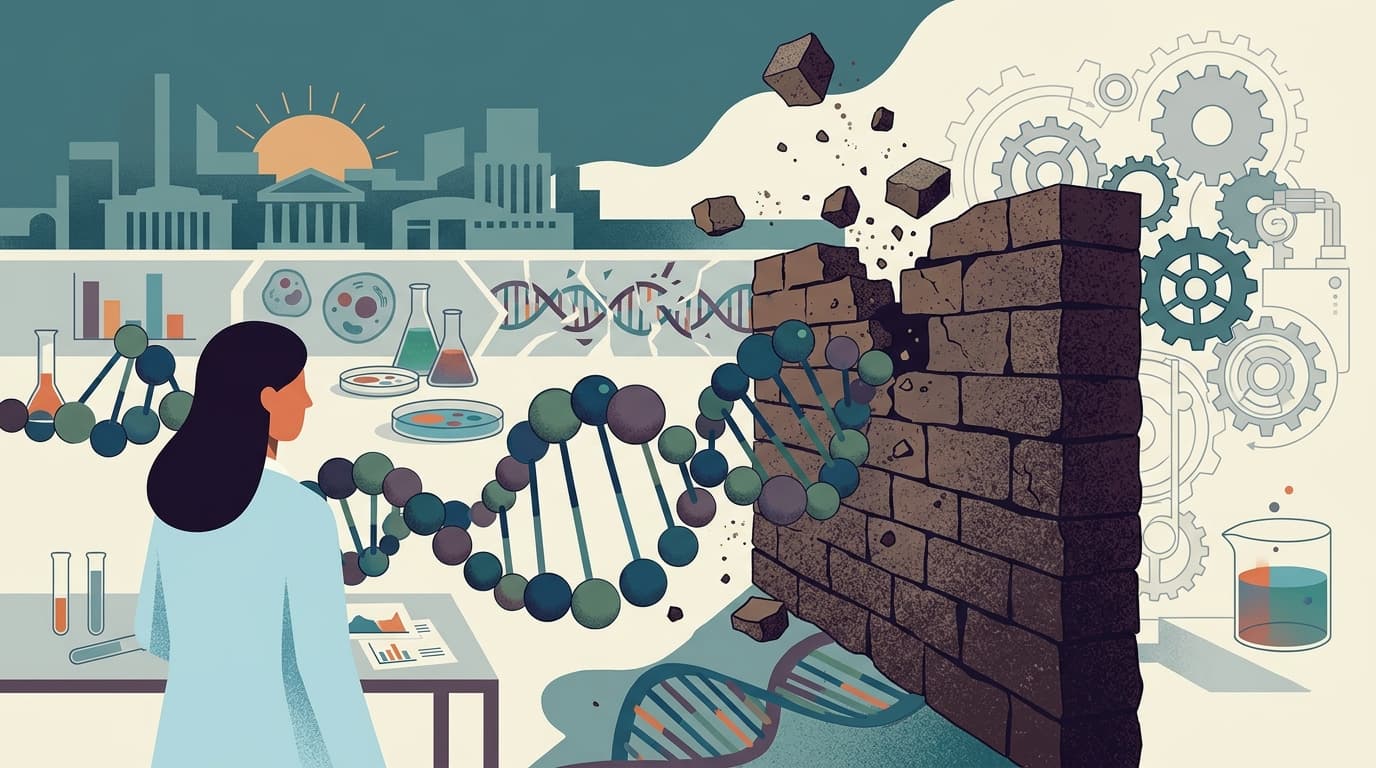
The mRNA Cancer Vaccine That Hit a Wall Nobody Saw Coming
BioNTech and Genentech killed their personalized mRNA cancer vaccine trial in colorectal cancer after a troubling survival signal. The failure raises hard questions about whether mRNA technology can leap from COVID to solid tumors, especially as rival Moderna just scored a Phase 3 win in melanoma.
Two years ago, mRNA was supposed to save us from cancer the same way it saved us from COVID. That dream just got a cold splash of reality.
BioNTech and Genentech quietly pulled the plug on their Phase 2 personalized cancer vaccine trial in colorectal cancer on August 28, 2026. The reason wasn't a safety disaster. It was something arguably worse: the vaccine simply wasn't working. And buried in the data was a troubling signal that patients getting the vaccine may have actually fared worse than those who got nothing at all.
BioNTech shares dropped roughly 7.5% to 9% on the news. But the real damage isn't to one stock. It's to an entire thesis: that mRNA technology, so brilliant at teaching your immune system to recognize a virus, can do the same thing against solid tumors.
The Trial That Was Supposed to Prove Everything
The vaccine in question is called autogene cevumeran (also known as BNT122), and the concept behind it is genuinely wild. Instead of a one-size-fits-all shot, this is a personalized vaccine. Doctors sequence a patient's tumor, identify the unique mutations on its surface (called neoantigens), and then build a custom mRNA vaccine tailored specifically to that person's cancer. Think of it as a bespoke suit for your immune system.
The trial enrolled about 200 patients with surgically resected stage II or stage III colorectal cancer who still had detectable circulating tumor DNA (ctDNA), which is essentially cancer's calling card floating in the bloodstream. These are high-risk patients; the surgery got the visible tumor, but the molecular breadcrumbs suggest cancer cells are still lurking.
Patients were randomized 1:1. Half got the personalized vaccine. Half got watchful waiting, which is exactly what it sounds like: no treatment, just monitoring. The primary goal was to show the vaccine could keep the cancer from coming back, measured by disease-free survival.
It didn't.
When "Not Working" Becomes "Maybe Making Things Worse"
An independent Data Safety Monitoring Board (DSMB), a group of outside experts who periodically peek at the data while a trial is still running, reviewed the results and concluded the trial was unlikely to ever show a benefit. They had actually hit the back in October 2025, which is a statistical tripwire indicating the drug probably isn't going to work no matter how long you wait.
Get tomorrow's biotech intelligence before your competitors.
Join thousands of biotech professionals who start their day with our free, daily briefing.
futility boundary
At the time, BioNTech argued the data were too immature to draw reliable conclusions, and the trial continued. But the latest review found something more alarming: a numerical imbalance in overall survival between the two groups. In plain English, more people appeared to be dying in the vaccine arm than in the watchful-waiting arm.
To be clear, BioNTech said there were no new safety signals tied to the vaccine itself. The company framed the stop as a futility decision, not a safety one. But BMO Capital Markets analyst Evan Seigerman called the update "more concerning than a conventional futility stop" precisely because of that survival imbalance. When a drug designed to help people might actually be hurting them, even numerically, regulators and investors take notice.
Why mRNA Vaccines Struggle Against Solid Tumors
With COVID, the assignment was relatively straightforward. The spike protein sits on the surface of every SARS-CoV-2 particle like a neon sign. Your immune system just needs to learn what it looks like, and mRNA vaccines are phenomenal at that kind of teaching.
Cancer is a completely different classroom. The challenges stack on top of each other like a terrible game of Jenga.
First, the targeting problem. Every patient's tumor is genetically unique, so you need to pick the right neoantigens to include in the vaccine. Get the selection wrong, and you've trained the immune system to look for the wrong face in a crowd.
Second, the delivery problem. mRNA is fragile. The lipid nanoparticles that carry it tend to accumulate in the liver and spleen rather than reaching the tumor. It's like mailing a letter to the right city but the wrong address.
Third, and most importantly, the tumor microenvironment problem. Solid tumors are surrounded by an immunological fortress. Regulatory T cells, suppressor cells, and inhibitory signals create a zone where even well-trained immune cells get exhausted and shut down. Imagine sending a SWAT team into a building where someone keeps turning off the lights and locking the doors.
Colorectal cancer is especially tough. These tumors are often considered immunologically "cold," meaning they don't naturally attract much immune attention. They also evolve constantly, shedding or changing the very antigens the vaccine is designed to target. It's like trying to catch someone who keeps changing their disguise.
The Scoreboard: Moderna Pulls Ahead
This failure stings even more when you look at what the competition just accomplished. Moderna and Merck recently reported that their own personalized mRNA cancer vaccine, intismeran autogene (V940), met its primary endpoint in the Phase 3 INTerpath-001 trial in resected melanoma. That's the first positive Phase 3 result for any individualized neoantigen therapy, period.
The earlier Phase 2b data for the Moderna/Merck program showed a 49% reduction in recurrence or death and a 59% reduction in distant metastasis or death when the vaccine was combined with Merck's blockbuster checkpoint inhibitor, KEYTRUDA.
Note the key difference: Moderna is testing its vaccine in combination with a checkpoint inhibitor (a drug that helps take the brakes off the immune system), while BioNTech tested autogene cevumeran as a monotherapy in colorectal cancer. That distinction matters enormously. If the tumor microenvironment is a fortress, the vaccine is the reconnaissance team and the checkpoint inhibitor is the battering ram. Sending in recon alone, especially against a cold tumor, may simply not be enough.
It also matters that melanoma is one of the most immunologically "hot" tumor types, making it a much friendlier testing ground than colorectal cancer. Moderna picked the easier exam first. BioNTech arguably tried to run before it could walk.
What Survives the Wreckage
BioNTech was quick to note that this termination does not affect its separate Phase 2 study of autogene cevumeran in pancreatic cancer, where the vaccine is being tested in combination with checkpoint inhibition and chemotherapy. That trial continues as planned.
Genentech also said it remains committed to investigating the vaccine with BioNTech. Citi analysts called the colorectal failure a setback that raises the bar, but maintained a buy rating on BioNTech, arguing the drug could still work in combination settings.
Those are reasonable positions. A Phase 2 failure in one tumor type doesn't invalidate an entire platform. But it does force a reckoning. BioNTech had previously described autogene cevumeran as being evaluated in three ongoing randomized Phase 2 trials: adjuvant pancreatic cancer, first-line melanoma, and adjuvant colorectal cancer. One of those three is now gone, and the remaining programs carry the extra weight of needing to prove this wasn't a fluke.
The Bigger Picture
The personalized cancer vaccine field is at a genuine crossroads. Moderna's melanoma success proves the concept can work: you can build a custom vaccine that helps the immune system hunt down residual cancer cells. But BioNTech's colorectal failure proves the concept doesn't automatically transfer across tumor types, treatment settings, or combination strategies.
The lesson might be deceptively simple. mRNA is a delivery vehicle, not a magic bullet. It can carry instructions to your immune system beautifully, but whether those instructions translate into dead cancer cells depends on everything else: the tumor's biology, the immune landscape, and what other drugs are clearing the path.
For patients with colorectal cancer, the search for better options continues. For BioNTech, the next twelve months will be defined by whether pancreatic cancer data can restore confidence. And for the broader field, the message is sobering but clarifying: personalized cancer vaccines are real, they can work, but biology still gets the final vote.
The mRNA revolution isn't over. It's just learning, the hard way, that cancer doesn't play by the same rules as a virus.
Clinical & Regulatory
4 min read
Novo's Weight-Loss Pill Just Landed in Europe. Now the Real Test Begins.
Novo Nordisk just started selling a weight-loss pill in Germany that works about as well as the Wegovy injection. The catch? German insurance won't cover it, so patients are footing the entire bill. This is the real-world experiment that could define the future of the oral GLP-1 market.