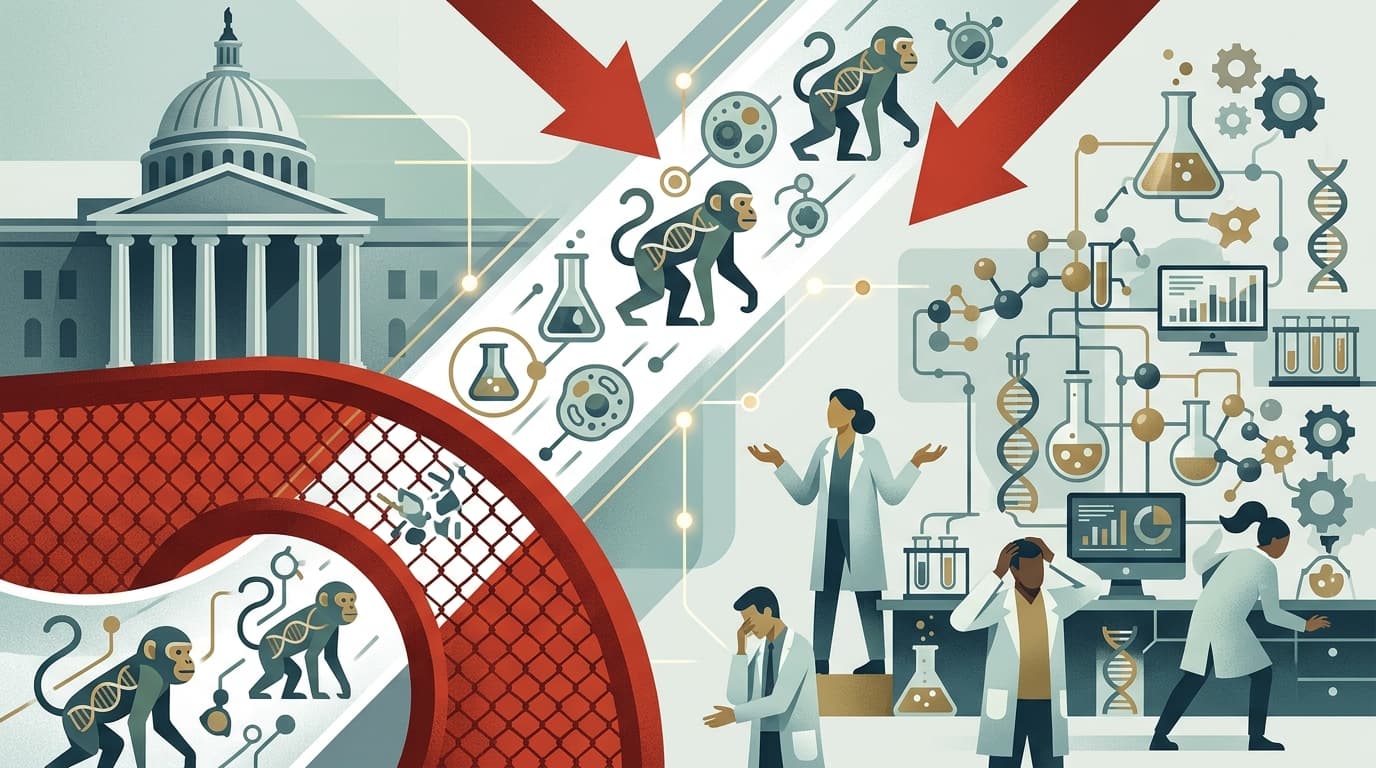

A bipartisan bill would ban all nonhuman primate imports into the U.S., threatening the supply chain for preclinical drug testing. With 20,000+ monkeys imported annually for research, the legislation could force an industry-wide scramble toward alternative testing methods.
Every year, the United States imports more than 20,000 nonhuman primates, mostly from Asia, Africa, and the Caribbean. The vast majority are cynomolgus macaques (crab-eating monkeys), and roughly 90-95% of them end up in labs where drugmakers test whether their compounds are safe enough for humans.
Now a bipartisan bill wants to shut that pipeline down entirely.
Rep. Greg Steube (R-FL) and Rep. Dina Titus (D-NV) introduced the PRIMATE Act (H.R. 8471), which stands for "Preventing Risky Importation of Monkeys to Avoid Toxic Exposures." The name alone tells you something about the framing: this isn't just an animal welfare play. It's pitched as a biosecurity measure, too.
The provisions are blunt. The bill would prohibit importing nonhuman primates into the U.S., with limited exceptions for accredited zoos. U.S. Customs and Border Protection would be directed to deny entry to prohibited shipments. Penalties hit $50,000 per violation, and any illegally imported primates would be seized.
"The humane treatment of monkeys is not just the responsible thing to do, it is also the right thing to do," Rep. Titus said in a press release, adding that the bill "prevents the importation of monkeys for the purposes of experimentation and research." Steube emphasized the biosecurity angle: keeping dangerous pathogens from crossing borders inside primate shipments.
PETA has thrown its full weight behind the legislation, calling lab imports "cruel and risky."
Primate testing isn't some relic of the 1990s. It's woven into the regulatory fabric of drug development. Before most drugs reach human trials, they need to pass safety tests in animals. For many biologics (think monoclonal antibodies, gene therapies, and complex molecules), monkeys are the closest approximation to a human system that regulators will accept.
Over 100,000 nonhuman primates are used in U.S. biomedical research annually. If imports dry up, that pool shrinks fast. Domestic breeding programs exist, but they can't fill a gap this large overnight. Think of it like banning steel imports and telling American mills to pick up the slack by next quarter.

The FDA is letting Amgen and AstraZeneca stream clinical trial data to regulators in real time, ditching the decades-old "run the study, then submit everything" model. If it works, drug development timelines could compress by months, and the entire industry will want in.


Join thousands of biotech professionals who start their day with our free, daily briefing.
The concern isn't hypothetical. When China restricted primate exports in 2020, U.S. imports dropped more than 20%. Research timelines stretched. Costs jumped. A single primate in a toxicology study can cost around $50,000. Scarcity only pushes that number higher.
The reaction from pharma and CROs (contract research organizations, the companies that actually run many of these studies) has been surprisingly measured. That's partly because the regulatory winds were already shifting before this bill dropped.
In April 2025, the FDA announced plans to phase out animal testing requirements for monoclonal antibodies when scientifically appropriate. The NIH has committed over $150 million to scale up what the industry calls New Approach Methodologies, or NAMs.
Charles River Laboratories, one of the largest safety testing CROs in the world, has publicly embraced the shift. Steve Bulera, their Corporate Vice President and Chief Scientific Officer of Discovery and Safety Assessment, predicted that NAMs will "dominate the space, but not overnight." That last part matters.
So what replaces a monkey? The toolkit is growing fast:
Organoids are miniature 3D organ models grown from stem cells. They mimic human tissue structure and can test drug toxicity in ways that are actually more relevant to humans than monkey data. Organ-on-chip systems use microfluidic devices with living human cells to simulate how drugs move through liver, lung, or brain tissue. AI and computational models can predict toxicity from massive datasets before a single cell is exposed.
One industry projection estimates these alternatives could save 90% on new drug startup costs by reducing the catastrophic attrition rate (currently, about 90% of drug candidates that pass animal testing still fail in humans).
But validation and standardization remain real obstacles. A February 2026 review from the Association of the British Pharmaceutical Industry found significant gaps between academic innovation and industry-ready tools. Scaling these technologies, making them reproducible, correlating them with existing animal datasets: all of that takes time.
This isn't Congress's first swing at primate research. The arc follows a pattern. In 2015, the U.S. effectively ended all invasive research on chimpanzees through a combination of endangered species protections and an NIH decision to stop funding chimp studies. The 2000 CHIMP Act had created sanctuaries. The 2007 "Chimp Haven is Home Act" made those retirements permanent.
Each step seemed radical at the time. Each one stuck.
Monkeys are a different story, though. Chimps were used in relatively small numbers for limited applications. Macaques are the workhorse of preclinical testing across oncology, neuroscience, infectious disease, and immunology. Replacing them isn't a single decision; it's a thousand decisions across thousands of drug programs.
The PRIMATE Act hasn't passed yet. It was recently introduced and hasn't even been referred to committee as of early May. But the direction of travel is unmistakable: regulators want fewer primates in testing, Congress is interested in banning imports, and the private sector is investing heavily in alternatives.
The question isn't whether primate testing will decline. It's whether the replacement technologies will mature fast enough to avoid a gap, one where promising drugs sit in regulatory limbo because the old testing methods are banned and the new ones aren't validated.
For biotech companies with programs that depend on primate toxicology data, the smart move is obvious: start building your NAM strategy yesterday. Because whether this bill passes or not, the era of shipping 20,000 monkeys a year across the Pacific is winding down.
UCB just paid $2.2 billion for Candid Therapeutics, a biotech that launched from stealth barely 18 months ago. The deal reveals big pharma's frenzied bet that T-cell engagers could become the new standard of care for autoimmune diseases.