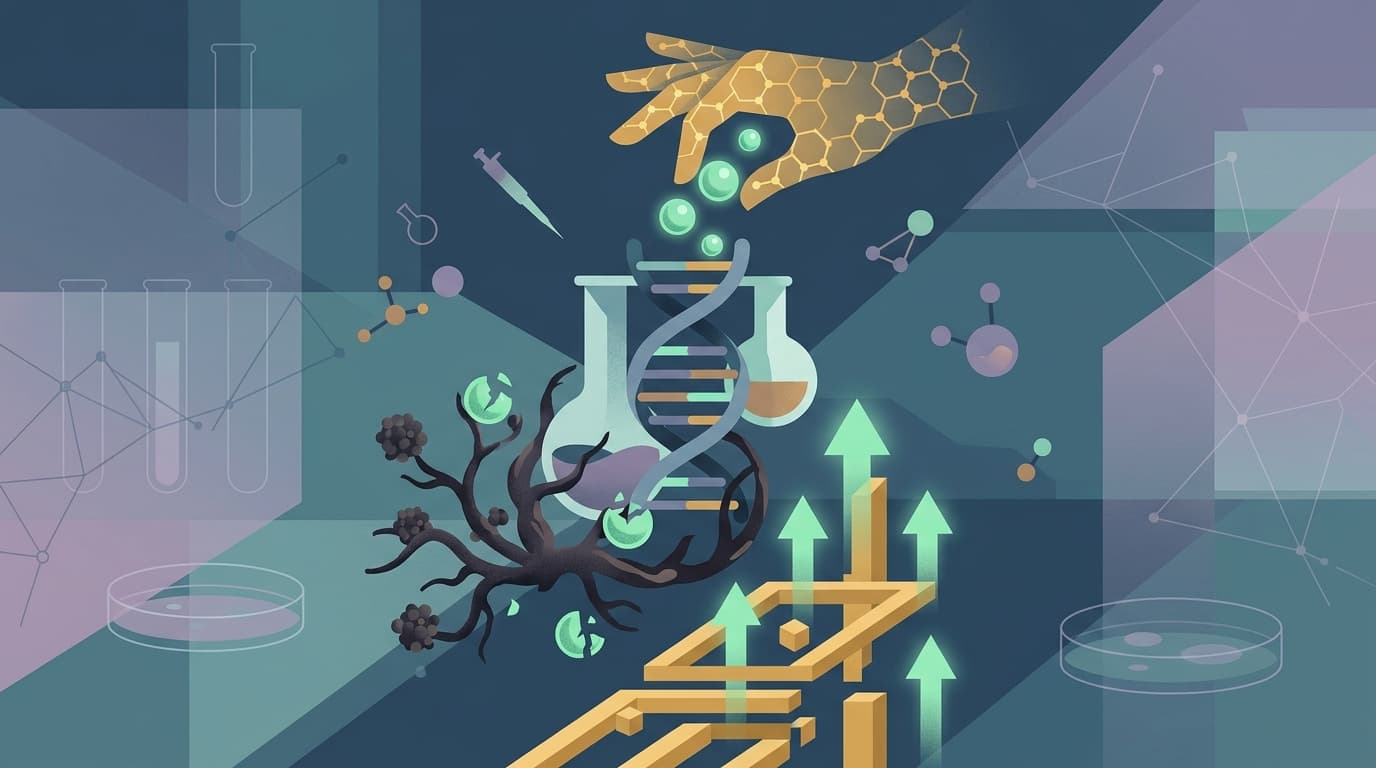

Prediction markets are letting people bet real money on clinical trial outcomes and FDA decisions. The potential for cleaner investing signals is real, but so are the insider trading risks and ethical landmines that come with gambling on whether a drug will save lives.
Imagine DraftKings, but instead of betting on the Cowboys covering the spread, you're betting on whether a psilocybin drug will get FDA approval by next year.
That's not a hypothetical anymore. Prediction markets, the platforms that let people wager real money on future events, have officially arrived in biotech. And the implications are wild.
Prediction markets blew up during recent election cycles. Polymarket, Kalshi, and others let users trade contracts on everything from presidential races to inflation numbers. The concept is simple: if you think an event will happen, you buy a "yes" contract. The price reflects the crowd's implied probability. If the event happens, you get paid.
Now these platforms are applying the same logic to drug development. Kalshi, a CFTC-regulated exchange, recently listed contracts tied to Compass Pathways' psilocybin drug COMP360 for treatment-resistant depression. Users can trade on when Compass will submit its application to the FDA and whether approval will come through, with different timing windows carrying different payouts.
Polymarket, the crypto-based platform, has started listing biotech contracts too. Search "FDA" or "Phase 3" and you'll find markets on GLP-1 obesity drugs, Alzheimer's therapies, and oncology readouts.
Then there's the newcomer: Endpoint Arena, a platform built specifically for clinical trial predictions. It now supports real-money trading on at least some Phase 3 trials and FDA-related contracts, and it focuses on phase 2 trials, the stage where most drugs face their make-or-break moment. An AI model sets the opening odds using public data, then users trade based on their own analysis.
Biotech stocks are notoriously messy. They move on macro fears, financing rumors, sector rotations, and random Twitter threads. If you want to know what the market actually thinks about a specific trial's chances, the stock price is a blurry signal at best.
Prediction markets promise something cleaner. One question, one answer: "Will this trial hit its primary endpoint?" No noise from short sellers, no dilution anxiety, no index rebalancing. Just a probability.

A Suzhou biotech just raised $80 million on the Hong Kong Stock Exchange to fight bacterial infections, an area most investors won't touch. Its lead drug crushed the standard of care for H. pylori in Phase III, and the company's hybrid chemistry platform could reshape how we treat everything from stomach bugs to infected hip implants.


Join thousands of biotech professionals who start their day with our free, daily briefing.
That's genuinely appealing. Endpoint Arena's founder, Fischer, argues these markets could motivate participants to become deep experts on specific trials, surfacing insights faster than traditional channels. He even suggests they could eventually help patients decide whether to enroll in a trial (alongside their doctor's advice, of course).
The academic evidence from other domains is encouraging too. Prediction markets on elections and economic events tend to be well-calibrated: when they say 70%, the event happens roughly 70% of the time. They update faster than analyst reports. And having real money on the line keeps people honest in a way that armchair analysis doesn't.
But biotech isn't an election. And that distinction matters enormously.
Consider who actually knows whether a trial is going well: the investigators running it, the biostatisticians analyzing interim data, the Data Safety Monitoring Board members reviewing unblinded results, the sponsor's internal team. That's a small group of people with information nobody else has.
Now give those people a market where they can profit from that knowledge. See the problem?
Michael Abrams of consulting firm Numerof put it bluntly in the Fierce Biotech feature: large financial incentives tied to trial outcomes could tempt people with non-public data to trade on inside information. That's not just an ethical concern; it's potentially criminal. The CFTC issued a staff advisory in March 2026 making clear that misappropriating confidential information to trade event contracts is prohibited, analogous to insider trading in securities.
The analogy that keeps coming up is sports betting. A prediction market on clinical trials is uncomfortably close to an athlete betting on their own game. A principal investigator with a position in a "trial succeeds" contract has a direct financial interest in the outcome they're supposed to evaluate objectively. Even if their behavior stays perfectly clean, the perception of bias could erode trust in the entire clinical trial system.
For now, the scale is tiny. Kalshi has less than $50,000 total staked across all its biotech contracts. These are pilot projects, not Wall Street infrastructure.
But "small and experimental" is how every disruptive market starts. And regulators are already paying attention. The CFTC published an Advance Notice of Proposed Rulemaking in March 2026, specifically asking whether events controlled by small groups of insiders (sound familiar?) should be restricted or prohibited on prediction platforms.
Meanwhile, compliance lawyers at firms like Ropes & Gray are telling pharma companies to update their codes of conduct now. The recommendation: treat prediction market participation the same way you treat insider trading in company stock. Ban employees from betting on events tied to their own products. Include prediction markets in annual compliance training. Don't wait for a headline about a researcher "gambling on patients."
If you're a biotech investor hoping to use prediction markets as a hedging tool or an alpha signal, pump the brakes a little.
The concept works in theory. If a prediction market says a trial has a 40% chance of success and your model says 65%, that's a potential edge. You could use prediction market contracts like binary options, buying "fail" contracts to hedge a long stock position ahead of a data readout.
In practice, though, the liquidity isn't there yet. Spreads are wide, order books are thin, and a single motivated trader can shove the implied probability around. Platform risk is real too: these aren't cleared through the Options Clearing Corporation. If the platform goes down, good luck collecting.
The smarter move for now is to treat prediction market odds as one more data point, not the data point. Cross-reference them with your own models, options-implied probabilities, and sell-side estimates. When they all agree, you've probably found something close to consensus. When they diverge sharply, that's worth investigating.
The real tension here isn't about trading platforms or regulatory frameworks. It's philosophical.
Clinical trials exist because patients volunteer their bodies to test unproven treatments. That system runs on trust: trust that researchers are objective, that data is reported honestly, that decisions are made in patients' interests. Creating a financial market that lets outsiders (and potentially insiders) profit from those outcomes introduces a pressure that cuts against every one of those values.
Prediction markets are brilliant at aggregating information about elections, sports, and economic data. Whether they belong anywhere near the process of developing medicine for sick people is a question that's going to define the next chapter of biotech's relationship with financial markets.
The contracts are live. The bets are being placed. And the rules are still being written.
Isomorphic Labs, the Google DeepMind spinoff, just raised $2.1 billion in the largest AI drug discovery financing ever. With Nobel Prize-winning science, $3 billion in pharma deals, and zero approved drugs, the company is making the biggest bet the field has ever seen.