A Billion-Dollar Bet on Parkinson's Just Went Up in Smoke
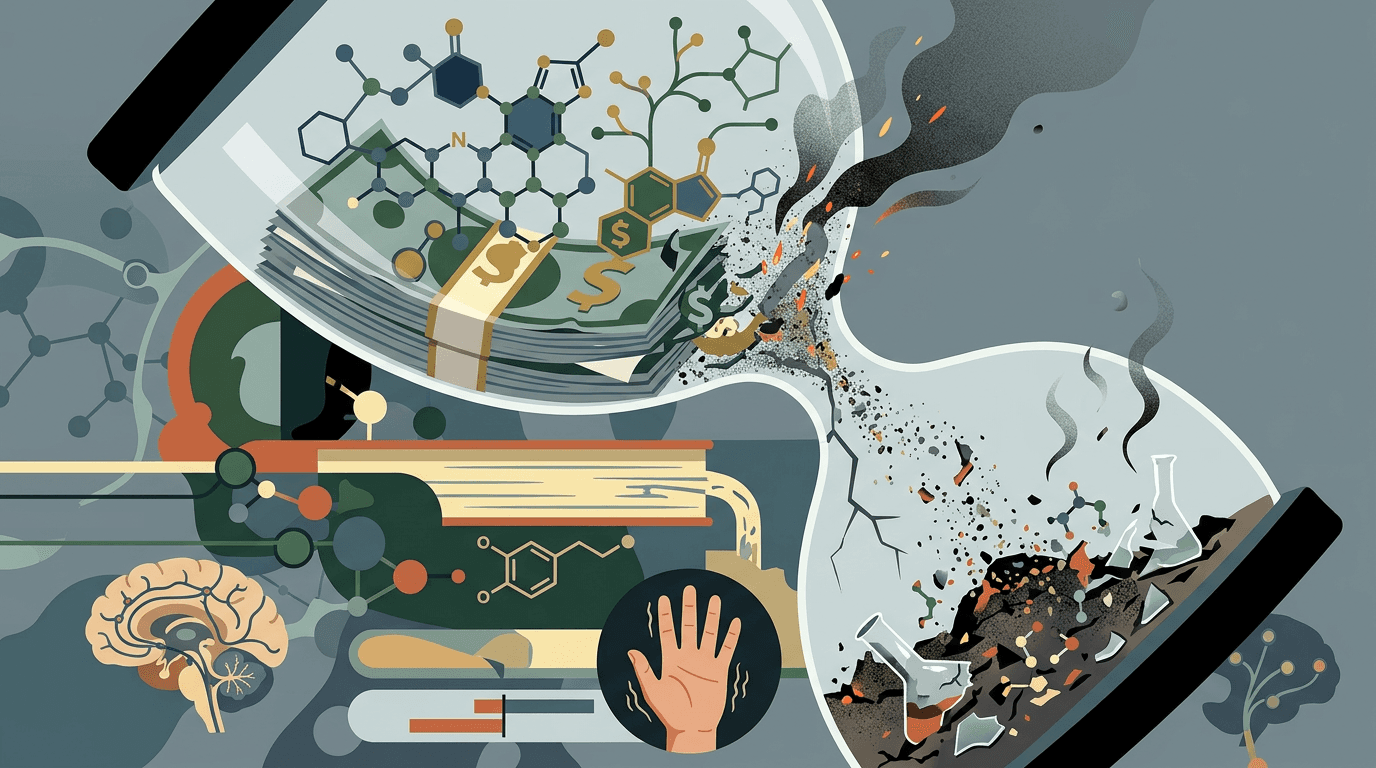
Biogen and Denali's LRRK2 inhibitor nailed every biological target in a 648-patient Parkinson's trial, then failed to help a single clinical measure. A billion-dollar partnership just lost its centerpiece, and the implications ripple across the entire field of neurodegeneration.
The Drug That Hit Every Target and Changed Nothing
Imagine training for a marathon, nailing every workout, hitting every split time in practice, and then finishing dead last on race day. That's essentially what just happened to Biogen and Denali Therapeutics.
Their Parkinson's drug BIIB122 did exactly what it was supposed to do inside the body. It crushed its molecular target. It showed up in the brain. Safety looked fine. But when it came to the only thing that actually matters (did patients get better, or at least get worse more slowly?), the answer was a flat, unambiguous no.
On May 21, 2026, Biogen and Denali pulled the plug on BIIB122 in broad Parkinson's disease after their Phase 2b LUMA trial missed its primary endpoint. The drug failed to slow disease progression in 650 early-stage Parkinson's patients. It also missed every secondary endpoint. Both companies are now walking away from one of the most closely watched programs in neurodegeneration.
What $1 Billion Buys You (Apparently, Not a Cure)
This wasn't some scrappy startup taking a moonshot. This was a $560 million upfront deal that Biogen struck with Denali back in August 2020, plus a $465 million equity investment and up to $1.125 billion in milestone payments. The collaboration was supposed to be Biogen's ticket into Parkinson's, and Denali's proof that its brain-targeting technology could tackle the biggest challenges in neuroscience.
The drug, originally called DNL151, is a small-molecule inhibitor of a protein called LRRK2 (leucine-rich repeat kinase 2). Mutations in LRRK2 are among the most common genetic risk factors for Parkinson's. The logic was straightforward: if overactive LRRK2 contributes to the disease, blocking it should slow things down.
Early data looked encouraging. Phase 1 trials showed the drug could substantially reduce LRRK2 activity in blood, with reductions of over 80% and up to approximately 98% at clinically relevant doses. A downstream biomarker called pRab10, which scientists use to gauge whether LRRK2 is actually being shut off, dropped by about half. The safety profile was clean. Everything pointed toward a green light for larger studies.
Get tomorrow's biotech intelligence before your competitors.
Join thousands of biotech professionals who start their day with our free, daily briefing.
Then LUMA happened.
The Cruel Math of "Biomarker Positive, Clinically Negative"
The LUMA trial measured whether BIIB122 could slow worsening on the MDS-UPDRS, a clinical scale that tracks both motor symptoms (tremors, stiffness, slowness) and daily functioning (buttoning a shirt, getting out of a chair). Think of it as a comprehensive report card for how Parkinson's is progressing.
The drug achieved greater than 90% inhibition of LRRK2 in the blood and roughly 30% reduction of pRab10 in spinal fluid. By every biological measure, BIIB122 was working. The kinase was blocked. The downstream pathway was quieter.
But patients on the drug progressed at the same rate as patients on placebo. No separation on the primary endpoint. No separation on secondaries. Nothing.
This is neuroscience's most heartbreaking pattern: the biology checks out, but the clinic doesn't care. It's happened with amyloid-clearing Alzheimer's drugs, with alpha-synuclein antibodies in Parkinson's, and now with LRRK2 inhibition. Hitting the target is necessary but nowhere near sufficient.
What This Means for Denali (Hint: It Stings)
Biogen can absorb this. The company has its Alzheimer's franchise, its multiple sclerosis portfolio, and other irons in the fire. Analysts are likely trimming pipeline valuations, not issuing downgrades.
Denali is a different story. BIIB122 in broad Parkinson's was a cornerstone of the company's value proposition. Before this failure, Denali's stock was already under pressure after a separate blow when partner Takeda walked away from a different collaboration. Wall Street's consensus price target sits near $34, but that gap between target and reality now feels more like optimism than analysis.
Denali does have other assets. Its blood-brain barrier Transport Vehicle platform (a clever piece of engineering that ferries large molecules across the brain's natural defenses) scored a real win: the FDA granted accelerated approval for tividenofusp alfa (branded AVLAYAH) in Hunter syndrome, a rare genetic disease that damages the brain. That approval validated the platform's core technology and gives Denali its first commercial product.
But a rare-disease launch and an early-stage pipeline of experimental programs don't replace the commercial potential of a Parkinson's drug in a disease affecting roughly one million Americans.
Not Dead Yet (Maybe)
There's a sliver of hope tucked inside the wreckage. Denali plans to keep running BEACON, a smaller Phase 2a study testing BIIB122 specifically in patients who carry LRRK2 mutations. Data is expected in the first half of 2027.
The reasoning makes sense. In patients where LRRK2 is genetically hyperactive, blocking the enzyme should have a more pronounced effect. It's the difference between prescribing glasses to everyone in a room versus prescribing them only to people who actually can't see. The LUMA trial enrolled "all comers" with early Parkinson's, regardless of genetic profile. That broad approach may have diluted a real signal hiding in a genetic subgroup.
But BEACON is a much smaller, much narrower bet. Even if it works, the addressable market shrinks dramatically. LRRK2 mutations account for only a fraction of all Parkinson's cases.
Parkinson's Remains Neuroscience's Toughest Nut
Step back, and the LUMA failure fits a discouraging pattern. As of early 2024, there were 136 active Parkinson's trials on ClinicalTrials.gov. About 44% targeted disease modification rather than just symptom relief. Yet only three Phase 3 disease-modifying trials were active as of early 2024, down from six in 2022. The pipeline is wide at the top and painfully narrow where it counts.
Roche and Prothena's prasinezumab, an antibody targeting alpha-synuclein (the sticky protein that clumps in Parkinson's brains), missed its primary endpoint in Phase 2 but showed hints of benefit on motor symptoms. A larger study is underway. Biogen's own cinpanemab, another alpha-synuclein antibody, failed outright. GBA modulators, GLP-1 receptor agonists, and mitochondrial rescue strategies are all in various stages of testing, but none has delivered a convincing win.
The fundamental problems haven't changed. Parkinson's probably isn't one disease; it's several diseases wearing the same trench coat. By the time patients are diagnosed, years of neuronal damage have already occurred. Clinical scales progress slowly and vary wildly between patients, making it incredibly hard to detect a treatment effect. And preclinical animal models often don't predict what happens in humans.
The Takeaway
BIIB122's failure doesn't mean LRRK2 biology is irrelevant to Parkinson's. It means that blocking one kinase in a broad, heterogeneous patient population wasn't enough to move the needle on clinical progression. The field is increasingly converging on a painful truth: the next generation of neurodegeneration trials will need to start earlier, pick patients more carefully using genetics and biomarkers, and probably combine multiple approaches.
For Denali, the path forward runs through BEACON's 2027 readout and the commercial success of AVLAYAH. For Biogen, it's a reminder that the brain remains the most expensive organ in drug development. And for the million-plus people living with Parkinson's, the wait for a drug that actually slows their disease continues.
Sometimes the marathon runner does everything right and still doesn't finish. The question is whether anyone laces up for the next race.
Funding & Financings4 min read
Google's Secret Weapon Just Raised More Than Most Biotechs Are Worth
Isomorphic Labs, the Google DeepMind spinoff, just raised $2.1 billion in the largest AI drug discovery financing ever. With Nobel Prize-winning science, $3 billion in pharma deals, and zero approved drugs, the company is making the biggest bet the field has ever seen.