Big Pharma Just Cut a Deal With the White House. Here's What They Gave Up.
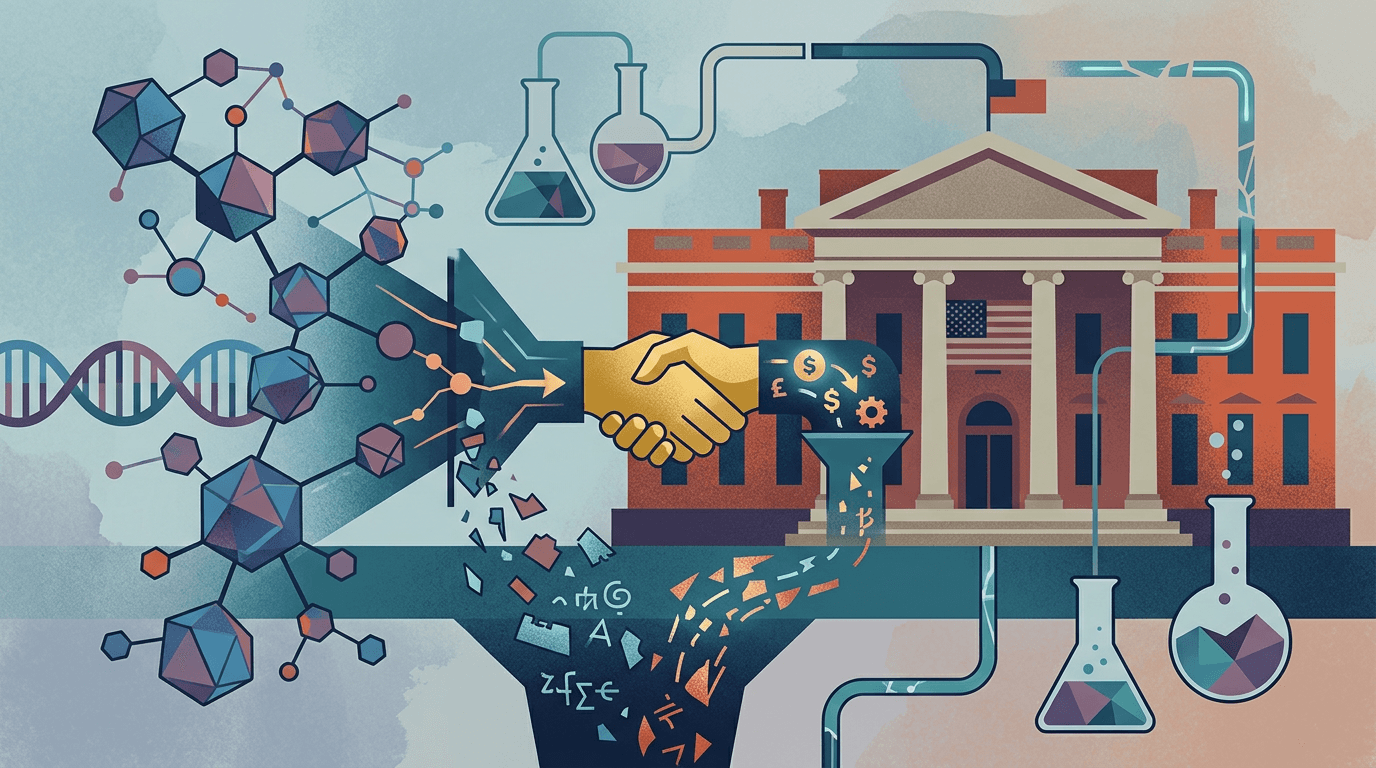
The Trump administration threatened 100% tariffs on imported brand-name drugs, and 16 pharma giants blinked. The deals they struck could reshape how America prices medicine, but Wall Street thinks the whole thing might be a giant nothingburger.
The Ultimatum Nobody Saw Coming
Imagine your landlord walks in and says rent is doubling tomorrow. Unless, of course, you agree to mow the lawn, paint the fence, and host Thanksgiving dinner every year. That's essentially what just happened to the pharmaceutical industry.
The Trump administration threatened 100% tariffs on imported brand-name drugs, the most aggressive trade action ever aimed at pharma. But there's a catch: companies that agree to lower their U.S. prices and build factories on American soil can dodge the tariffs entirely. Fourteen of the world's biggest drugmakers have already signed on the dotted line.
The result? A strange new era where the White House is effectively setting drug prices through trade policy, not legislation. And Wall Street, surprisingly, doesn't seem to mind.
How the Tariff Machine Works
The policy, formalized through a Section 232 presidential proclamation (the same national-security authority used for steel tariffs), targets patented pharmaceuticals and their ingredients. Generics and biosimilars are exempt. So are orphan drugs, cell and gene therapies, plasma-derived treatments, and a handful of other categories.
For everyone else, the math is simple. Companies have three options:
Option A: Sign both a pricing deal with HHS and a manufacturing agreement with Commerce. Your tariff rate: 0% through January 2029.
Option B: Commit to building U.S. factories but skip the pricing deal. You'll pay 20% tariffs instead of 100%, but that rate could jump back up by 2030.
Option C: Do nothing. Pay 100% when the tariffs kick in on July 31 for large companies, September 29 for smaller ones.
It's a tiered system designed so that almost nobody actually pays the full 100%. The tariff is less a tax and more a cattle prod, pushing companies toward the outcomes the administration wants: cheaper drugs and American-made pills.
Get tomorrow's biotech intelligence before your competitors.
Join thousands of biotech professionals who start their day with our free, daily briefing.
The 14 Who Said Yes
The roster of companies that struck deals reads like a pharma all-star team. Eli Lilly, Pfizer, Merck, Amgen, Bristol Myers Squibb, Gilead, Novartis, Sanofi, GSK, and AstraZeneca are among the confirmed participants, with additional names yet to be publicly disclosed from the group of 14.
In return, they get tariff-free imports through the end of Trump's term.
The pricing concessions come in three flavors. First, companies agreed to launch new drugs at prices comparable to what other wealthy countries pay, a concept called most-favored-nation (MFN) pricing. Second, they'll offer certain existing drugs to state Medicaid programs at those same international price levels. Third, selected medicines will be available at deep discounts through TrumpRx.gov, a government-run search and referral portal that redirects users to manufacturers' own sites or provides coupons for pharmacies.
The Biggest Experiment in U.S. Drug Pricing History
To appreciate how radical this is, consider the backstory. When Congress created Medicare Part D in 2003, it explicitly banned the government from negotiating drug prices. That wall held for nearly two decades. President Biden's Inflation Reduction Act (IRA) cracked it open in 2022, authorizing Medicare to negotiate prices on just 10 drugs starting in 2026, with plans to expand to 15 additional drugs in 2027 and 2028, and then 20 additional per year from 2029 onward.
The Trump approach skips the legislative process entirely. Instead of negotiating through Medicare, the administration is using tariff threats as leverage to force pricing concessions across entire company portfolios. The IRA is a scalpel; this is a sledgehammer.
And unlike the IRA's transparent process (where CMS publishes selected drugs and negotiated prices), the details of these MFN arrangements haven't been fully disclosed. Analysts have described the deals as "uneven" and noted that much of the fine print remains behind closed doors.
Wall Street Shrugs
You might expect pharma stocks to crater on news of 100% tariffs. They didn't. In fact, big pharma stocks like Merck, Lilly, and J&J slightly outperformed the S&P 500 on the tariff headlines. Sector ETFs have been broadly stable.
Why the calm? Analysts point to three reasons.
First, the exemptions are so broad that most major companies won't actually pay the tariff. The deals were structured as a compromise: political wins for the White House, manageable concessions for pharma. One analyst described the financial impact on participating companies as "between nebulous and negligible."
Second, big pharma was already building U.S. factories before the tariffs were announced. Most major manufacturers had construction underway or planned, meaning they cleared the onshoring requirement without breaking a sweat.
Third, and perhaps most importantly, the deals reduce political uncertainty. For years, the threat of aggressive government price controls hung over the sector. Now that threat has been "crystallized" into something concrete, and concrete turns out to be less scary than the unknown.
Small Biotechs Are a Different Story
While Pfizer and friends negotiate from positions of strength, smaller biotech companies are sweating. These firms develop over half of FDA-approved medicines but often rely on foreign contract manufacturers. They lack the balance sheets to build U.S. plants, and they can't absorb pricing concessions on products that might not even be profitable yet.
The exemptions for orphan drugs and cell therapies help some startups, but the broader tariff structure creates a world where scale is survival. Companies without the resources to cut deals or build factories face a cost penalty their larger competitors don't. Some analysts expect this pressure to accelerate M&A activity, as tariff-squeezed biotechs become attractive acquisition targets for cash-rich pharma giants.
The Factory Problem Nobody Wants to Talk About
The administration's vision hinges on a seductive idea: bring drug manufacturing home. The reality is messier. Building a new pharmaceutical plant costs up to $2 billion and takes 5 to 10 years from permits to production. The U.S. has strong capacity for innovative biologics but has allowed its generic drug and raw ingredient (API) manufacturing base to atrophy over decades.
Workforce shortages compound the challenge. Chemical engineers, bioprocess specialists, and GMP-trained operators are in short supply. Ninety-seven percent of U.S. executives surveyed cite regulatory complexity as a top reshoring obstacle.
So while the pledged investments sound impressive, most of that capacity won't come online for years. In the meantime, companies will keep importing drugs, just with different paperwork and political optics.
What This Actually Means for Drug Prices
The honest answer: it's complicated. For patients on Medicaid or buying through TrumpRx.gov, some drugs could get meaningfully cheaper. For new drug launches, international price parity could prevent the sticker shock Americans have grown accustomed to.
But net prices (what insurers and PBMs actually pay after rebates) may not change much. Several analysts noted that the headline discounts in these deals are unlikely to dramatically alter the economics underneath. The deals offer political optics with negligible effects on sales and profits, according to sell-side research.
The bigger shift is structural. The U.S. government is now, for the first time, using trade policy as a direct lever on pharmaceutical pricing. Whether you see that as long-overdue accountability or dangerous overreach probably depends on your politics. But either way, the pharmaceutical industry just entered a world where the price of doing business in America includes a conversation with the White House.
Deals & M&A5 min read
UCB Just Bet $1.15 Billion That Brain Cells Can Stop Seizures
UCB is spending up to $1.15 billion on Neurona Therapeutics and its lab-grown brain cell therapy for drug-resistant epilepsy. The early clinical data is stunning, but the real test is just getting started.