
Pfizer's sigvotatug vedotin, a key ADC from its $43 billion Seagen acquisition, just failed its pivotal lung cancer trial. The Seagen bet isn't dead yet, but the margin for error is shrinking fast.
When Pfizer shelled out $43 billion for Seagen in 2023, it was buying a future. COVID revenues were evaporating. The patent cliff loomed. And Seagen, the company that practically invented antibody-drug conjugates (ADCs), was supposed to be the lifeboat.
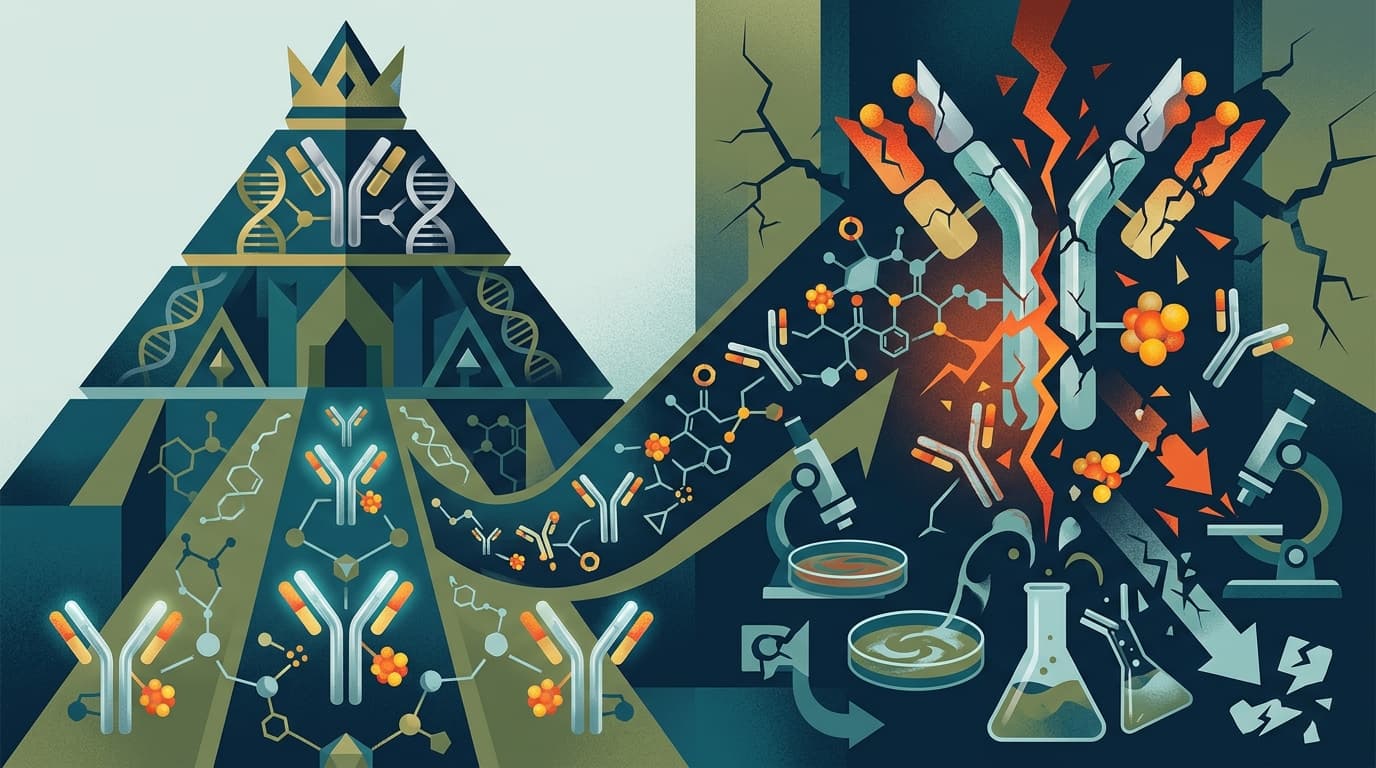
Think of ADCs like guided missiles for cancer. A regular antibody finds the tumor. But an ADC finds the tumor and delivers a toxic payload directly to the cancer cell, sparing healthy tissue. Seagen built its entire business around this elegant concept, and Pfizer bet the farm that it could turn Seagen's technology into a $10 billion-a-year oncology empire by 2030.
This week, that bet got a lot harder to win.
Pfizer's sigvotatug vedotin, an ADC inherited from the Seagen deal, failed its pivotal Phase 3 trial in advanced non-squamous non-small cell lung cancer (NSCLC). The drug didn't improve overall survival compared to docetaxel, a decades-old chemotherapy that serves as the default second-line option. In plain English: the shiny new missile didn't outperform the old artillery.
The trial, called SigVie-002, enrolled 703 patients who had already been treated with at least one prior round of therapy. Pfizer designed the study with overall survival as the main goal, the gold standard in oncology. The drug missed it.
Pfizer hasn't released specific numbers yet (no hazard ratios, no median survival figures, no p-values). What we got was the corporate equivalent of a shrug: the drug "did not show a statistically significant improvement in overall survival" in the overall population.
Pfizer is trying to find roses among the thorns. In patients who had received only one prior line of therapy (roughly two-thirds of the study), the company says it saw "a stronger trend" in favor of sigvotatug vedotin for both survival and progression-free survival.
But here's the catch: "stronger trend" is not the same as "statistically significant benefit." It's the clinical trial equivalent of saying "we almost won." Without published p-values or formal statistical testing in that subgroup, it's more of a hypothesis than a result.

Eli Lilly's retatrutide just posted the best weight-loss numbers any drug has ever achieved, rivaling bariatric surgery. But its failure to show a clear cardiovascular benefit could limit insurance coverage and hand competitors a surprising edge.


Join thousands of biotech professionals who start their day with our free, daily briefing.
There's another wrinkle that complicates the path forward. Pfizer found no clear relationship between tumor expression of the drug's target (a protein called integrin β6) and how well patients responded. That matters because if you can't identify who benefits most, it's very hard to design a follow-up trial that succeeds, or to convince regulators to approve the drug for a narrower group of patients.
The stock reaction tells an interesting story. This is clearly bad news, but analysts are split on how bad.
HSBC downgraded Pfizer from Buy to Hold, slashing its price target from $32 to $28. Their analysts cut the drug's probability of reaching market to just 40% and raised Pfizer's risk profile. Their take: the first pivotal readout from the Seagen acquisition just flopped, and there's no obvious near-term catalyst to replace it.
RBC Capital Markets called it a "notable setback" and flagged that Pfizer has already booked about $4.5 billion in write-offs from various development disappointments. Another impairment charge could be coming.
But BMO Capital Markets kept its Outperform rating and $34 target, arguing the failure was largely priced in. Their view: one trial miss doesn't invalidate an entire ADC platform.
That disagreement captures the real tension. Is this a flesh wound or a broken bone?
To understand why this matters (and why it doesn't sink the whole thesis), you need to zoom out.
Seagen came with four marketed products. The acquisition doubled Pfizer's oncology pipeline to about 60 programs. The crown jewel isn't sigvotatug vedotin; it's PADCEV (enfortumab vedotin), an ADC for bladder cancer that has blockbuster Phase 3 data supporting expansion into earlier-stage disease.
Pfizer's plan was always to build a biologics-heavy oncology portfolio. Before the Seagen deal, biologics contributed just 6% of oncology revenues. By 2030, the company expects that number to hit 65%. That transformation rests on multiple ADCs and bispecific antibodies, not just one lung cancer drug.
The remaining Seagen lineup includes ADCETRIS (for Hodgkin lymphoma and other CD30-expressing lymphomas), TIVDAK (for cervical cancer), and TUKYSA (a small-molecule tyrosine kinase inhibitor for HER2-positive breast cancer), along with next-generation ADC candidates targeting novel proteins. Another Phase 3 trial is already running: sigvotatug vedotin combined with Merck's Keytruda as a first-line treatment for PD-L1-positive NSCLC. That could offer a second chance for the drug, if the combination proves more potent than monotherapy.
The lung cancer ADC landscape in 2026 looks like a crowded bar on a Friday night. Daiichi Sankyo and AstraZeneca already have an approved TROP2-targeting ADC (datopotamab deruxtecan) in NSCLC. Merck and Kelun are running over a dozen Phase 3 trials with their competing TROP2 ADC. AbbVie got its c-MET ADC approved in May 2025. And Hansoh/GSK reported a 47.1% response rate with their B7-H3 ADC combination at AACR 2026.
Every month Pfizer loses ground in lung cancer, competitors fill the gap. That's the real cost of this trial failure: not just the lost revenue from one drug, but the lost time in a race where first-mover advantage matters enormously.
Pfizer's $43 billion Seagen bet isn't dead. PADCEV is performing well, the ADC platform is intact, and the pipeline still has dozens of shots on goal. But the margin for error just got thinner.
The company told investors it could generate over $10 billion a year from Seagen assets by 2030. With sigvotatug vedotin stumbling, the remaining programs need to deliver. PADCEV's bladder cancer expansion needs to clear regulatory hurdles. The combination trials need to produce real results, not just "trends."
Pfizer bought Seagen because it needed a new growth story after COVID. This week reminded everyone that growth stories don't write themselves.
The FDA just approved a CRISPR gene therapy for kids as young as two, a world first. Casgevy's expansion into toddlers could prevent the silent organ damage that sickle cell disease inflicts from infancy, but delivering a treatment this complex to tiny patients is a whole different challenge.