Pfizer's Half-Billion-Dollar Bet on Killing Proteins Before They're Born
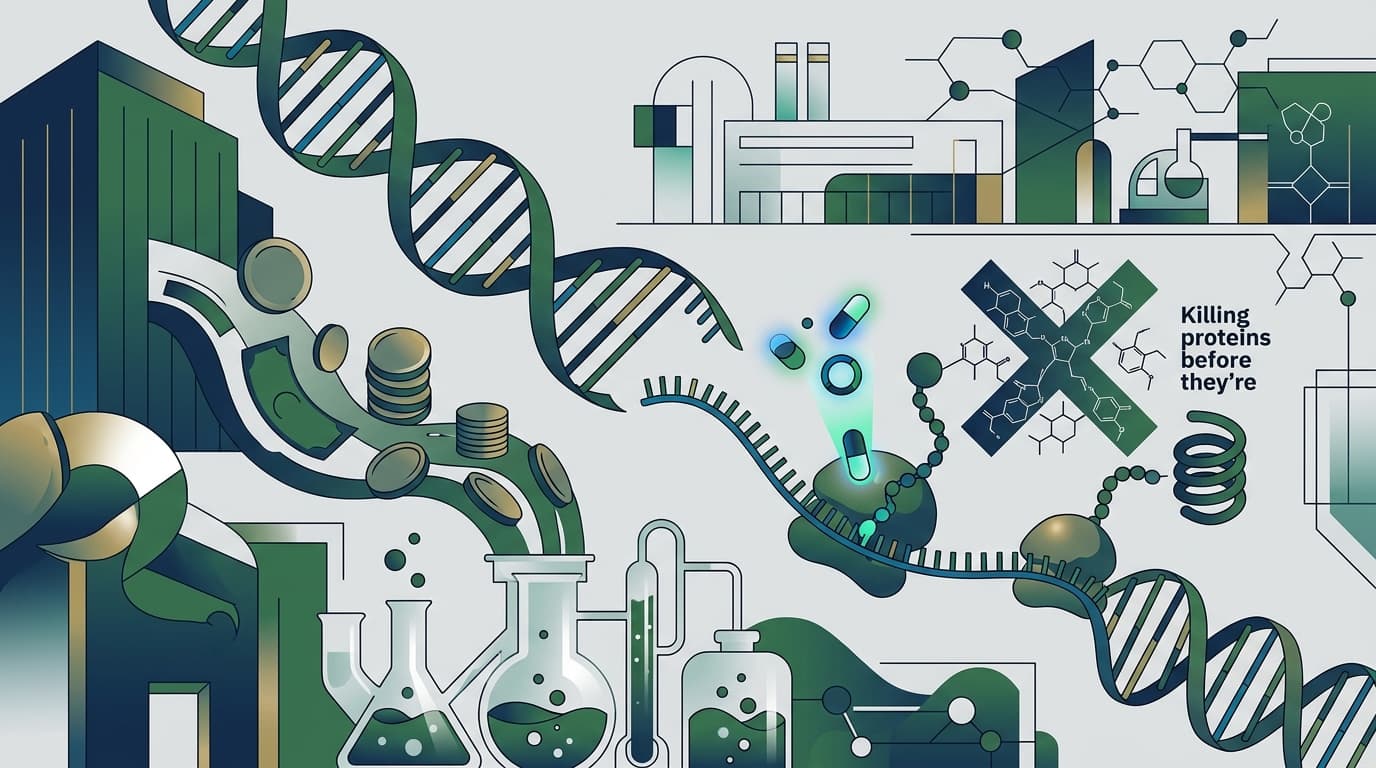
Pfizer just dropped $500 million on a French biotech that kills disease-causing proteins before they're even made. It's the latest move in the pharma giant's quiet quest to dominate the booming protein degradation space.
The Bouncer at the Cellular Door
Most drug companies try to clean up the mess after bad proteins have already wrecked the place. Pfizer just paid to hire a bouncer that stops them at the door.
The pharma giant signed a deal worth more than $500 million with French biotech Enodia Therapeutics, gaining access to a protein degradation approach that works differently from almost everything else in the field. Instead of chasing rogue proteins around the body and tagging them for destruction, Enodia's tech blocks them from ever being made in the first place.
Think of it like this: most protein degradation strategies are the cleanup crew mopping up after a party. Enodia is the guest list that keeps the troublemakers from walking through the front door.
What Enodia Actually Does
Enodia's platform targets something called Sec61, a protein complex that acts as a gateway in your cells. When a cell manufactures a new protein, Sec61 is the channel that ushers it into the secretory pathway, the cellular conveyor belt that sends proteins to the cell surface or out into the body.
By selectively blocking Sec61, Enodia can stop disease-causing proteins from ever completing their journey. The key word there is "selectively." A blunt shutdown of all protein trafficking would be catastrophic for healthy cells. Enodia's tech, built on machine learning, proteomics, and structural biology, aims to target only the harmful proteins while leaving normal cellular functions intact.
The company was born in 2025 out of research at the Institut Pasteur, built by the biotech incubator Argobio Studio. Scientist Caroline Demangel co-founded the company based on her work studying Sec61 and a natural inhibitor called mycolactone. Enodia also acquired Sec61 program assets from Kezar Therapeutics, giving it a running start on chemistry.
Its initial focus spans inflammatory diseases, immunology, and oncology, with potential applications in virology.
Get tomorrow's biotech intelligence before your competitors.
Join thousands of biotech professionals who start their day with our free, daily briefing.
Follow the Money
Under the deal's structure, Enodia handles the early-stage work: discovery, screening, optimization, and initial development. Pfizer picks up the baton for clinical trials, manufacturing, regulatory filings, and commercialization. The $500 million-plus headline figure includes an undisclosed upfront payment, research and development milestones, sales milestones, and tiered royalties on net sales.
Important caveat: that $500 million is the maximum potential value, not a guaranteed check. Most of it is locked behind milestones that could take years to hit, if the science pans out at all. For Pfizer, this is a calculated bet with limited downside; for Enodia, it's a validation event that reduces financing risk and stamps credibility on a young platform.
And this wasn't a cold call. Pfizer Ventures co-led Enodia's €20.7 million seed round alongside Elaia and Bpifrance's InnoBio fund. The pharma giant had already been watching this technology from the inside. This deal is the natural escalation: Pfizer liked what it saw and decided to go deeper.
Pfizer's Protein Destruction Portfolio Is Getting Crowded
The Enodia deal doesn't exist in a vacuum. Pfizer has been quietly assembling a diversified portfolio in targeted protein degradation (TPD), the broad field of therapies designed to eliminate harmful proteins rather than simply blocking them.
Consider the lineup. With Arvinas, Pfizer co-developed vepdegestrant, a PROTAC-based therapy (proteins that lure bad actors to the cell's recycling machinery) for breast cancer. That drug became the first FDA-approved protein degradation therapy in May 2026, a genuine landmark. With Triana Biomedicines, Pfizer signed a deal potentially worth up to $1.5 billion (with a $49 million upfront) in October 2024 to discover molecular glue degraders, another flavor of protein destruction.
Now add Enodia's Sec61 inhibitors to the mix. Pfizer is placing chips on three distinct modalities: PROTACs, molecular glues, and protein biogenesis inhibitors. It's the biotech equivalent of not putting all your eggs in one basket, except each basket costs hundreds of millions of dollars.
The Bigger Picture: Big Pharma Can't Get Enough of Protein Degradation
Pfizer isn't alone in its enthusiasm. The last two years have seen a flood of big pharma capital pouring into the TPD space, and the deals keep getting richer.
AbbVie partnered with Neomorph on molecular glues. Gilead teamed up with Kymera around a CDK2-targeting degrader. Eli Lilly struck a deal with Magnet Biomedicine, and Novartis expanded its collaboration with Monte Rosa. Roche, BMS, and others have placed their own bets across the landscape. The common thread: pharma companies are paying premium prices for platform access, not just individual drugs. They want the discovery engine, not a single molecule.
Why the frenzy? Because protein degradation can potentially tackle targets that traditional small molecules can't touch. Many disease-driving proteins lack the convenient "pockets" where conventional drugs bind. Degradation sidesteps that problem entirely by removing the protein from the equation.
The field's maturity is accelerating, too. Beyond vepdegestrant's approval, multiple degraders are now in Phase 3 trials, including programs in prostate cancer, CLL, and pancreatic cancer. What started as a scientific curiosity a decade ago has become a legitimate portfolio strategy for the world's biggest drug companies.
So What Does This Mean?
For Enodia, this deal is transformational. A two-year-old company spun out of the Institut Pasteur now has one of the world's largest pharma companies funding its pipeline and handling the expensive, risky work of late-stage development. That's about as good as it gets for a startup.
For Pfizer, the calculus is different. This is a low-risk, high-optionality bet. The upfront cost (undisclosed but likely modest relative to Pfizer's scale) buys access to a novel biology platform. If Sec61 inhibitors work, Pfizer could have a whole new class of medicines across inflammation, oncology, and beyond. If they don't, the financial damage is contained.
For the protein degradation field, the Enodia deal signals something important: the technology is expanding beyond its original modalities. PROTACs and molecular glues have dominated the conversation for years. Sec61-mediated inhibition represents a genuinely different approach, one that intervenes even earlier in the protein lifecycle. If it proves clinically viable, it could open therapeutic doors that even other degradation strategies can't reach.
The race to control unwanted proteins just added another lane. And Pfizer is making sure it has a car in every one of them.
4 min read
Novartis Just Bet $7.8 Billion That Your Body Can Build Its Own Medicine
Novartis just paid $575 million upfront for access to Abogen's RNA technology, in a deal worth up to $7.8 billion. The bet: that your own cells can be programmed to build medicines from scratch, starting with a clever new approach to autoimmune disease.