
For 40 years, the protein driving pancreatic cancer was called "undruggable." Revolution Medicines just reported phase 3 results that nearly doubled survival in previously treated patients, and the oncology world is paying attention.
For four decades, scientists had a name for the protein driving pancreatic cancer: KRAS. They also had a nickname for it: undruggable.
KRAS sits at the heart of over 90% of pancreatic tumors, acting like a light switch stuck permanently in the "on" position, telling cancer cells to grow and never stop. Researchers knew it was the villain. They just couldn't figure out how to grab it. The protein's surface was too smooth, too slippery, too tightly bound to its molecular fuel. Every attempt to block it failed. Entire drug programs were built and abandoned. The word "undruggable" became gospel.
Then Revolution Medicines decided the gospel was wrong.
The company's drug, daraxonrasib, just delivered phase 3 results that are shaking the oncology world. In the RASolute 302 trial, patients with previously treated metastatic pancreatic cancer who took daraxonrasib lived a median of 13.2 months. Patients on standard chemotherapy lived 6.7 months.
That's roughly double. In pancreatic cancer. In the second line, where patients have already failed one round of chemo.
To put that in perspective: the best second-line option currently available (a nanoliposomal irinotecan combination approved based on the NAPOLI-1 trial) extends median survival to about 6.1 months compared to 4.2 months on a simpler chemo regimen. Oncologists celebrated that as meaningful progress. Daraxonrasib didn't just clear that bar; it pole-vaulted over it.
The hazard ratio (a measure of how much the drug reduced the risk of death compared to chemo) came in at 0.40, meaning a 60% reduction in the risk of dying. The p-value was less than 0.0001, which in statistical terms is about as definitive as it gets. The trial met every primary and key secondary endpoint.
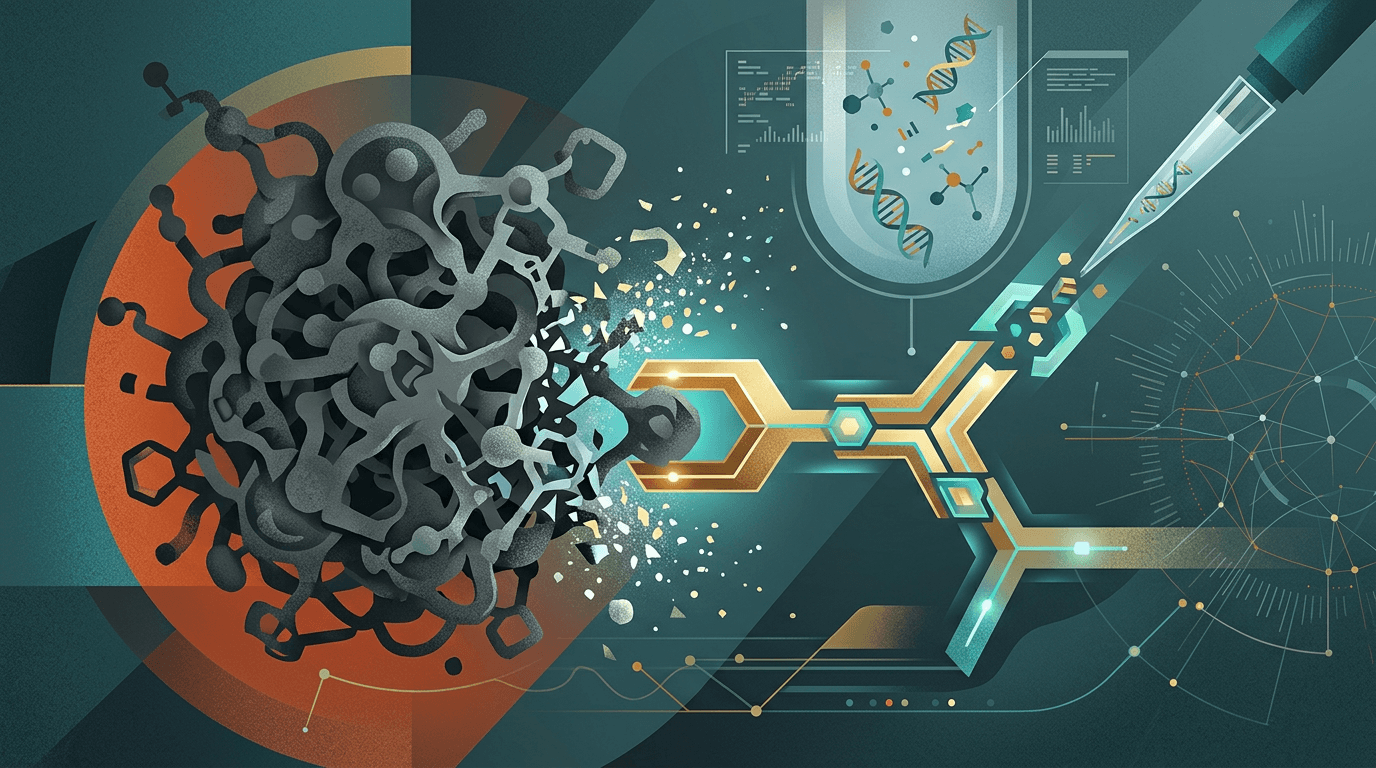
Imagine trying to put a padlock on a billiard ball. That's roughly what targeting KRAS felt like for researchers. The protein is tiny, almost featureless on the outside, and binds its natural fuel (a molecule called GTP) with incredible strength. There's nowhere obvious for a drug to latch on.

BMS's CELMoD drug mezigdomide just delivered a major Phase 3 win in multiple myeloma, providing the strongest clinical validation yet for the targeted protein degradation drug class. The implications stretch far beyond one company and one cancer.


Join thousands of biotech professionals who start their day with our free, daily briefing.
The first real crack in the wall came in the mid-2010s, when scientists discovered a hidden pocket on one specific KRAS variant called G12C. That led to sotorasib (approved in 2021) and adagrasib (approved in 2022), both designed to lock KRAS G12C in its "off" position. They worked in lung cancer. They were genuinely historic.
But for pancreatic cancer, they were mostly irrelevant. Only about 1-2% of pancreatic tumors carry the G12C mutation. The variants that dominate pancreatic cancer (G12D, G12V, G12R) stayed out of reach.
Daraxonrasib took a fundamentally different approach. Instead of targeting KRAS in its inactive "off" state, it goes after KRAS while it's switched on and actively signaling. Revolution Medicines calls this the RAS(ON) strategy. The drug works across multiple KRAS mutations, covering the variants that actually matter in pancreatic cancer. It's like designing a universal remote instead of one that only works with a single TV brand.
The full data will be presented at the 2026 ASCO Annual Meeting on May 31 in a Plenary Session, the most prestigious slot in oncology's biggest conference. Brian M. Wolpin, M.D., M.P.H., will present the findings.
Plenary sessions at ASCO are reserved for practice-changing results. The last time pancreatic cancer earned that kind of stage time for a survival breakthrough? It's hard to remember one.
On the regulatory front, daraxonrasib already holds FDA Breakthrough Therapy Designation and Orphan Drug Designation for previously treated metastatic pancreatic cancer with G12 mutations. It was also selected for the FDA Commissioner's National Priority Voucher pilot program. Revolution Medicines has signaled that global regulatory filings are coming, though no specific submission date has been announced yet.
When the topline results dropped in April 2026, Revolution Medicines' stock (RVMD) surged sharply, with trading volume hitting 2.7 times normal levels.
Analyst consensus has shifted accordingly. The Street is essentially pricing in a high probability of approval and treating daraxonrasib as Revolution's first commercial product rather than a clinical-stage bet.
The risks haven't disappeared, of course. Revolution Medicines has no revenue yet and has burned through significant cash. Execution on launch, reimbursement, and the safety profile will all face scrutiny. But for now, the market's verdict is clear: this data package changes the company's trajectory.
Pancreatic cancer remains one of medicine's cruelest diagnoses. Even with the best available first-line chemotherapy, median survival for metastatic disease barely reaches a year. The five-year survival rate hovers around 3%. Most patients who make it to second-line treatment are choosing between regimens that offer weeks of additional life, not months.
Daraxonrasib doesn't cure pancreatic cancer. But 13.2 months of median survival in the second line, where patients used to get about six months on the best available option, is a seismic shift. It's also a daily oral pill, which means no infusion chairs, no chemo pumps, no weekly hospital visits.
Experts are already thinking bigger. Eileen O'Reilly has noted that these results "set the stage for building on targeted therapy as a major backbone for the treatment of pancreas cancer." Combination trials (daraxonrasib plus chemotherapy, plus immunotherapy, plus mRNA vaccines) are being designed. The logical next step is moving this drug into first-line treatment and even earlier stages of the disease.
For 40 years, KRAS mocked the entire pharmaceutical industry. It sat at the center of one of the deadliest cancers on the planet, visible but untouchable. Now, for the first time, a drug targeting that protein has nearly doubled survival in a rigorous phase 3 trial.
The "undruggable" era is officially over.
Curium Pharma just slid a $7 billion offer across the table to Lantheus Holdings, the company behind prostate cancer imaging blockbuster Pylarify. If the deal goes through, it would create a global radiopharmaceutical powerhouse and mark one of the biggest PE-backed moves into oncology infrastructure ever.