Big Pharma Is Betting More Than $350 Billion That America Can Make Its Own Drugs Again
Biopharma companies have pledged a jaw-dropping $292 billion to build drug factories in the U.S. since January. But between 100% tariffs, five-year construction timelines, and a severe talent shortage, the gap between promise and production is wider than anyone wants to admit.
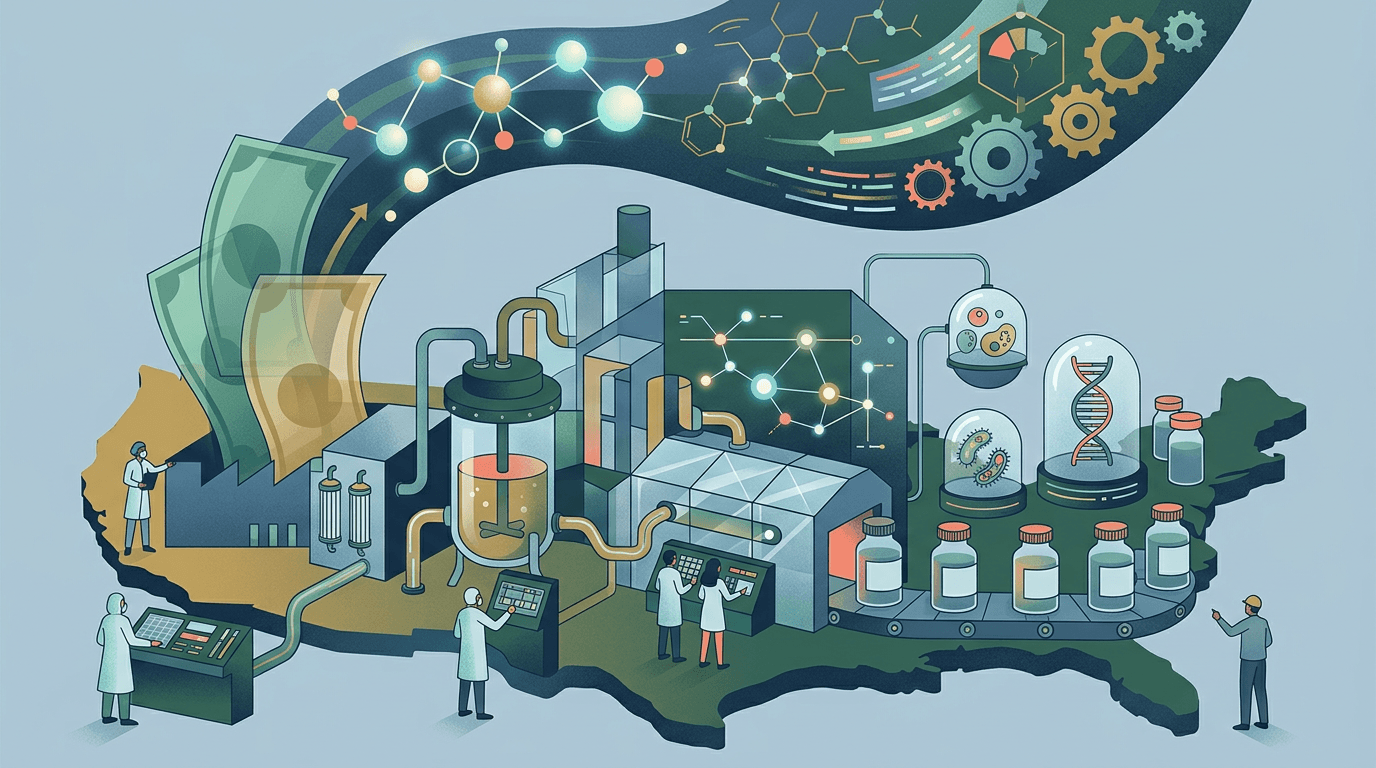
In the six months since January 2026, biopharma companies have pledged more than $350 billion to build drug factories on American soil. That's not a typo. It's a staggering sum, promised in half a year, all pointed at a single goal: making medicines in the United States instead of shipping them from overseas.
The question nobody can answer yet: will any of it actually work?
The Tariff Gun to Big Pharma's Head
To understand why dozens of companies are suddenly racing to pour concrete in North Carolina and Texas, you need to understand what's waiting for them if they don't.
In April 2026, the Trump administration signed a sweeping executive order slapping 100% tariffs on imported patented drugs and their active pharmaceutical ingredients (APIs, the chemical building blocks that make medicines work). The legal basis is Section 232, the same national security authority previously used on steel and aluminum. The message is blunt: make it here, or pay double.
The tariff structure works like a menu of increasingly painful options. Companies that submit an approved plan to build U.S. factories get a 20% tariff instead of 100%. Those that also agree to charge Americans no more than the lowest price they offer in any other developed country (called an MFN pricing deal) pay 0%. But there's a catch: the 20% rate automatically jumps to 100% by April 2030 if companies don't follow through on their construction promises.
It's the policy equivalent of "nice supply chain you've got there; shame if something happened to it."
A $350 Billion Down Payment
The resulting investment wave has been staggering. According to tracking data from DPR Construction, CBRE, and Endpoints News, the pledges cluster around a handful of pharma giants:
Johnson & Johnson leads the pack with more than $55 billion committed over four years, including four new U.S. plants and a $2 billion biologics facility in Wilson, North Carolina. is close behind with a program to build four factories.
Get tomorrow's biotech intelligence before your competitors.
Join thousands of biotech professionals who start their day with our free, daily briefing.
Eli Lilly
$27 billion
Roche has pledged roughly $50 billion in U.S. investment over five years. Novartis has pledged $23 billion in U.S. investment over five years. Merck has earmarked a large share of a $70 billion U.S. spending plan for manufacturing, including a $3 billion center of excellence in Virginia. Even smaller players like Hikma have committed $1 billion to new U.S. facilities by 2030.
Wider industry tallies put the full five-year wave closer to $370 billion, with the $350 billion figure representing the most concrete, site-specific commitments announced so far.
Why Skeptics Aren't Popping Champagne
Before you start imagining gleaming new factories humming by Christmas, consider this: building a pharmaceutical plant is nothing like opening a warehouse. From breaking ground to producing validated, FDA-approved medicine, the typical timeline runs three to five years. That's not bureaucratic slowness; it's the reality of cleanrooms, specialized equipment, and regulatory inspections that literally determine whether pills are safe to swallow.
Plants announced in 2025 are, at best, in early construction by now. Most won't produce a single dose before 2028 or 2029.
Then there's the labor problem. JLL's life sciences practice has flagged that the biggest constraint is people, not buildings. Bioprocess engineers, quality assurance specialists, and validation experts are in short supply. Novo Nordisk is hiring up to 1,000 people at its Clayton, North Carolina site alone. Lilly expects more than 3,000 new hires across its four plants. Multiply that across the industry and you're looking at a workforce bottleneck that no amount of capital can instantly solve.
Repligen's CEO captured the mood among equipment suppliers by suggesting that $50 to $100 billion in realized spending would be a strong outcome, implicitly acknowledging that the full pledge total is more aspiration than guarantee.
The Repackaging Problem
Here's something that doesn't get enough attention: not all of these billions are new. Independent analysts have pointed out that the headline figure stretches over a decade and partially includes projects that were already planned before tariffs entered the conversation. Some companies are re-branding existing expansion plans as "onshoring responses," inflating the apparent size of the reshoring wave.
It's a bit like cleaning your apartment before guests arrive and calling it a renovation.
America's Drug Factory Deficit
The backstory makes the current scramble more understandable. U.S. pharmaceutical manufacturing output peaked around December 2006 and then fell roughly 35% by April 2020, according to Federal Reserve data. Cheap labor in India and China, plus favorable tax regimes in places like Ireland, pulled production overseas for decades.
By the time COVID-19 hit, the dependence was painfully obvious. Shortages of essential medicines, sedatives, and antibiotics used in ICUs revealed supply chains stretched dangerously thin. Research from Washington University found that about 49% of U.S. generic manufacturing capacity was sitting idle in the early 2020s. The factories existed; the economics just didn't support running them.
Substantial bipartisan legislative activity in Congress after 2020 sought to encourage domestic drug production. Most efforts went nowhere. The current tariff regime is, in many ways, the blunt instrument that lawmakers couldn't assemble through legislation.
What Actually Gets Built (and What Doesn't)
Perhaps the sharpest critique is about what these factories will make. Most of the announced plants focus on high-margin biologics, GLP-1 obesity drugs, cell therapies, and gene therapies. That's where the money is. But the products the U.S. most desperately needs to manufacture domestically are low-margin generics, staple antibiotics, and commodity APIs, the exact categories where cost gaps with India and China are widest.
Policy analysts at CSIS and Think Global Health have warned that if the reshoring wave skews entirely toward premium medicines, it won't fix the chronic shortages and supply vulnerabilities that actually put patients at risk.
States, meanwhile, are competing aggressively for whatever does get built. Pennsylvania secured Lilly's $3.5 billion Lehigh County facility with a $100 million incentive package, the largest life sciences investment in the state's history. North Carolina, Virginia, Texas, Maryland, and Massachusetts are all vying for their share of construction spending and the thousands of jobs that come with it.
The Bottom Line
The more than $350 billion in pledges is real in the sense that companies have made public, named commitments. But treating it as a done deal misreads how pharma manufacturing works. The realistic scenario for 2026 is a handful of flagship sites under construction, thousands of workers being hired and trained, and a lot of concrete being poured. The structural reshoring of American drug production, if it happens at all, is a late-2020s story.
The tariff pressure is genuine. The money is flowing. Whether it arrives fast enough to matter is the multibillion-dollar question.
Deals & M&A5 min read
The $7 Billion Bet That Could Reshape Nuclear Medicine
Curium Pharma just slid a $7 billion offer across the table to Lantheus Holdings, the company behind prostate cancer imaging blockbuster Pylarify. If the deal goes through, it would create a global radiopharmaceutical powerhouse and mark one of the biggest PE-backed moves into oncology infrastructure ever.