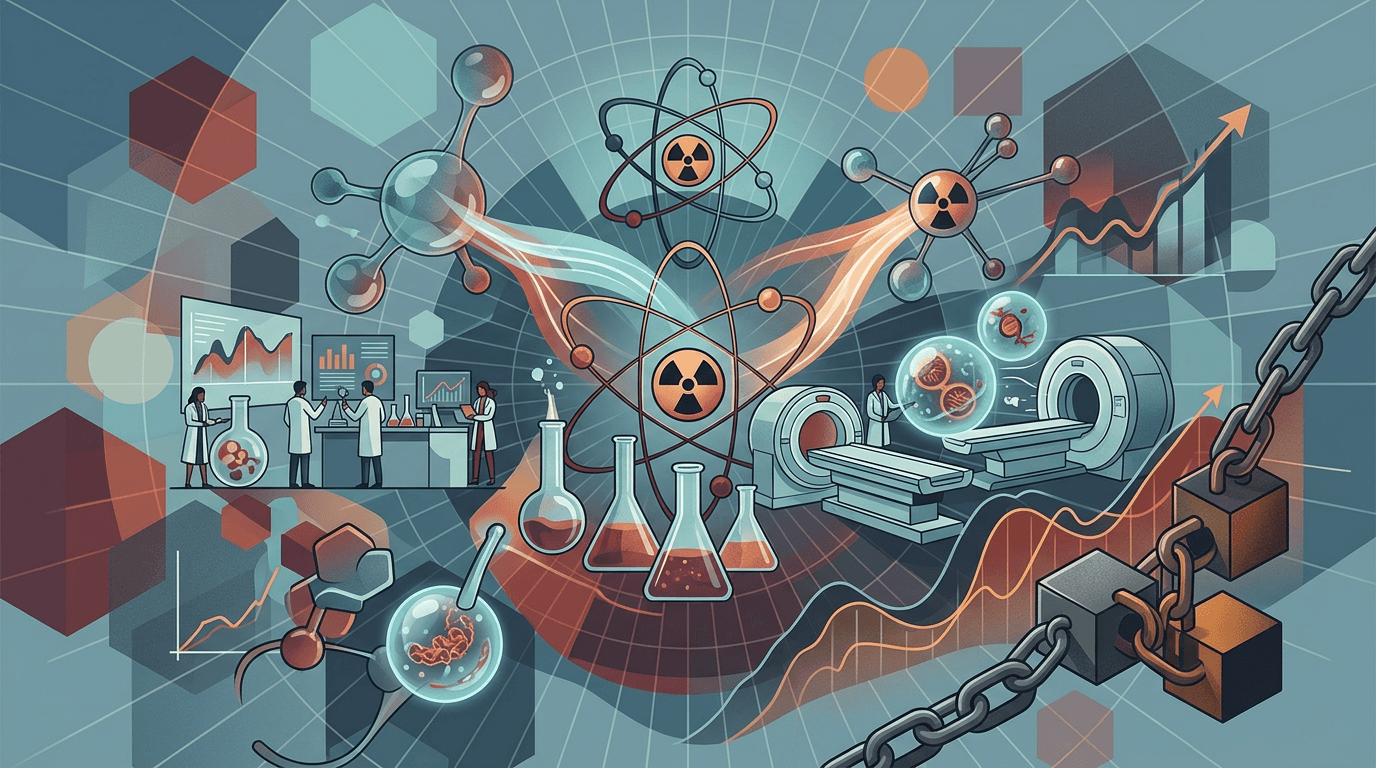

Curium Pharma just slid a $7 billion offer across the table to Lantheus Holdings, the company behind prostate cancer imaging blockbuster Pylarify. If the deal goes through, it would create a global radiopharmaceutical powerhouse and mark one of the biggest PE-backed moves into oncology infrastructure ever.
Imagine you own the best pizza shop in town. Business is solid, the regulars love you, and then one day the biggest restaurant chain in the state slides a napkin across the counter with a number on it. That's roughly what just happened to Lantheus Holdings.
Curium Pharma, a nuclear medicine company backed by private equity firm CapVest Partners, has made a takeover offer valuing Lantheus at roughly $7 billion. Lantheus is now actively exploring a sale, according to Bloomberg reporting from May 22. The stock popped about 9% in a single session on the news.
But nobody has signed anything yet. Talks are ongoing, a deal could come together within weeks, and there's no guarantee it happens at all. Both companies have declined to comment publicly.
So why does this matter beyond two companies negotiating in a conference room somewhere?
Lantheus isn't just any biotech. Its flagship product, Pylarify, is a major PSMA PET imaging agent for prostate cancer. Think of it as a molecular flashlight: inject it into a patient, put them in a PET scanner, and the drug lights up prostate cancer cells with remarkable precision, even at very low levels of disease.
Pylarify was Lantheus's rocket fuel. The stock went from about $13 in 2020 to an all-time high of $123.62 in July 2024, a nearly tenfold run driven largely by this single product. Lantheus pulled in roughly $1.54 billion in total revenue for 2025, with Pylarify contributing the lion's share.
But the rocket has been losing altitude. Pylarify revenue declined 6.5% in 2025 and management expects another 8 to 10% drop in 2026. Volumes are actually growing modestly; the problem is price. A competing F-18 PSMA tracer has been slashing prices aggressively, and Lantheus chose to walk away from some accounts rather than match what it called "unsustainable" discounts.
The stock reflected this pain. After peaking near $124, shares fell sharply. The recent bounce back has been fueled partly by improving fundamentals (Pylarify beat expectations in Q1 2026) and partly by, well, the takeover chatter.

BMS's CELMoD drug mezigdomide just delivered a major Phase 3 win in multiple myeloma, providing the strongest clinical validation yet for the targeted protein degradation drug class. The implications stretch far beyond one company and one cancer.


Join thousands of biotech professionals who start their day with our free, daily briefing.

Curium isn't some random suitor. It's the largest independent platform in nuclear medicine, serving about 14 million patients per year across more than 70 countries. The company offers more than 50 radiopharmaceutical products and runs an enormous manufacturing network that includes a molybdenum-99 facility in the Netherlands, three major SPECT facilities, and approximately 10 high-energy cyclotrons along with over 40 radiopharmacies.
CapVest created Curium in 2017 by merging IBA Molecular (which it had acquired in 2016) with Mallinckrodt's nuclear medicine business. Since then, it's been on an acquisition spree, adding companies like IASON GmbH and Cyclopharma's French operations. In November 2025, CapVest recapitalized Curium through a $7 billion continuation vehicle, the largest deal ever in nuclear medicine at the time, bringing in investors like ICG, TPG, Goldman Sachs Alternatives, and others.
Now Curium wants to bolt on Lantheus. The strategic logic is straightforward: Curium is strong in Europe, Lantheus dominates the U.S. Combine them and you get a global radiopharmaceutical behemoth with both diagnostic and therapeutic capabilities. Curium is also building a pipeline of radioligand therapies (RLTs) targeting prostate and neuroendocrine cancers, which would pair neatly with Pylarify's diagnostic imaging platform.
This deal doesn't exist in a vacuum. Over the past two years, big pharma has been throwing billions at radiopharmaceuticals like a kid in an arcade with a roll of quarters.
Bristol Myers Squibb grabbed RayzeBio for $4.1 billion in early 2024. AstraZeneca scooped up Fusion Pharmaceuticals for roughly $2 billion. Novartis acquired Mariana Oncology for up to $1.75 billion while its existing radioligand therapies, Lutathera and Pluvicto, are on track to exceed $2 billion in combined sales. Eli Lilly bought POINT Biopharma for about $1.4 billion and layered on collaborations with Radionetics (up to $1.14 billion) and Aktis Oncology ($60 million upfront).
The thesis is simple: radioligand therapies are one of the most exciting new modalities in oncology. You attach a radioactive isotope to a molecule that targets cancer cells, and you deliver radiation directly to the tumor while sparing healthy tissue. It's like a guided missile versus carpet bombing. And you need diagnostic imaging agents (like Pylarify) to find the targets first.
What makes the Lantheus/Curium situation unusual is that this isn't big pharma doing the buying. It's a PE-backed platform competing for the same assets that Novartis, BMS, and Lilly are chasing. That signals something important: private equity sees radiopharmaceuticals not as a niche but as core oncology infrastructure worth owning at scale.
Analysts are cautiously optimistic. Of seven covering the stock, six rate it Buy or Outperform. Mizuho and Truist both raised their price targets to $115 in late May 2026 following deal rumors. The consensus target sits around $105.
The wrinkle: LNTH was already trading in the mid-$90s when the news broke, which means the stock has largely priced in a reasonable probability of a deal. If talks collapse, analysts suggest shares could pull back toward standalone-value targets in the $80s. If a bidding war erupts (perhaps a big pharma player jumping in), there could be meaningful upside.
Interim CEO Mary Heino has called 2026 "a year of commercial execution and regulatory milestones." William Blair noted that management acknowledges a guidance revision is likely overdue but will probably wait until a permanent CEO is in place. That leadership vacuum adds another layer of uncertainty to the situation.
Lantheus at $7 billion would be one of the largest radiopharmaceutical deals ever. It would create a company with global reach, a diversified diagnostic portfolio, and an expanding therapeutic pipeline, all under PE ownership rather than a pharma conglomerate's umbrella.
But plenty can go wrong. Antitrust regulators in both the U.S. and EU will scrutinize a combination of two major nuclear medicine players. Pylarify's pricing headwinds aren't going away; competition from alternative PSMA tracers and theranostic bundling by larger pharma players will only intensify. And the FDA recently extended its review of Lantheus's diagnostic imaging kit LNTH-2501 by three months, a reminder that pipeline risk is always lurking.
For now, both sides are at the negotiating table. No binding agreement, no confirmed price per share, no regulatory filings. Just a number on a napkin and a lot of smart people trying to figure out if it's the right one.
The next few weeks should tell us whether this becomes the deal that reshapes nuclear medicine, or just another M&A headline that fizzled out.
Biopharma companies have pledged a jaw-dropping $292 billion to build drug factories in the U.S. since January. But between 100% tariffs, five-year construction timelines, and a severe talent shortage, the gap between promise and production is wider than anyone wants to admit.