Novartis Just Dropped $1.1 Billion on a Company With Zero Approved Drugs
Novartis is paying $1.1 billion upfront for Myricx Bio, a London biotech with zero approved drugs and a completely novel ADC payload nobody else is using. It's either a visionary platform play or the most expensive preclinical bet in pharma history.
The Most Expensive Science Project in London
Imagine buying a restaurant that hasn't opened yet, has no customers, and hasn't even finalized the menu. Now imagine paying $1.1 billion for it. That's essentially what Novartis just did.
On July 6, 2026, the Swiss pharma giant agreed to acquire Myricx Bio, a London-based biotech with no approved products, no late-stage clinical trials, and a team working out of labs connected to Imperial College London and the Francis Crick Institute. The total deal could reach $1.5 billion once milestones are included. And Novartis is betting every dollar of it on a single idea: a completely new way to kill cancer cells.
So what could possibly be worth that much money before a single patient has been dosed in a clinical trial?
A New Weapon for an Old Warhead
To understand Myricx, you need to understand antibody-drug conjugates, or ADCs. Think of them as guided missiles for cancer. An antibody (the GPS system) finds the tumor cell. A chemical linker (the missile body) holds everything together. And a toxic payload (the warhead) blows up the cancer from the inside.
ADCs are one of oncology's hottest drug classes right now. The global market sits around $14 to $16 billion in 2026, with projections reaching $30 to $70 billion by the early 2030s.
But most ADCs rely on the same handful of warheads: tubulin inhibitors and topoisomerase I inhibitors. Cancer cells, being the resourceful little villains they are, have started figuring out how to dodge these payloads. Resistance is growing. Toxicity remains a problem.
Myricx's pitch is simple: forget those old warheads. We built a new one.
The Enzyme Nobody Was Targeting
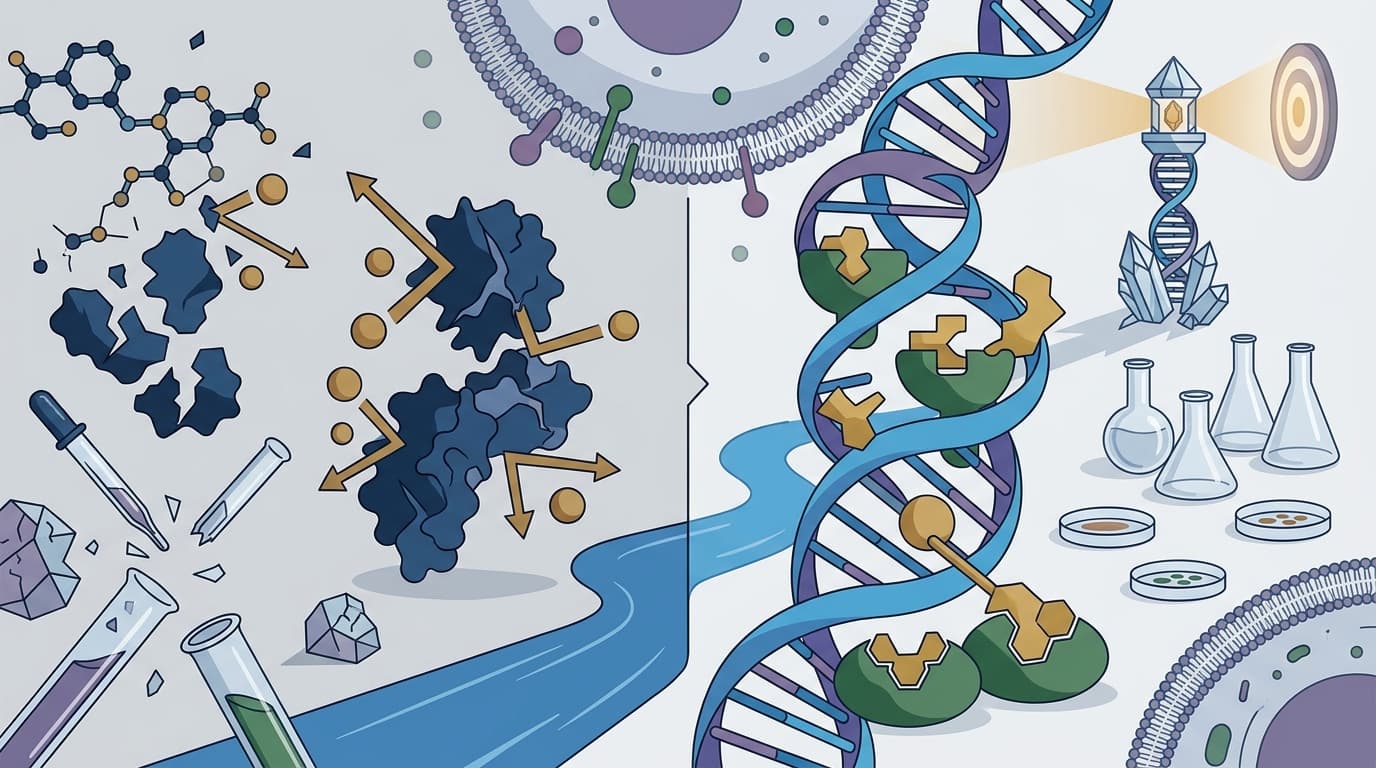
Myricx's secret weapon is an N-myristoyltransferase inhibitor, or NMTi. That's a mouthful, so here's the plain English version: there's an enzyme in your body called NMT that sticks a tiny fat molecule onto certain proteins. Cancer cells depend on this process to survive. Block the enzyme, and the cancer cell falls apart.
Get tomorrow's biotech intelligence before your competitors.
Join thousands of biotech professionals who start their day with our free, daily briefing.
The Myricx team, founded in 2019 by Prof. Ed Tate, Dr. Roberto Solari, and Dr. Andrew Bell, originally tried using NMT inhibitors as standalone drugs. But the toxicity was too broad; healthy cells need NMT too. So they pivoted. They attached the NMT inhibitor to an antibody, turning it into an ADC payload that gets delivered only to tumor cells.
It's like switching from carpet-bombing to a sniper rifle. Same destructive power, dramatically less collateral damage.
Their preclinical data reportedly shows complete and durable tumor regression across multiple solid tumor types, with what the company describes as a wide therapeutic window (the gap between "kills the cancer" and "hurts the patient"). Their two lead programs target B7-H3 and HER2, two well-known cancer antigens found across breast, lung, gastric, and other solid tumors.
Why Novartis Had to Move Now
For years, Novartis was the odd one out among major cancer drugmakers. While competitors were writing enormous checks for ADC technology, Novartis CEO Vas Narasimhan said publicly at J.P. Morgan in January 2024 that the company "has not been successful" with ADCs and would focus instead on radioligand therapies (RLTs), a different type of targeted cancer treatment.
That stance lasted about two years.
By mid-2025, Narasimhan had shifted his tone. He told investors that Novartis needed depth across all targeted oncology modalities: small molecules, bispecifics, RLTs, and ADCs. He called ADCs and bispecifics the two areas where the company lacked a compelling position and said he was "actively looking" to fix that through deals.
The Myricx acquisition is that fix. Novartis isn't just buying two drug candidates; it's buying an entire payload platform it can plug into multiple antibody targets over the next decade. Fiona Marshall, Novartis's President of Biomedical Research, described the NMTi platform as a "promising, differentiated mechanism that could broaden the use of ADCs across multiple tumour settings."
In other words, Novartis wants to do for NMTi-based ADCs what it already did for radioligand therapies: build a scalable platform, not just a one-off product.
The Price Tag Raised Eyebrows
Not everyone is comfortable with the check Novartis wrote. Stefan Schneider at Vontobel noted with some surprise that Novartis is paying this much for assets "at such an early stage of development." Novartis shares barely moved on the news (hovering around CHF 125.10), suggesting public investors are taking a wait-and-see approach.
And the skeptics have a point. Preclinical data, no matter how impressive, is not clinical data. Roughly 90% of drugs that enter clinical trials never make it to approval. Paying $1.1 billion upfront for a preclinical platform is like buying a house based entirely on the architect's rendering.
But context matters. When Merck wanted access to Daiichi Sankyo's ADC portfolio in 2023, it paid $4 billion upfront in a deal worth up to $22 billion. Bristol Myers Squibb handed SystImmune $800 million upfront for a bispecific antibody-drug conjugate in a deal worth up to $8.4 billion.
By those standards, $1.1 billion for a novel payload platform with multiple potential applications doesn't look quite as wild. Especially when early-stage ADC licensing deals typically command only $30 to $80 million upfront.
What Makes This Deal Different
The venture investors who backed Myricx are framing this as a validation moment. Sofinnova Partners, an early backer, called the deal "a powerful example of what European life sciences can produce." Myricx raised a £90 million ($114 million) Series A in mid-2024, led by Novo Holdings and Abingworth. Less than two years later, Novartis is paying roughly ten times that amount just in upfront cash.
For the broader ADC landscape, the Myricx deal signals something important: Big Pharma isn't just buying ADC drugs anymore. It's buying ADC platforms. The companies that can offer a novel payload class, applicable across multiple targets and tumor types, are commanding premiums that would have seemed absurd five years ago.
Swiss equity analysts at ZKB expect more deals like this from Novartis, noting that the Myricx acquisition fits a stated pattern of diversifying oncology through acquisitions.
The Bottom Line
Novartis spent years watching the ADC gold rush from the sidelines. Now it's all in, betting $1.1 billion that a group of London scientists found something the rest of the industry missed. If Myricx's NMTi payloads work in human trials, Novartis will have bought itself a next-generation cancer franchise at a relative bargain. If they don't, this becomes one of the most expensive preclinical flameouts in pharma history.
The deal is expected to close in the second half of 2026. Clinical data will take years to generate. Until then, Novartis is asking investors to trust the science, the platform, and the $1.1 billion bet that a brand-new warhead can change how we fight cancer.
No pressure.
Clinical & Regulatory5 min read
CRISPR Just Got Cleared for Toddlers. Yes, Toddlers.
The FDA just approved a CRISPR gene therapy for kids as young as two, a world first. Casgevy's expansion into toddlers could prevent the silent organ damage that sickle cell disease inflicts from infancy, but delivering a treatment this complex to tiny patients is a whole different challenge.