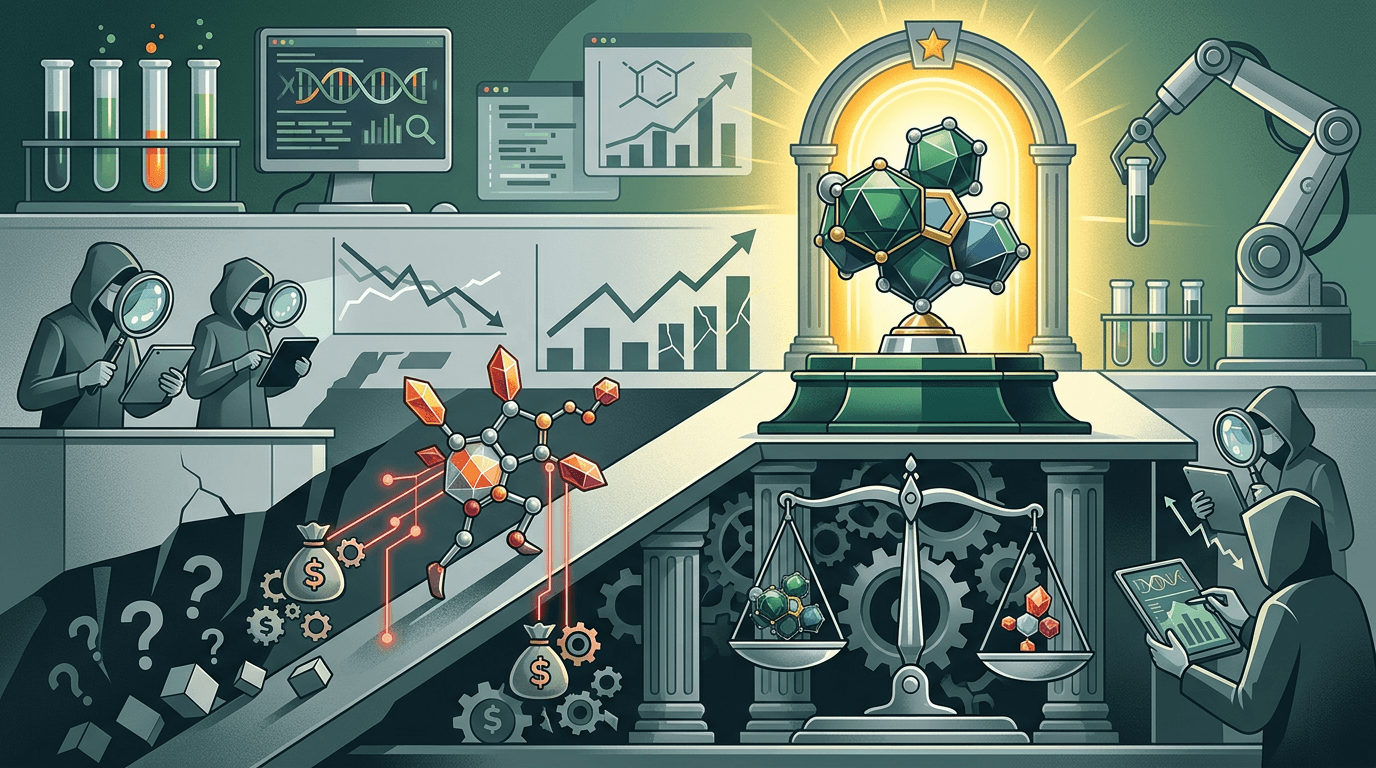

Novartis killed two late-stage trials for its next-gen blood thinner after it couldn't outperform Eliquis, the $14.4 billion anticoagulant behemoth. The $925 million bet on abelacimab just got a lot narrower, and the implications ripple across the entire Factor XIa race.
Imagine buying a house, renovating it, moving back in, and then discovering the foundation is cracked. That's roughly what just happened to Novartis.
The Swiss pharma giant paid $925 million in early 2025 to reacquire Anthos Therapeutics, a company co-founded by Blackstone Life Sciences and Novartis in 2019. The prize: abelacimab, a next-generation blood thinner that was supposed to be safer than anything on the market. On April 22, Novartis pulled the plug on two late-stage trials testing abelacimab in cancer patients. The reason? It couldn't beat Eliquis, the blockbuster anticoagulant from Bristol Myers Squibb and Pfizer.
The retreat raises an uncomfortable question: can anything dethrone the king of blood thinners?
Abelacimab belongs to a new class of anticoagulants called Factor XI/XIa inhibitors. Think of your blood's clotting system as a chain reaction, like dominoes falling in sequence. Traditional blood thinners (called Factor Xa inhibitors) knock out a domino near the end of the chain, which is effective but can cause serious bleeding. Factor XIa inhibitors target a domino further upstream, theoretically stopping dangerous clots without the same bleeding risk.
In early studies, the approach looked promising. Abelacimab showed 60 to 90% reduced bleeding compared to standard anticoagulants. That's a massive safety advantage, the kind of data that gets boardrooms excited enough to write nine-figure checks.
So Novartis launched two phase 3 trials (the final stage before seeking approval) in patients with cancer-associated thrombosis, a condition where tumors make blood dangerously prone to clotting. The ASTER trial enrolled approximately 1,600 patients and pitted abelacimab head-to-head against Eliquis. A second trial called MAGNOLIA compared it to Fragmin (dalteparin), an older injectable blood thinner, in patients with GI or genitourinary cancers.
Neither trial will ever produce a final result. A data review of ASTER showed the drug simply wasn't going to win. Novartis terminated both studies.

Eli Lilly just paid up to $300 million for a three-year-old startup that hasn't tested a single drug in humans. CrossBridge Bio's dual-payload ADC technology is so hot that Lilly couldn't wait for clinical data, and the deal reveals just how frenzied the ADC arms race has become.


Join thousands of biotech professionals who start their day with our free, daily briefing.
To understand why this matters, you need to appreciate just how dominant Eliquis has become. It's less a drug and more a force of nature.
In 2024, Eliquis generated approximately $13.3 billion in revenue for Bristol Myers Squibb alone (Pfizer books its own share separately). That figure accounted for roughly 27.5% of BMS's entire revenue, making it the company's single most important product. For context, it outsold Opdivo, BMS's blockbuster cancer immunotherapy, by more than $5 billion.
And it's still growing. BMS projects 10 to 15% revenue growth for Eliquis in 2026, which could push worldwide sales north of $16 billion. Trying to compete against a drug with that kind of clinical track record and market momentum is like challenging a Formula 1 car to a drag race in a Honda Civic. Your car might be perfectly fine; it's just not winning that particular race.
Before you write abelacimab's obituary, know this: Novartis isn't abandoning the drug entirely. The company is refocusing on its lead indication, atrial fibrillation (AFib), where a phase 3 trial called LILAC-TIMI 76 is still running. AFib is a heart rhythm disorder that affects millions of people worldwide, and patients typically need blood thinners for years (sometimes decades) to prevent strokes.
That's where the bleeding safety advantage could really shine. Current anticoagulants work well at preventing strokes, but their bleeding side effects are a persistent headache for doctors and patients alike. Studies suggest that 12 to 16% of patients on standard anticoagulants experience bleeding complications over two years. If abelacimab can match the stroke prevention of Eliquis while dramatically cutting bleeding risk, it would have a compelling case.
That's a long runway, but AFib is a far larger market than cancer-associated thrombosis. The strategic pivot makes financial sense, even if it stings.
Novartis isn't alone in chasing the Factor XIa dream. The competitive landscape looks like a crowded marathon where everyone keeps tripping.
Bayer's asundexian hit a speed bump in 2024 when it failed a non-inferiority test against Eliquis (again, that drug). But it did show roughly 70% reduced bleeding, enough to keep the program alive. Johnson & Johnson's milvexian is further along, currently in phase 3 trials for AFib under the name LIBREXIA-AF.
The pattern is telling. Factor XIa inhibitors consistently show they're safer in terms of bleeding. The challenge is proving they prevent clots just as well as the drugs already on the market. It's the classic innovator's dilemma: you need to be at least as good at the main job while being better at the side effects. That's a high bar when the incumbent is a $14 billion product with years of real-world data behind it.
Despite this setback, Novartis hasn't lost faith in heart medicine. Cardiovascular, renal, and metabolic diseases remain one of the company's four core therapeutic areas, alongside oncology, immunology, and neuroscience.
Entresto, its heart failure drug, pulled in $7.8 billion in 2024 sales with 31% growth. And Novartis recently signed a $1.8 billion collaboration with Unnatural Products to develop cardiovascular drugs targeting proteins that were previously considered undruggable. The Anthos reacquisition and abelacimab setback are a chapter, not the whole story.
Novartis spent nearly a billion dollars to bring abelacimab back in-house, and within a year, it had to scale back the program's ambitions. That's not a failure of science; it's a reminder of how brutally competitive the anticoagulant market has become. Eliquis isn't just a successful drug. It's a moat, a fortress, and a warning sign to anyone who thinks they can waltz in without something truly differentiated.
The AFib bet is still live, and if abelacimab can deliver on its bleeding safety promise in that indication, the story could look very different by 2028. But for now, Novartis learned an expensive lesson that plenty of pharma companies already knew: beating Eliquis requires more than a good idea. It requires a better result.
A gene therapy trial just restored hearing in 90% of deaf patients, some within weeks of a single injection. The results are 'mind-boggling,' and pharma companies are spending billions to win the race.