
Neomorph just raised $100M to advance a drug that works nothing like traditional medicine: instead of blocking cancer proteins, it glues them to the cell's trash compactor. With Deerfield, Regeneron Ventures, and three Big Pharma partnerships already in hand, the real test starts now.
Some proteins cause cancer but refuse to be stopped by traditional drugs. They have no convenient pocket for a pill to latch onto, no obvious weak spot. For decades, scientists called them "undruggable." Neomorph thinks that label is outdated.
The San Diego biotech just closed a $100 million Series B to prove it. The round, led by Deerfield Management, also pulled in Regeneron Ventures, Longwood Fund, Alexandria Venture Investments, and Binney Street Capital (the venture arm of Dana-Farber Cancer Institute). That's a roster of investors who don't throw money at science projects; they back companies heading toward the clinic.
And Neomorph is already there.
To understand why this matters, you need to know what a molecular glue degrader actually does. Think of it like this: if a traditional drug is a cork stuffed into a bottle to block what's inside, a molecular glue degrader is more like duct-taping the entire bottle to a trash compactor.
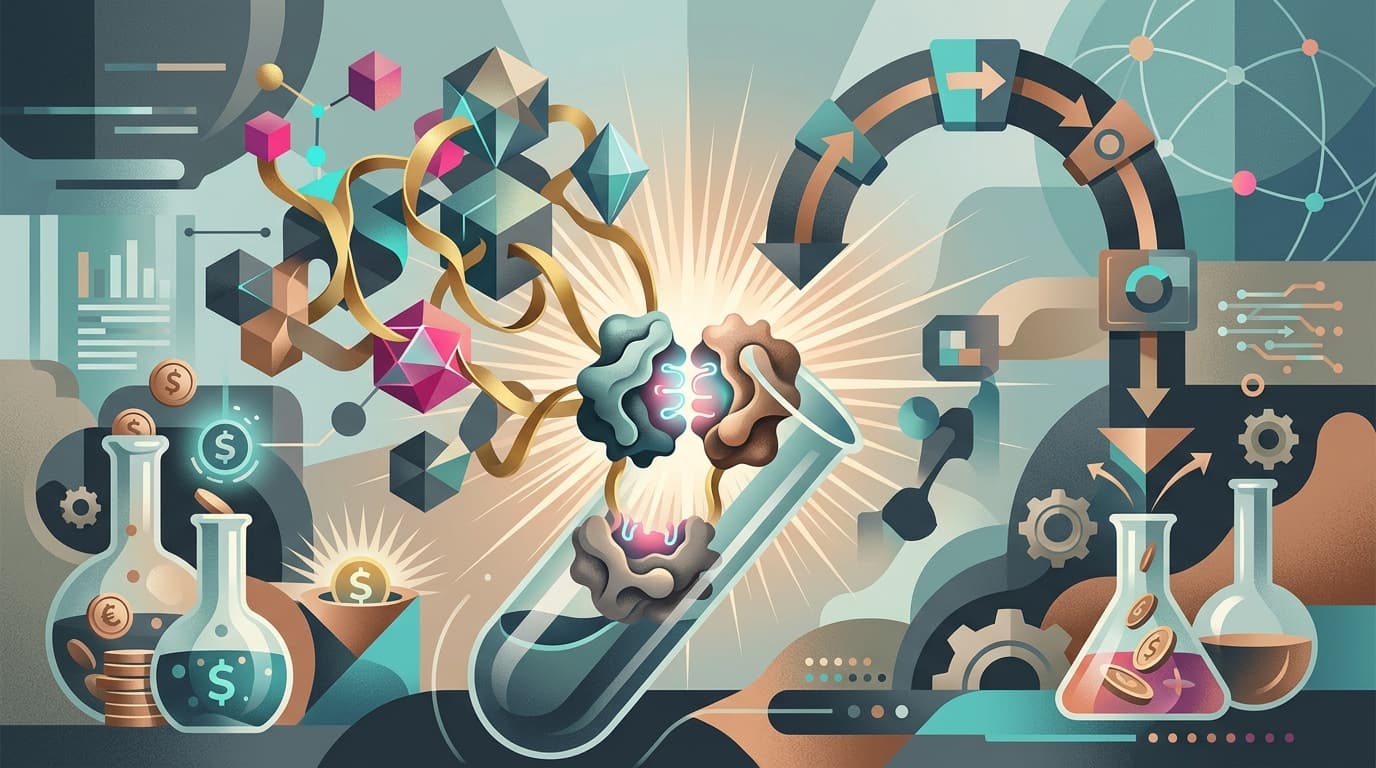
Instead of simply blocking a problem protein, molecular glues trick the cell's own cleanup machinery into destroying it. They create an artificial bond between the target protein and a cellular recycling system called the proteasome. The cell does the rest, chewing up the disease-causing protein like it's yesterday's leftovers.
The beauty of this approach? It works on proteins that traditional drugs can't touch. No binding pocket required. If you can glue the target to the trash compactor, it gets crushed regardless.
Neomorph's lead program, NEO-811, is an oral molecular glue degrader that hijacks a protein called cereblon to trigger the destruction of a key cancer-driving protein in clear cell renal cell carcinoma (ccRCC), the most common form of kidney cancer. The company hasn't disclosed which specific protein NEO-811 targets, but they say it fully shuts down a central signaling pathway in the disease.
This isn't a preclinical story anymore. NEO-811 entered a Phase 1/2 clinical trial (the first-in-human study) and dosed its first patient on February 3, 2026. The trial is actively recruiting patients with locally advanced or metastatic ccRCC who've run out of good options.

Eli Lilly just dropped up to $300 million on a two-year-old company with zero drugs in human testing. CrossBridge Bio's dual-payload ADC technology has Big Pharma salivating, and this deal says a lot about where the antibody-drug conjugate arms race is headed.


Join thousands of biotech professionals who start their day with our free, daily briefing.

The study starts with dose escalation to figure out how much drug patients can tolerate safely, then moves into expansion cohorts to look for early signs that tumors are actually shrinking. It's being chaired by Toni Choueiri, MD, at Dana-Farber and Harvard, one of the top kidney cancer specialists in the world.
Why kidney cancer? Because the current treatments aren't cutting it. Today's standard of care combines targeted therapies (tyrosine kinase inhibitors) with immune checkpoint inhibitors. These combos help some patients, but responses are often short-lived. Drug resistance remains a major reason treatments fail. For patients who've been through multiple lines of therapy, the cupboard is practically bare.
A completely new mechanism of action, one that destroys the problem protein rather than just blocking it, could change the equation.
Neomorph isn't some scrappy startup anymore. The company raised $109 million in its Series A back in 2020, also led by Deerfield, which provided seed financing for the company. With this new round, total funding sits north of $200 million.
But the investor list tells a bigger story than the dollar figure. Deerfield has been building a targeted protein degradation portfolio for years, including an $80 million collaboration with Dana-Farber to create an entire Center for Protein Degradation back in 2018. Regeneron Ventures joining signals that one of pharma's most scientifically rigorous companies sees real clinical potential here.
And then there are the partnerships. Neomorph has already inked deals with Novo Nordisk (worth up to $1.46 billion in milestones), AbbVie (up to $1.64 billion in milestones plus royalties), and Biogen. Three major pharma companies essentially renting access to Neomorph's platform to go after their own targets. That's serious external validation.
Co-Founder, President, and CEO Phil Chamberlain said the funding validates the platform and team, enabling execution on near-term priorities like generating clinical data from NEO-811.
Neomorph isn't alone in the molecular glue game. The broader targeted protein degradation market is growing rapidly.
Bristol Myers Squibb signed a deal with VantAI in February 2024 worth up to $674 million in milestones to discover molecular glues using AI. Eli Lilly, C4 Therapeutics, and Evotec are all jockeying for position. The field that once relied on serendipity (the original molecular glues were discovered by accident) now uses cryo-electron microscopy, molecular dynamics simulations, and AI-trained models to design these molecules from scratch.
What separates Neomorph? Its founding DNA, literally. The company was built by four Harvard/Dana-Farber scientists: Eric Fischer, Benjamin Ebert, Scott Armstrong, and Phil Chamberlain. Fischer, in particular, is one of the researchers who figured out how existing molecular glues (like the cancer drug lenalidomide) actually work at the molecular level. His lab essentially wrote the playbook that the entire field now follows.
Molecular glue degraders represent one of the most exciting ideas in drug development right now: the ability to destroy, rather than merely inhibit, disease-causing proteins. Neomorph has the scientific pedigree, the pharma partnerships, and now the cash to find out if this translates from elegant chemistry into real patient benefit.
The first clinical data from NEO-811 will be the moment of truth. Preclinical results showed the drug could reduce cancer cell growth, but mice aren't people. Early safety and pharmacology readouts from the Phase 1/2 trial are expected next, and they'll tell us whether Neomorph's molecular superglue actually sticks where it counts.
For a company betting everything on a mechanism that didn't exist as a deliberate drug design strategy ten years ago, $100 million says the future is worth the gamble.
AbbVie just licensed two early-stage, non-opioid pain drugs from a Chinese pharma company most people have never heard of, in a deal worth up to $745 million. It's a small upfront bet with massive implications for AbbVie's post-Humira future and the booming China-to-West licensing pipeline.