

A protein detection company you've probably never heard of just tripled its revenue and is asking Wall Street for a billion-dollar valuation. Alamar Biosciences is betting that proteins, not just DNA, hold the key to finding diseases early.
Imagine reading a novel by looking at only half the pages. That's basically what scientists have been doing with the human body for years: sequencing DNA (the instruction manual) while mostly ignoring proteins (the workers actually building the house). Alamar Biosciences thinks it can change that, and it just kicked off an IPO roadshow asking investors for up to $150 million to prove it.
The Fremont, California company plans to list on Nasdaq under the ticker ALMR on April 17, offering 9.375 million shares priced between $15 and $17 each. If it prices at the top of the range, Alamar would debut with a valuation near $1.1 billion. That's unicorn territory for a company most people outside the life sciences world have never heard of.
But the numbers behind the curtain are genuinely wild.
Alamar pulled in $74 million in revenue last year, up from just $25 million in 2024. That's 195% year-over-year growth. For context, that kind of trajectory is rare even among high-flying software companies; for a life sciences tools business selling instruments and consumables to researchers, it's almost unheard of.
The company isn't profitable yet (it posted a net loss of $29.8 million in 2025), but even that loss is shrinking fast. It was $47.1 million the year before. And its gross margin leapt from 34% to 56% in one year, which tells you the economics of each sale are improving dramatically as Alamar scales.
More than 100 instruments are now installed across customer labs. Each one generates over $400,000 in annual pull-through revenue from consumables, which accounted for roughly half of 2025 sales. That's the razor-and-blade model working exactly as designed: sell the instrument, then keep selling the refills.
Proteins are the molecules that actually do things in your body. They fight infections, carry oxygen, signal when something's wrong. If DNA is the blueprint for a building, proteins are the construction crew, the plumbing, the electrical wiring, and the security system all at once.

Eli Lilly just dropped up to $300 million on a two-year-old company with zero drugs in human testing. CrossBridge Bio's dual-payload ADC technology has Big Pharma salivating, and this deal says a lot about where the antibody-drug conjugate arms race is headed.


Join thousands of biotech professionals who start their day with our free, daily briefing.
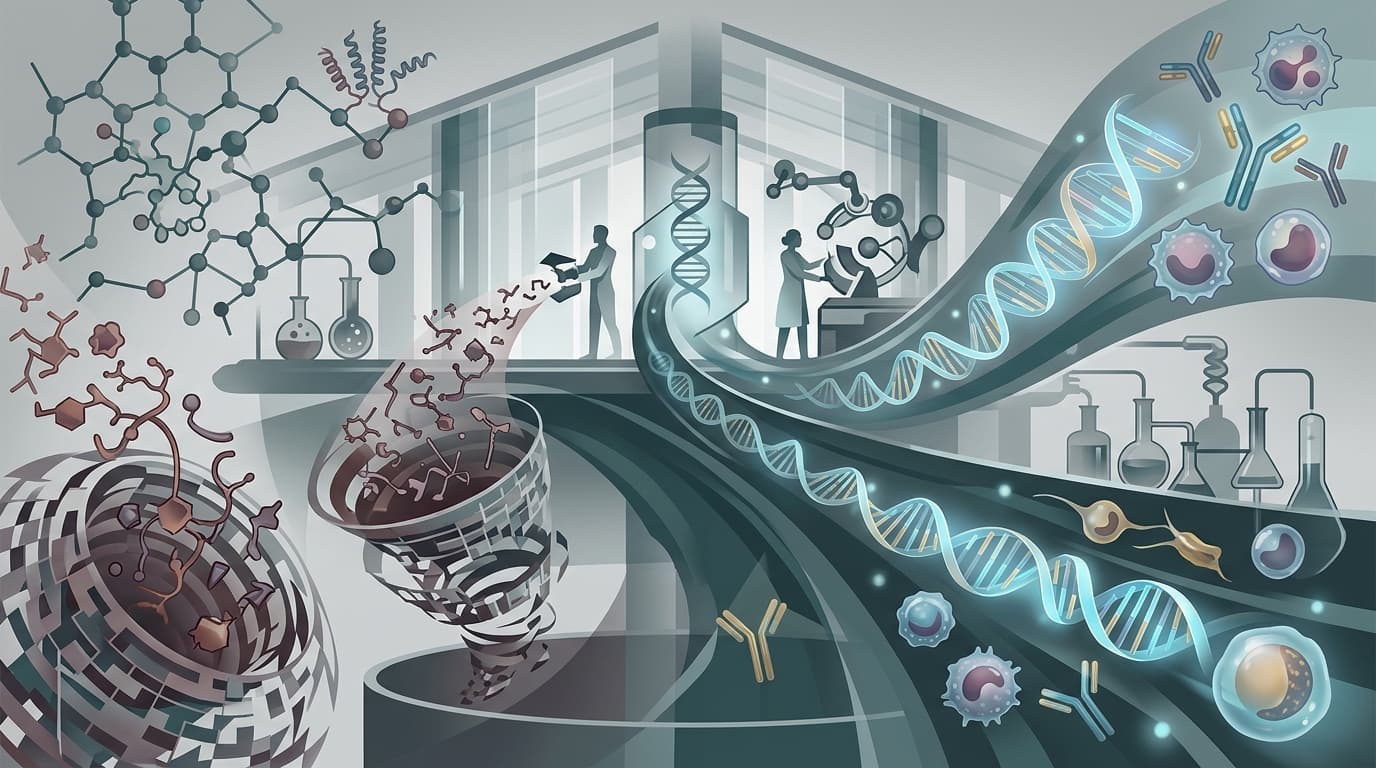
The problem? Detecting specific proteins in blood has historically been like trying to hear someone whisper across a packed stadium. Proteins exist at incredibly low concentrations, and blood plasma is full of molecular noise that drowns out the signal.
Alamar's core technology, called NULISA (nucleic acid-linked immunoassay), solves this by tagging proteins with DNA barcodes and then amplifying the signal using the same sequencing techniques that revolutionized genomics. The system suppresses background noise by a factor of 10,000, letting researchers detect proteins at concentrations so low they're measured in attomoles (think: a grain of sand in an Olympic swimming pool).
Alamar isn't operating in a vacuum. The broader proteomics market (tools and services for studying proteins) was valued at roughly $36 to $41 billion in 2025, depending on the source, and it's growing at 12% to 14% annually. The space has attracted heavyweights: Thermo Fisher Scientific (which acquired Olink, another protein analysis company) commands about 15% market share, while SomaLogic, Agilent, and Bruker all compete for researcher dollars.
What makes Alamar interesting is its positioning. The company sells to both academic institutions and biopharma companies, which means it isn't overly dependent on either customer type. And its technology sits at the intersection of two massive trends: precision medicine and multiomics, the idea that combining DNA, RNA, and protein data gives you a far richer picture of human health than any single layer alone.
The company has also generated more than 100 scientific publications and preprints, which matters because in research tools, peer-reviewed validation is your marketing department.
Alamar's timing looks deliberate. After biotech IPOs cratered in recent years, the window has reopened in early 2026. Several companies have already priced successfully this year: Aktis Oncology raised $318 million in January, Generate Biomedicines pulled in $400 million in February, and Eikon Therapeutics landed $381 million.
Investors are clearly willing to write checks again, but they're pickier than before. The "IPO for everyone" era of 2020 and 2021 isn't coming back. Companies need real revenue, clear growth trajectories, and a compelling reason to exist.
Alamar checks those boxes more convincingly than most. Nearly tripling revenue in a single year is the kind of proof point that gets institutional investors' attention. The company has raised over $250 million in private funding from firms like Sands Capital, T. Rowe Price, and Illumina Ventures, which signals that smart money has already validated the story.
J.P. Morgan, Bank of America, TD Cowen, Leerink Partners, and Stifel are running the books on this one; that's a first-tier underwriting lineup.
A $1.1 billion valuation on $74 million in revenue means investors are paying roughly 15 times trailing sales. That's not cheap, but it's not absurd for a company growing at nearly 200% a year with expanding margins and a large addressable market.
The risks are real, though. Alamar is still losing money. The proteomics tools space is getting crowded. And much of the company's future growth depends on pushing into clinical diagnostics (where regulatory hurdles are steep), not just research use. The company has hinted at an instrument called ARGO DX designed for the diagnostics market, but that chapter hasn't been written yet.
Founder and CEO Yuling Luo, a serial entrepreneur who previously built Advanced Cell Diagnostics (sold to Bio-Techne in 2016) and co-founded Panomics (acquired by Affymetrix), brings credibility. He's done this before: built a life sciences tools company from scratch and sold it to a strategic buyer. Investors tend to like that pattern.
Alamar Biosciences is betting that proteins are the next frontier in precision medicine, and the market seems inclined to agree. With scorching revenue growth, a differentiated technology platform, and a favorable IPO window, the company has one of the stronger debut cases we've seen this year.
The question isn't whether proteomics matters (it obviously does). It's whether Alamar can maintain this growth rate as competition intensifies and the company scales from research darling to commercial juggernaut. At $1.1 billion, investors are pricing in a lot of optimism. April 17 will tell us if Wall Street thinks it's justified.
AbbVie just licensed two early-stage, non-opioid pain drugs from a Chinese pharma company most people have never heard of, in a deal worth up to $745 million. It's a small upfront bet with massive implications for AbbVie's post-Humira future and the booming China-to-West licensing pipeline.