MIT Built a Drug-Screening AI That's 1,000x Faster Than the Gold Standard
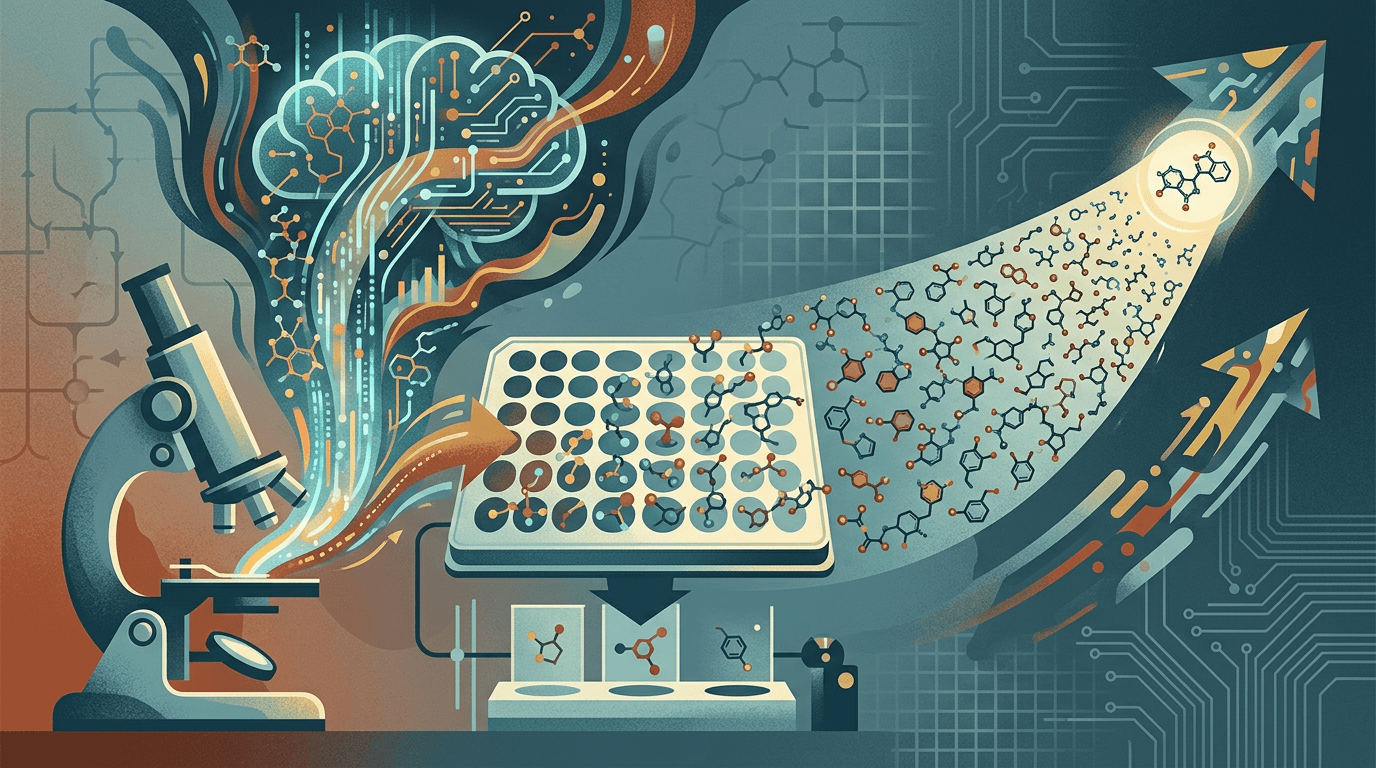
MIT and Recursion just open-sourced an AI model that predicts drug binding as accurately as the gold standard, but 1,000 times faster. It could reshape how the entire industry screens for new medicines.
Imagine you're looking for a needle in a haystack. Now imagine someone hands you a magnet that works a thousand times faster than your hands. That's roughly what just happened in drug discovery.
MIT's Jameel Clinic for Machine Learning in Health, working alongside biotech company Recursion, has released Boltz-2: an open-source AI model that predicts how tightly a drug molecule will bind to its target protein. Binding affinity (basically, how well a drug sticks to the thing it's supposed to stick to) is one of the oldest, hardest problems in pharmaceutical science. Getting it right computationally has always been painfully slow and expensive. Boltz-2 claims to do it at the accuracy of the best physics-based methods, but over 1,000 times faster.
If that holds up in practice, it could reshape how the entire industry finds new drugs.
The Problem That's Haunted Drug Hunters for Decades
Before a drug can treat a disease, it needs to grab onto a specific protein in your body and hold on. Think of it like a key fitting into a lock. Too loose, and nothing happens. Too tight in the wrong lock, and you get side effects.
For decades, scientists have relied on a technique called free-energy perturbation (FEP) to predict these interactions computationally. FEP is considered the gold standard. It's also brutally expensive, requiring massive computing power and significant time for each prediction. When you're trying to screen millions of potential drug candidates, that's a dealbreaker.
So the industry has been stuck in an awkward middle ground: fast screening tools that aren't very accurate, or accurate tools that aren't very fast. Boltz-2 is the team's attempt to close this long-standing open problem.
What Makes Boltz-2 Different
Boltz-2 is a successor to Boltz-1, which launched in November 2024 as an open-source alternative to DeepMind's AlphaFold3. Boltz-1 was good at predicting molecular structures (what a protein-drug complex looks like in 3D). But structure alone doesn't tell you how strongly the drug binds. It's like knowing what a key looks like without knowing whether it actually turns the lock.
Get tomorrow's biotech intelligence before your competitors.
Join thousands of biotech professionals who start their day with our free, daily briefing.
Boltz-2 does both at once. It predicts the structure and the binding affinity simultaneously, using a transformer-based architecture (the same type of AI that powers ChatGPT, but pointed at molecules instead of words). The model was trained on millions of lab measurements, physics simulations, and synthetic data.
The technical upgrades are significant. Boltz-2 expanded from 48 processing layers to 64, added a new attention mechanism called "trifast triangle attention," and incorporated physics-based steering controls that let scientists fine-tune predictions with experimental constraints. It can handle proteins, DNA, RNA, and small molecules all at once.
But the number that matters most? Each prediction takes about 20 seconds on a GPU. Compare that to the hours or days FEP methods can require for a single compound, and you start to see why people are paying attention.
The Receipts
Bold claims need bold evidence, and Boltz-2 has some impressive benchmarks to show. On the FEP+ benchmark (a standard test for binding affinity prediction), it scored a Pearson correlation of 0.62, matching OpenFE, a leading physics-based tool. Translation: it's predicting binding strength about as accurately as methods that cost orders of magnitude more to run.
It also ranked first in the CASP16 affinity challenge, a prestigious international competition for protein prediction models. And in hit-discovery screening (the earliest stage of finding drug candidates), it doubled the precision of other machine learning and traditional docking methods.
Recursion, which co-developed the model, has already integrated Boltz-2 into its drug discovery workflows. Najat Khan, Recursion's CEO and President, noted that the company is using it for virtual screening, hit identification, and lead optimization, while continuing experimental validation to refine the algorithms.
Why "Open Source" Is the Real Story
Plenty of AI models can predict molecular properties. What makes Boltz-2 genuinely unusual is that everything is open: the model weights, the inference code, and the training code, all released under a permissive MIT license. That means any academic lab, any startup, any pharma company can use it, modify it, and build on it for free.
This is a direct shot at DeepMind's AlphaFold3, which restricted commercial use of its model. It's also a shot at the broader trend of AI companies keeping their best tools behind paywalls. By open-sourcing the full stack, MIT and Recursion are essentially saying: "We think drug discovery moves faster when everyone has the best tools."
For small biotech companies and academic labs that can't afford enterprise-level computational chemistry software, this is a big deal. Running 117,000 virtual binding evaluations to discover new drug candidates? That used to require serious infrastructure. Now it requires a decent GPU and some Python skills.
The Bigger Picture: AI Is Compressing Drug Discovery Timelines
Boltz-2 doesn't exist in a vacuum. It's part of a broader wave of AI tools that are squeezing years out of early-stage drug discovery.
Foundation models like Boltz-2 and competitors like Chai-2 are a big reason why AI-integrated workflows are compressing early-stage drug discovery timelines.
Chai-2, for instance, recently reported hit rates of 16-20% for biologics, about 100 times better than traditional computational baselines. Hybrid quantum-AI approaches have screened 100 million molecules down to actionable candidate lists. The tools are getting faster, cheaper, and more accurate all at once.
Boltz-2 fits neatly into this acceleration story. If you can screen compounds a thousand times faster without sacrificing accuracy, your hit-to-lead timeline shrinks dramatically. Fewer wasted experiments. Fewer dead-end compounds. More shots on goal.
The Fine Print (Because There's Always Fine Print)
Before anyone starts popping champagne, some honest caveats.
Independent evaluations have found that Boltz-2's predictions tend to cluster in a narrow range (roughly -5 to -8 kcal/mol for binding energy), which can make the model overconfident. It's great at ranking compounds relative to each other, but it can struggle to flag non-binders with certainty. On large, diverse datasets (one study tested over 16,000 compounds), it showed only weak-to-moderate correlation with physics-based methods, and structural predictions sometimes had high error rates.
In plain English: Boltz-2 is excellent for initial screening, for separating the promising needles from the haystack of junk. It's less reliable for the precision work of lead optimization, where you need to know exactly how a small chemical change affects binding. Think of it as a brilliant first filter, not a replacement for the entire pipeline.
And the elephant in the room: no AI-discovered drug has received FDA approval yet. AI tools are speeding up the early stages of discovery, but clinical trials, regulatory review, and the fundamental unpredictability of human biology remain unchanged. The 90% attrition rate in drug development hasn't budged.
So What Does This Actually Mean?
Boltz-2 isn't going to cure cancer tomorrow. But it represents something important: the moment when AI-driven binding prediction became fast enough, accurate enough, and accessible enough to change how the average drug discovery team works.
The combination of near-gold-standard accuracy, radical speed improvement, and fully open-source availability is rare. Most breakthroughs in computational biology come with at least one asterisk (too slow, too expensive, too locked down). Boltz-2 checks all three boxes at once.
For the biotech industry, the practical impact will unfold over the next few years. Smaller companies will use it to compete with pharma giants that have massive screening budgets. Academic labs will use it to test hypotheses they couldn't afford to explore before. And the hit-to-lead phase of drug discovery, long one of the most expensive and time-consuming bottlenecks, will get a little bit faster.
The haystack hasn't gotten any smaller. But the magnet just got a whole lot stronger.
4 min read
The FDA Wants to Approve Your Drug Faster. There's a Catch.
FDA Commissioner Marty Makary is rewriting the rules of drug approval: one trial instead of two, AI-powered reviews, and a new pathway for ultra-rare diseases. The biotech industry loves the vision, but Wall Street isn't sure the execution can keep up.