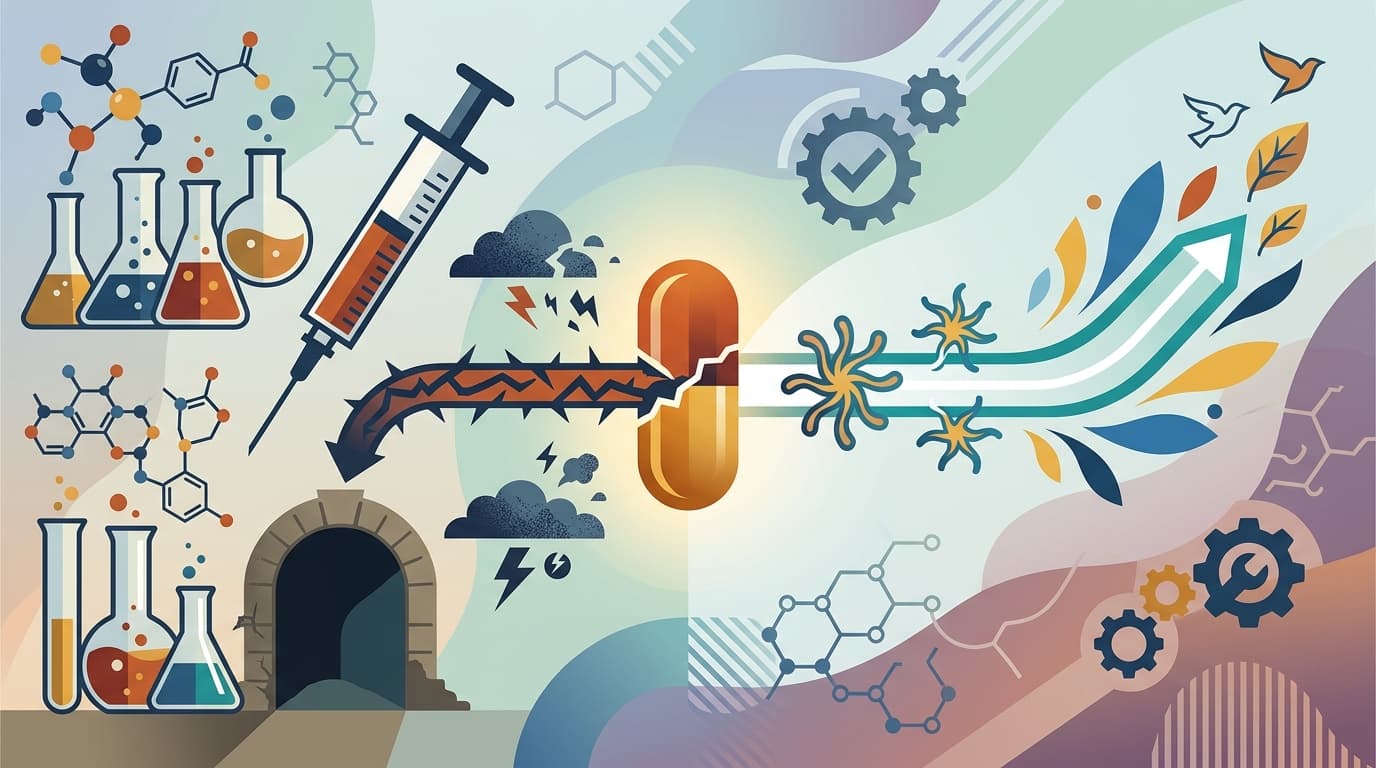
For a decade, the most powerful cholesterol drugs required injections, and most eligible patients never used them. Merck's LIPFENDRA just became the first oral PCSK9 inhibitor approved by the FDA, matching injectable-level potency in a once-daily pill at one-third the price.
A Decade of Needles, Over in One Swallow
For ten years, the most powerful cholesterol drugs on the planet came with a catch: you had to inject them. Every two weeks or every month, patients rolled up their sleeves for a shot of Repatha or Praluent. The drugs worked brilliantly, slashing LDL (the "bad" cholesterol) by roughly 60%. But needles are needles. An estimated 50% or more of eligible high-risk patients never started or stuck with the treatment.
On July 16, the FDA changed that math. Merck's LIPFENDRA (enlicitide) became the first oral PCSK9 inhibitor ever approved in the United States. One pill. Once a day. No needles, no clinic visits, no cold-chain shipping. And the kicker? It cuts LDL cholesterol just as well as the injections it's designed to replace.
What PCSK9 Actually Does (and Why Blocking It Matters)
Think of your liver as a recycling center for cholesterol. It has receptors on its surface that grab LDL particles out of your bloodstream and break them down. A protein called PCSK9 acts like a saboteur: it tags those receptors for destruction, so your liver can't clean up as much cholesterol.
Block PCSK9, and you restore the recycling center to full capacity. LDL plummets. Heart attack risk drops. That's been the playbook since Repatha and Praluent launched in 2015. The problem was never the science; it was the delivery method.
Injectable-Level Power, in Tablet Form
Merck's Phase 3 program, called CORALreef, tested enlicitide across thousands of patients in three major trials. The results were strikingly consistent.
In the CORALreef Lipids trial (patients with general high cholesterol already on statins), the pill produced a 56% placebo-adjusted LDL reduction at 24 weeks. In the CORALreef HeFH trial (patients with a genetic form of high cholesterol called heterozygous familial hypercholesterolemia), the reduction hit 59%. And those results held up: at 52 weeks, the between-group difference actually widened to about 61.5%.
Get tomorrow's biotech intelligence before your competitors.
Join thousands of biotech professionals who start their day with our free, daily briefing.
For context, injectable PCSK9 antibodies typically lower LDL by 58 to 63%. Enlicitide is playing in the same league, just without the syringe.
Merck also ran a head-to-head comparison against existing oral cholesterol add-ons. Enlicitide beat bempedoic acid by a 56.7 percentage-point margin. It topped ezetimibe by 36 points. It even outperformed the two drugs combined by 28 points. Nearly 78% of patients on enlicitide hit the toughest cholesterol target (50%+ LDL reduction and absolute LDL below 55 mg/dL), compared to just 20% on the combination.
On the safety side, adverse events looked similar to placebo across all three trials. No major organ toxicity signals. No discontinuation spikes. Drug adherence in the trials ran at roughly 98%, which is almost unheard-of for a chronic disease medication.
The Business Case: Why Wall Street Perked Up
Analysts are already sharpening their revenue models following the approval.
The excitement boils down to three things: a massive addressable market, a clear convenience advantage, and smart pricing.
Merck set LIPFENDRA's list price at roughly $315 per month. Injectable PCSK9 antibodies typically run $570 to $760 per month. That's roughly half the cost, which should make payer negotiations considerably smoother. Injectable PCSK9 therapies have been hamstrung for years by brutal prior authorization requirements. A cheaper oral option sidesteps some of the biggest objections.
Scotiabank analyst Louise Chen described LIPFENDRA's "peak sales potential of tens of billions of dollars." That's the high end. RBC Capital Markets analyst Trung Huynh modeled a more measured $5 billion in peak sales by 2034, citing the enormous pool of undertreated patients.
Regardless of which forecast proves right, every estimate lands firmly in blockbuster territory. And for Merck, this isn't just about cholesterol; it's about life after Keytruda. The company's oncology juggernaut faces biosimilar competition in the coming years, and LIPFENDRA offers a credible pillar of diversification.
Why the Competition Is Still Miles Behind
Merck didn't just win the approval; it won the race. AstraZeneca has its own oral PCSK9 inhibitor, AZD0780, but that program is years behind. AstraZeneca completed Phase IIb in late 2024 and launched a large cardiovascular outcomes trial (AZURE-Outcomes) in mid-2025. The estimated completion date? October 2029.
That means Merck could have three or four years of market exclusivity before a true oral competitor arrives. In pharma, a first-mover advantage of that magnitude can be worth billions in entrenched prescribing habits and formulary positions.
The existing injectable players face a different kind of threat. Repatha (Amgen) still dominates the PCSK9 market with an estimated 60–62% revenue share, and the overall injectable market is worth roughly $4 to $5 billion in 2026. Novartis's Leqvio (inclisiran), a twice-yearly injection, has been the recent growth story thanks to its convenience edge over biweekly shots. But a daily pill is even more convenient than a twice-yearly clinic visit for many patients, especially those managing multiple chronic conditions from home.
LIPFENDRA probably won't kill injectables overnight. Some patients genuinely prefer infrequent dosing. But it will almost certainly expand the overall PCSK9 market by pulling in the millions of patients who refused needles entirely.
The Bigger Picture for Cholesterol Care
Step back, and this approval represents something larger than one drug launch. For decades, cardiologists have faced a frustrating paradox: we know exactly how to prevent heart attacks with aggressive LDL lowering, yet the tools to get there have been either too weak (statins alone) or too inconvenient (injections).
LIPFENDRA fills that gap. A primary care doctor can now prescribe a statin, see that the patient isn't at goal, and add a once-daily pill that cuts remaining LDL by nearly 60%. No referral to a specialist. No injection training. No prior authorization nightmare (hopefully).
Merck still has work to do. The company hasn't yet completed a large cardiovascular outcomes trial proving that LIPFENDRA actually reduces heart attacks and strokes, not just LDL numbers. That data is expected later this decade. For now, the approval rests on LDL reduction as a well-established surrogate marker.
But the clinical logic is strong, the commercial setup is favorable, and the unmet need is enormous. Heart disease remains the world's leading killer. A pill that fights it this effectively, this simply, at this price point?
That's not just a new drug. That's a new era.
Clinical & Regulatory
5 min read
The FDA Just Carpet-Bombed 25 Telehealth Companies Over Knockoff Ozempic
The FDA just hit 25 telehealth companies with warning letters for marketing compounded knockoffs of Ozempic and Mounjaro with bogus claims. It's the third enforcement wave in under a year, with over 100 total letters sent, and the real numbers on patient harm are alarming.