Jennifer Doudna Just Built CRISPR Enzymes That Evolution Never Imagined
Jennifer Doudna's team used AI to design gene-editing enzymes that don't exist in nature, and they work in human cells. The implications for CRISPR's future (and its messy patent landscape) could be enormous.
Nature spent billions of years evolving CRISPR. Jennifer Doudna's lab just asked a computer to do it differently.
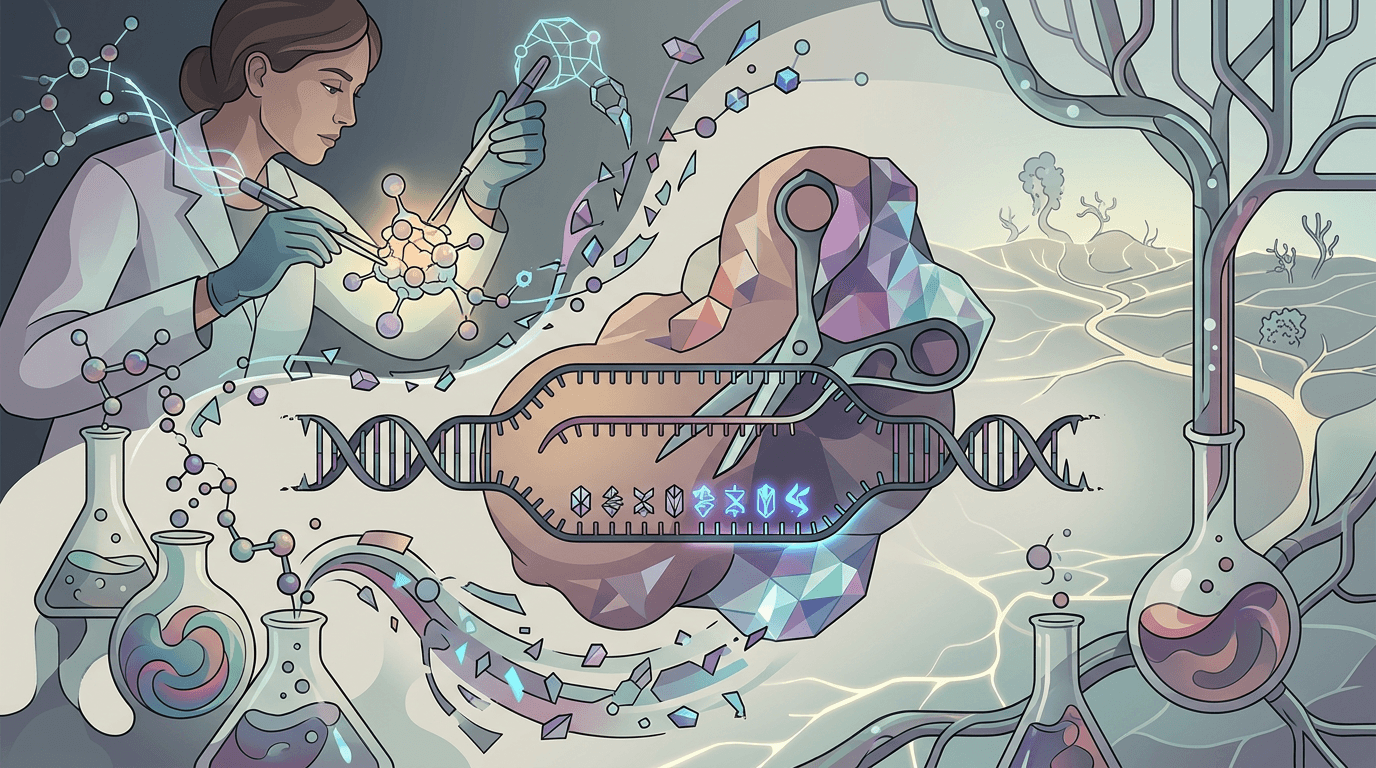
The Nobel laureate's team published a new paper in Science describing something that sounds like science fiction: an AI platform that designs gene-editing enzymes from scratch. These aren't tweaks to existing tools. They're synthetic proteins that don't exist anywhere in nature, yet they cut DNA in human, plant, and bacterial cells just as well as (or better than) the originals.
If CRISPR was the discovery of scissors, this is the invention of a scissor factory.
The Problem With Nature's Scissors
CRISPR tools like Cas9 are remarkable, but they come with baggage. Think of Cas9 as a GPS-guided pair of scissors: it follows an RNA guide to a specific spot in the genome and cuts. The problem? The GPS has restrictions.
Cas9 needs a specific DNA sequence called a PAM (protospacer adjacent motif) near its target. That's like needing a parking spot next to every building you want to visit. Only about 1 in 16 genomic sites have the right "parking spot" for standard Cas9. Many disease-causing mutations sit in spots without one.
Then there's the accuracy issue. Cas9 sometimes cuts the wrong location, creating unintended mutations. It's also a large protein, which makes delivery into cells tricky, especially through the tiny viral vehicles (AAVs) commonly used in gene therapy. And because Cas9 comes from bacteria, many humans already have immune cells primed to attack it.
Scientists have spent years hunting for better natural alternatives: Cas12, Cas13, CasX, and dozens more. Each one solves some problems but introduces others. Cas12 handles AT-rich DNA better but often edits less efficiently. Cas13 targets RNA instead of DNA, which is great for some applications, but it has a nasty habit of shredding bystander RNA molecules nearby.
The pattern is clear: evolution optimized these tools for bacteria, not for human medicine. What if you could design your own?
Get tomorrow's biotech intelligence before your competitors.
Join thousands of biotech professionals who start their day with our free, daily briefing.
Led by structural biologist Petr Skopintsev, Doudna's team started with a tiny, ancient nuclease called TnpB. Think of TnpB as the grandparent of modern CRISPR systems: a compact, RNA-guided DNA cutter that scientists believe eventually evolved into the Cas12 family. Its small size makes it an ideal starting point for engineering.
The team then did something clever. Instead of using AI the way most people think of it (predicting a protein's shape from its sequence, like AlphaFold does), they ran the process in reverse. They used Meta's ESM-IF model, an "inverse folding" AI that takes a desired 3D structure and generates protein sequences predicted to fold into that shape.
Imagine you have a blueprint for a house. Normal AI tells you what the house looks like from the blueprint. Inverse folding AI takes a photo of the house and writes you a new blueprint that builds something structurally identical but with completely different materials.
The team fed TnpB's backbone structure into the model, then layered on constraints from evolutionary data. Critical residues (the ones responsible for gripping DNA and RNA) were locked in place. Everything else was fair game for the AI to redesign.
The result: a flood of candidate sequences for proteins that had never existed before, each predicted to fold into a functional gene editor.
From Computer to Cell
Of course, predicted proteins are just that: predictions. The real test came in the lab.
The team screened their AI-generated variants first in bacteria, then in plant cells, then in human cells. Multiple synthetic enzymes passed every test. The best variant (referred to as SynTnpB) showed editing efficiency that matched or exceeded wild-type TnpB, with reduced off-target activity to boot.
To understand why it worked so well, the team turned to cryo-electron microscopy, which captures proteins at near-atomic resolution. The images revealed something fascinating: the AI had introduced new electrostatic and hydrogen-bond interactions at the guide RNA/DNA interface. These novel contacts stabilized the editing complex in ways that natural evolution hadn't stumbled upon.
The AI didn't just copy nature. It improved on it.
What the Experts Are Saying
The reaction from the gene-editing community has been enthusiastic but measured. Benjamin Kleinstiver, a leading enzyme engineer at Harvard and Mass General, called the extent of sequence diversification while retaining activity "impressive." He noted something intriguing: different AI-designed enzymes performed best on different target sites in human cells, suggesting a rich design space to explore.
But Kleinstiver was also candid. "He doesn't see any new capabilities for genome editing just yet," FierceBiotech reported. Translation: these synthetic enzymes do what existing tools already do. They just do it with different (and potentially more useful) protein sequences.
That distinction matters enormously for one reason: patents. The CRISPR intellectual property landscape is notoriously messy, with years of legal battles over who owns the rights to Cas9 and Cas12. Kleinstiver pointed out that if AI-designed nucleases are sufficiently sequence-divergent, they "may be able to create IP-evading enzymes." For biotech startups looking to build proprietary editing platforms without licensing someone else's foundational patents, that's a very big deal.
Independent experts commenting via the Science Media Centre described the work as "democratizing the protocol to design your own new-to-nature RNA-guided nucleases." The study lays out a clear experimental roadmap: structural analysis, AI design, bacterial screening, then validation in mammalian cells. Other labs can follow the recipe.
The Bigger Picture
Doudna's work doesn't exist in a vacuum. It lands in a landscape where AI and gene editing are converging fast. Profluent Bio previously unveiled OpenCRISPR-1, a fully AI-designed Cas9 alternative generated using protein language models trained on over 1.2 million CRISPR-Cas operons from 26.2 terabases of microbial data. That enzyme reportedly showed roughly 95% fewer off-target edits than standard Cas9 in human cells.
What makes Doudna's approach distinct is the starting scaffold. Rather than optimizing a big, well-known enzyme like Cas9, her team worked with TnpB: smaller, simpler, and easier to deliver. The compact size could prove especially valuable for in vivo gene therapies, where every kilobase of cargo space counts.
Not a Revolution Yet, But Maybe the Blueprint for One
Let's be honest about where things stand. No AI-designed nuclease is entering a clinical trial tomorrow. The synthetic enzymes haven't demonstrated fundamentally new editing capabilities; they can't yet be tailored to recognize arbitrary DNA sequences on command. And extensive safety validation (off-target profiling, immunogenicity testing, long-term stability) still lies ahead.
But the platform is the point. Before this work, designing a new gene editor meant finding one in nature or slowly mutating an existing one. Now there's a systematic, AI-driven pipeline for generating editors that evolution never produced. The implications stretch beyond CRISPR; the same inverse-folding strategy could theoretically be applied to design other complex proteins with custom properties.
For an industry that's spent a decade arguing over who owns a handful of bacterial enzymes, the prospect of generating entire families of synthetic alternatives is transformative. The CRISPR toolbox just got an upgrade: not a new tool, but a machine that builds them.
Clinical & Regulatory
5 min read
The FDA Just Carpet-Bombed 25 Telehealth Companies Over Knockoff Ozempic
The FDA just hit 25 telehealth companies with warning letters for marketing compounded knockoffs of Ozempic and Mounjaro with bogus claims. It's the third enforcement wave in under a year, with over 100 total letters sent, and the real numbers on patient harm are alarming.