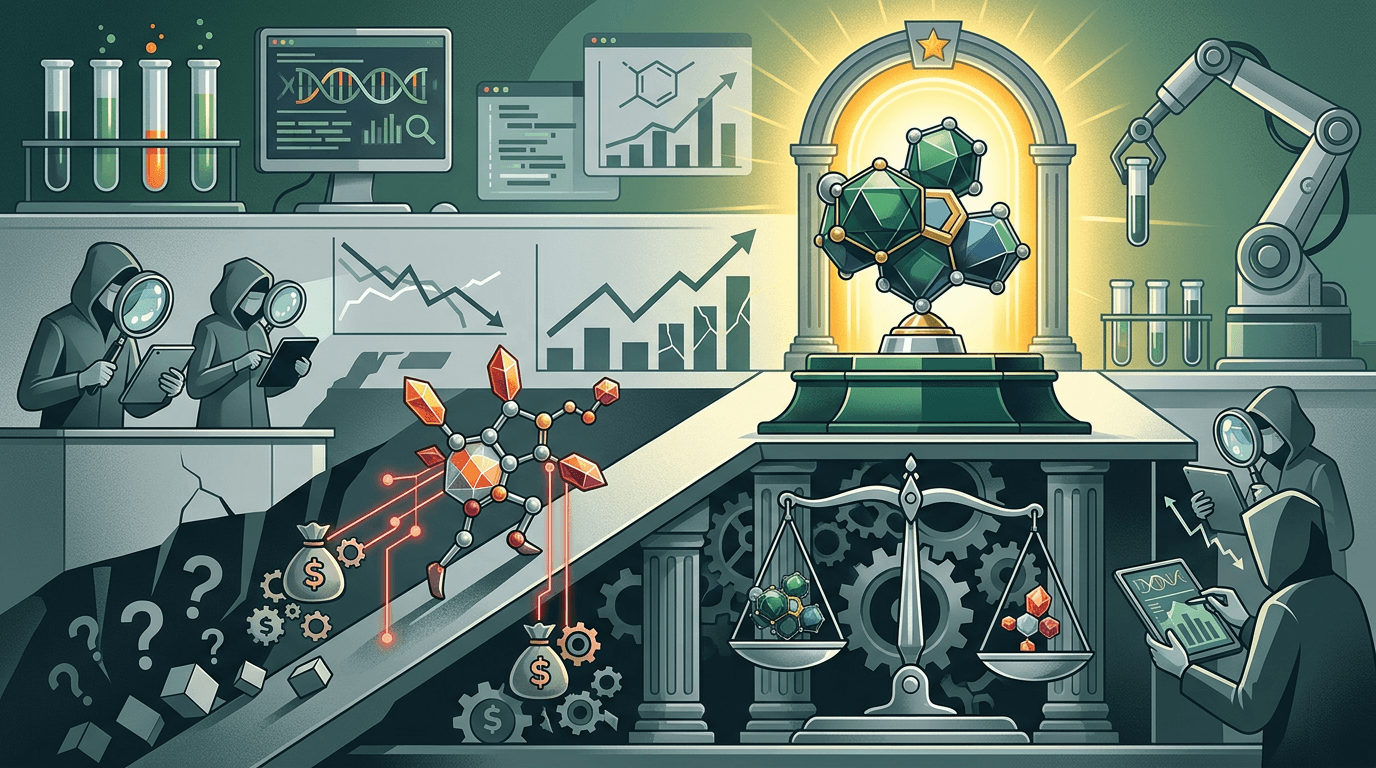

Eli Lilly just killed a RIPK1 partnership with Rigel Pharmaceuticals that was worth up to $960 million. The move says less about Rigel and more about how ruthlessly Lilly is pruning everything that isn't a potential blockbuster.
Imagine getting a $125 million engagement ring, being promised nearly a billion more, and then getting dumped by text. That's roughly what just happened to Rigel Pharmaceuticals.
On April 16, Eli Lilly sent Rigel a termination notice for their RIPK1 inhibitor collaboration, effective June 15, 2026. The deal, originally worth up to $960 million in upfront payments, milestones, and royalties, is now dead. All of it. Lilly is walking away, and Rigel gets to keep the keys to a house nobody's sure they want.
A Lilly spokesperson put it bluntly: ocadusertib "did not meet our high bar for continued development."
The partnership started with plenty of optimism back in February 2021. Lilly paid Rigel $125 million upfront for exclusive worldwide rights to develop and sell RIPK1 inhibitors. The scope was ambitious: autoimmune diseases like rheumatoid arthritis on one side, brain diseases on the other. Rigel stood to earn up to $835 million in milestone payments, plus tiered royalties on sales.
RIPK1 (receptor-interacting protein kinase 1) is a protein that acts like a molecular switchboard, controlling both inflammation and a type of cell death called necroptosis. Think of it as a traffic controller that, when it malfunctions, starts waving every car straight into a pileup. Block the controller, and you might stop the crashes: less inflammation, less tissue damage, fewer disease symptoms.
The theory was elegant. The execution? Not so much.
This wasn't a sudden breakup. It was a slow fade.
Lilly first killed the CNS (brain disease) portion of the program back in October 2025. That left ocadusertib, an oral RIPK1 inhibitor being tested in a Phase 2a trial for severe rheumatoid arthritis, as the last survivor.
But Lilly didn't wait for the results. They pulled the plug before the trial was set to wrap up, which tells you something about their confidence level. When a pharma giant walks away from a trial it's already running, the internal data (or lack thereof) has usually told the story long before the press release.

Eli Lilly just paid up to $300 million for a three-year-old startup that hasn't tested a single drug in humans. CrossBridge Bio's dual-payload ADC technology is so hot that Lilly couldn't wait for clinical data, and the deal reveals just how frenzied the ADC arms race has become.


Join thousands of biotech professionals who start their day with our free, daily briefing.

To understand why Lilly dropped RIPK1, you have to understand what Lilly is chasing.
The company posted $19.3 billion in revenue in Q4 2025 alone, fueled largely by its GLP-1 drugs for obesity and diabetes (think Mounjaro and Zepbound). That success has given Lilly both the resources and the confidence to be ruthlessly selective about what stays in the pipeline.
In February 2026, Lilly cut three other clinical programs in a single sweep: a gene therapy for a rare form of dementia, an anti-CD19 antibody for multiple sclerosis and rheumatoid arthritis, and a radioligand therapy for prostate cancer. None failed on safety; they just didn't clear what Lilly called their "differentiation bar."
It's pouring more than $50 billion into manufacturing. And its new programs span cardiovascular disease, Alzheimer's, oncology, and genetic medicines.
In other words, Lilly isn't cutting because it's struggling. It's cutting because it can afford to bet only on things it believes will be blockbusters. RIPK1 inhibitors, apparently, didn't make that list.
Rigel now gets all its RIPK1 assets back, which sounds like a consolation prize at best. The company loses its entire future milestone and royalty stream from the Lilly deal. No more checks in the mail.
To be fair, Rigel isn't in crisis mode. The company projected $275 to $290 million in total 2026 revenue, driven mostly by its blood disorder drug Tavalisse. Analysts still have a median price target of $50 on the stock (it trades around $32), and the consensus rating is a Strong Buy. But those projections were built before this termination was factored in, and losing a partner like Lilly changes the calculus on any asset.
The bigger question is whether anyone else wants RIPK1 inhibitors right now. The landscape isn't exactly thriving. Genentech already terminated its own Phase 2 RIPK1 program. Sanofi had a RIPK1 candidate in a Phase 2 trial for cutaneous lupus, but that program was discontinued in October 2023 after failing to meet its primary endpoint. The field has yet to produce a single approved drug.
The science behind RIPK1 makes a compelling pitch on paper. The protein sits at a crossroads of inflammation and cell death, playing roles in diseases from rheumatoid arthritis to Alzheimer's to ALS. Blocking it in mice reduces brain inflammation, limits amyloid buildup, and protects vulnerable cell types.
But getting from "works in mice" to "works in humans" is where biotech dreams go to die. RIPK1 has a dual personality: it controls cell death and it serves as a structural scaffold for other signaling pathways. Inhibiting its kinase activity without disrupting those scaffold functions requires a surgical precision that's proven elusive. There's also the risk of broad immunosuppression, since RIPK1 is deeply woven into the body's TNF receptor signaling (the same pathway targeted by blockbuster drugs like Humira).
And for brain diseases, you need a drug that actually crosses the blood-brain barrier, a notoriously difficult engineering challenge that adds another layer of complexity.
Lilly's exit from RIPK1 isn't just a partnership dissolution; it's a signal. When a company with $19 billion quarters and a reputation for aggressive dealmaking decides a target isn't worth pursuing, the rest of the industry notices.
Rigel will evaluate its options. Maybe another partner emerges. Maybe the Phase 2a data (if it's ever completed) tells a different story. But for now, RIPK1 inhibitors are a therapeutic class with a lot of promise, a lot of failed experiments, and zero approved drugs.
Sometimes the most interesting molecule in the room still can't get a date.
Novartis killed two late-stage trials for its next-gen blood thinner after it couldn't outperform Eliquis, the $14.4 billion anticoagulant behemoth. The $925 million bet on abelacimab just got a lot narrower, and the implications ripple across the entire Factor XIa race.