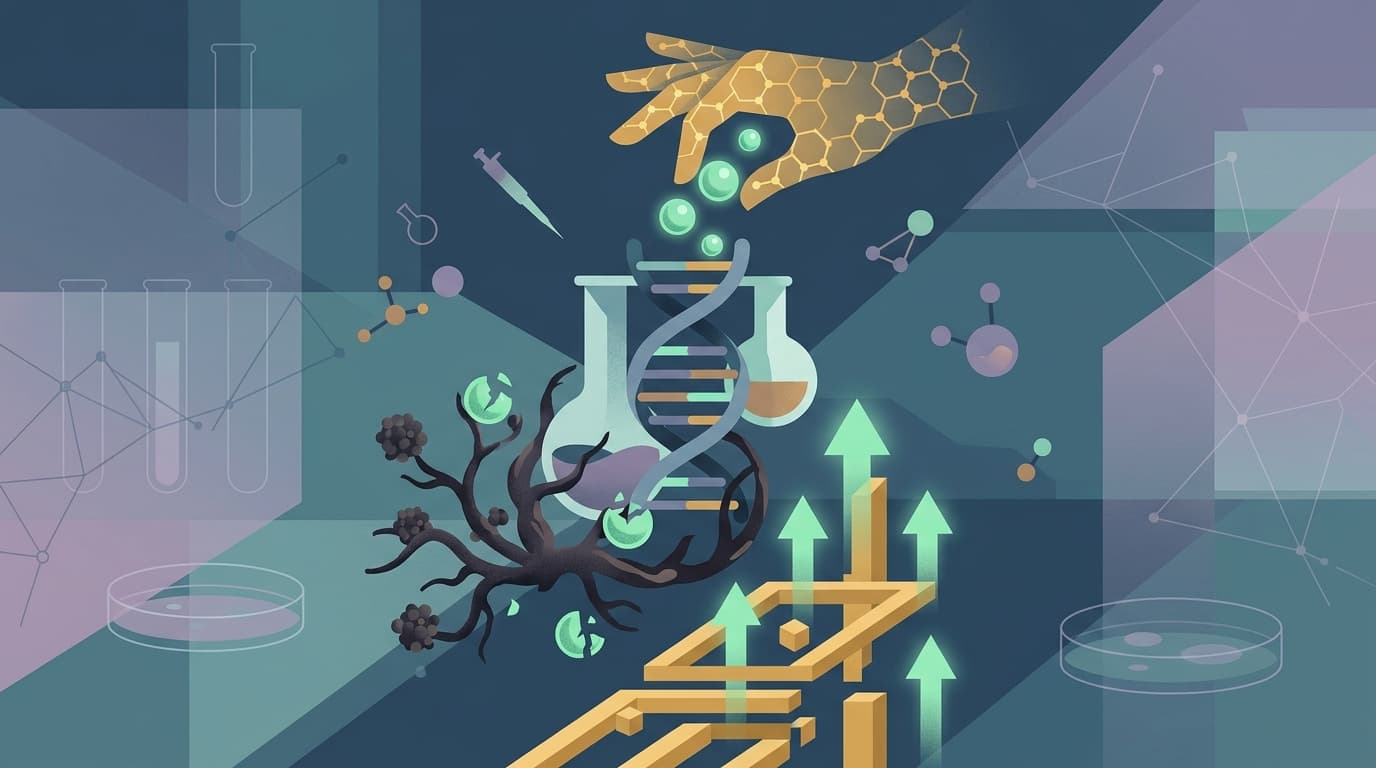

Eli Lilly just paid up to $202 million for a startup with zero products, zero revenue, and zero clinical trials. The reason? A tiny fat bubble called Tethosome that might solve gene therapy's hardest problem.
Getting a package delivered to your front door is easy. Getting a strand of DNA delivered to the nucleus of a specific cell inside a living human body? That's one of the hardest problems in medicine.
Eli Lilly just bet $202 million that a tiny California startup has cracked it.
Lilly acquired Engage Biologics, a preclinical biotech based in San Carlos, California, for up to $202 million in cash and milestones. Engage has no approved products. No clinical trials. No revenue. It was founded in 2021 and went through Y Combinator (yes, the tech accelerator) in 2022.
What it does have is a platform called Tethosome, a non-viral DNA delivery system built on lipid nanoparticles (tiny fat bubbles that carry genetic cargo into cells). Think of it as a molecular FedEx truck, except instead of dropping a package on your porch, it has to navigate past your immune system, slip through a cell membrane, escape a cellular recycling bin, and then find the nucleus. That last part is the really hard bit.
Gene therapy has a dirty little secret: we're actually pretty good at designing the genetic fix, but terrible at getting it where it needs to go.
Most gene therapies today rely on viral vectors, essentially hollowed-out viruses that carry therapeutic DNA into cells. The workhorse is a virus called AAV (adeno-associated virus). It works, but it comes with serious baggage. Your immune system recognizes it, which means you typically get one shot. If the therapy doesn't work the first time, you can't easily try again because your body will attack the delivery vehicle before it reaches its target.
AAV also has a size limit. It can only carry small genes, like trying to move a couch through a doggy door. And manufacturing viral vectors at scale is expensive and painfully slow.
Non-viral delivery systems, particularly lipid nanoparticles, promise to fix all of this. They're cheaper to make, can carry bigger payloads, and (crucially) can be given more than once because they don't trigger the same lasting immune memory. The COVID mRNA vaccines from Moderna and BioNTech proved that LNPs work brilliantly at scale for RNA.

A Suzhou biotech just raised $80 million on the Hong Kong Stock Exchange to fight bacterial infections, an area most investors won't touch. Its lead drug crushed the standard of care for H. pylori in Phase III, and the company's hybrid chemistry platform could reshape how we treat everything from stomach bugs to infected hip implants.


Join thousands of biotech professionals who start their day with our free, daily briefing.
But DNA isn't RNA. DNA is bigger, stiffer, and needs to reach the cell's nucleus to work. RNA just needs to float around in the cell's cytoplasm (the gooey interior). Getting DNA all the way to the nucleus, especially in cells that aren't dividing, remains one of biotech's stubbornest bottlenecks.
That's what Engage's Tethosome platform claims to solve. It combines LNPs with mRNA-encoded proteins that act as nuclear shuttles, escorting the DNA payload past the final barrier. If it works as designed, it could improve potency, tolerability, and the ability to redose patients.
This isn't a one-off purchase. It's more like the latest piece in a genetic medicines jigsaw puzzle that Lilly has been assembling at remarkable speed.
Consider the shopping spree. In 2025 alone, Lilly acquired Verve Therapeutics for roughly $1.3 billion (gene editing for heart disease), bought Adverum Biotechnologies (eye gene therapy), and licensed ophthalmology programs from MeiraGTx for over $475 million. In 2026, the pace actually accelerated: Lilly grabbed Kelonia Therapeutics for up to $7 billion (in vivo CAR-T / gene delivery in oncology), acquired Orna Therapeutics (circular RNA and in vivo CAR-T), and partnered with SanegeneBio in an RNAi deal worth up to $1.2 billion.
All told, Lilly has deployed nearly $21 billion across acquisitions and partnerships in 2026 alone. Over a third of its pipeline now consists of genetic medicines.
The company even built an Institute for Genetic Medicine in Boston, anchored by a $700 million investment, with plans for more than 250 scientists focused on RNA and DNA therapies. Lilly isn't dabbling in genetic medicine. It's building an empire.
Engage fills a specific gap in that empire: a non-viral way to deliver DNA. Lilly already has AAV gene therapies (Prevail, Adverum, MeiraGTx), gene editing tools (Verve, Kelonia), and RNA platforms (Orna, SanegeneBio). What it lacked was a proprietary system for getting DNA into cells without a virus. Now it has one.
Lilly isn't the only pharma giant chasing this prize. Intellia Therapeutics and Verve (now inside Lilly) have built clinical programs around LNP-delivered gene editing. Moderna and BioNTech have massive LNP infrastructure from their vaccine businesses that could theoretically be redirected toward gene therapy. Specialists like Aera Therapeutics, ReCode Therapeutics, and Tessera Therapeutics are all attacking the non-viral delivery problem from different angles.
But nobody has cracked DNA delivery at scale with a non-viral system in humans. Not yet. That's what makes this space so high-risk and, if someone wins, potentially transformative.
At $202 million max, this deal barely registers on Lilly's balance sheet. Analyst commentary has been polite but measured. The consensus: Engage is "high-optionality" for a company whose stock price still lives and dies by its GLP-1 obesity and diabetes drugs.
Investors see it as a signal, not a catalyst. It tells them Lilly is serious about building a diversified genetic medicines platform, which matters for the long-term thesis that Lilly is more than a one-trick (albeit very profitable) pony. But nobody's updating their price targets over a preclinical acquisition with no named pipeline programs.
The risks are real, too. Engage's technology is entirely preclinical, meaning it hasn't been tested in a single human yet. Integrating a Y Combinator startup into a $900 billion pharma company is its own kind of challenge. And the fundamental science of non-viral nuclear DNA delivery could simply hit a wall that no clever engineering can overcome.
Zoom out and the Engage deal tells a story about where the entire industry is headed. Delivery used to be an afterthought in gene therapy; now it's the bottleneck. The companies that solve it will own the future of genetic medicine, and the ones that don't will be stuck paying licensing fees to those who did.
Lilly is betting it can buy its way to the front of that line. Engage Biologics, a five-year-old startup with a Y Combinator pedigree and grants from the Gates Foundation and NIH, is just the latest ticket.
Whether Tethosome actually works in humans is a question for the clinic, not the boardroom. But at $202 million for a potential solution to gene therapy's hardest problem? That's the kind of bet a company flush with GLP-1 cash can afford to make, and one it can't really afford to skip.
Isomorphic Labs, the Google DeepMind spinoff, just raised $2.1 billion in the largest AI drug discovery financing ever. With Nobel Prize-winning science, $3 billion in pharma deals, and zero approved drugs, the company is making the biggest bet the field has ever seen.