Gilead Paid $405 Million for a Drug It Just Threw in the Trash
Gilead just killed the lead drug from its $405 million MiroBio acquisition, adding to a growing list of pricey deals that haven't delivered. As the company books $11.5 billion in new deal charges this year, investors are asking an uncomfortable question: is Gilead getting worse at shopping?
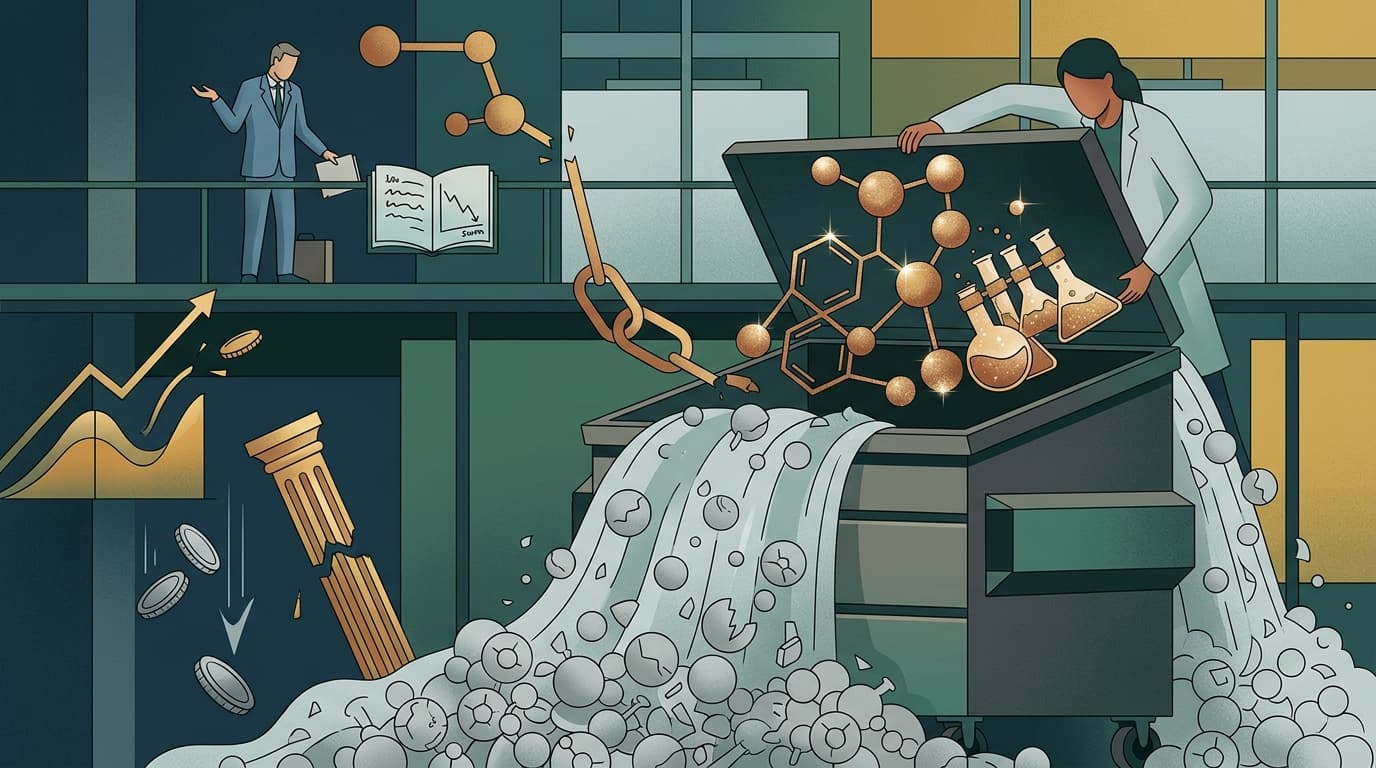
The Most Expensive Trash Can in Biotech
Imagine buying a house for $405 million, moving in, looking around for a couple of years, and then deciding you don't actually want it. No refund. No resale. Just gone.
That's essentially what Gilead Sciences just did with MiroBio, the small biotech it acquired in 2022 for roughly $405 million in cash. The crown jewel of that deal was MB272, a first-in-class antibody designed to calm overactive immune responses by flipping on an immune "off switch" called BTLA (B- and T-Lymphocyte Attenuator). It was supposed to be Gilead's ticket into the autoimmune disease space. Instead, the program has been discontinued, and Gilead is left holding a very expensive receipt.
What MiroBio Was Supposed to Be
When Gilead announced the acquisition, the pitch was compelling. MiroBio had built a platform called I-ReSToRE that could discover drugs targeting immune inhibitory receptors, basically the brakes on your immune system. In autoimmune diseases like arthritis and lupus, the immune system attacks the body's own tissues. MiroBio's approach: find ways to press those brakes harder.
MB272 was the lead candidate, targeting T cells, B cells, and dendritic cells to suppress inflammation. It had just dosed its first patient in a Phase 1 trial when the deal was announced. Gilead also got a second candidate, MB151 (a PD-1 agonist), plus a handful of earlier-stage programs.
At the time, the deal made strategic sense. Gilead wanted to build an inflammation franchise alongside its dominant HIV business and growing oncology portfolio. MiroBio gave them novel biology and a discovery engine to generate more candidates. The $405 million price tag seemed reasonable for a platform with multiple shots on goal.
So what went wrong?
When the Science Doesn't Cooperate
Gilead hasn't offered a detailed public explanation for killing MB272, which is frustratingly common in Big Pharma. Companies often cite "portfolio prioritization" and move on, leaving investors to read between the lines.
Get tomorrow's biotech intelligence before your competitors.
Join thousands of biotech professionals who start their day with our free, daily briefing.
The most likely culprits are the usual suspects: disappointing clinical data, safety signals, or a realization that the biology simply didn't translate from the lab to actual patients. MB272 was testing a genuinely novel mechanism. That's exciting on a whiteboard, but novel mechanisms fail at notoriously high rates in the clinic. The odds were never in MiroBio's favor.
When Gilead booked the deal in 2022, it expensed the vast majority of the purchase price as acquired in-process R&D, reducing GAAP and non-GAAP earnings per share by $0.30 to $0.35 that year. Translation: Gilead's accountants basically told you from day one that this was a bet, not an asset.
A Pattern That's Getting Hard to Ignore
If this were an isolated incident, you could shrug it off. Every pharma company swings and misses. But Gilead has developed a habit of writing large checks for acquisitions that don't deliver.
The biggest wound is still Forty Seven, the company Gilead bought for $4.9 billion to get magrolimab, a promising cancer drug. That program hit a full FDA clinical hold after safety and efficacy failures. Billions, gone.
Then there's Immunomedics, acquired for a staggering $21 billion to get the cancer drug Trodelvy. Trodelvy reached the market, but it hasn't come close to generating the blockbuster returns that price tag implied. Analysts widely consider that deal a mixed outcome at best.
Now add MiroBio's $405 million to the pile. On its own, it's a rounding error for a company Gilead's size. But as part of a pattern, it tells a story about capital allocation discipline, or the lack thereof. The Street has noticed: analysts at RBC flagged after the magrolimab failure that the result could "further hurt sentiment around both their oncology programs and their M&A prowess," pointing to a "string of setbacks in recent years from acquired or partnered programs."
The $11.5 Billion Elephant in the Room
Here's where the timing gets awkward. In 2026, Gilead has booked $11.5 billion in deal-related charges tied to its recent acquisition spree, including purchases of Arcellx ($7.8 billion for a CAR-T therapy), Ouro Medicines (autoimmune), and Tubulis (antibody-drug conjugates). Those charges are large enough to push Gilead into a GAAP loss for the year, even though its HIV franchise still prints money.
So at the exact moment Gilead is asking investors to trust it with billions more in new deals, it's also admitting that one of its earlier bets was a total write-off. It's like asking your friends to invest in your new restaurant while the last one is still smoldering.
Analysts aren't panicking (most still rate Gilead a Buy with targets around $150 to $160), but the skepticism around deal-making is palpable. The MiroBio discontinuation isn't changing anyone's model in a meaningful way; the financial impact is too small. What it is doing is reinforcing a narrative that Gilead systematically overpays for early-stage science.
The Inflammation Bet Isn't Dead (Just Bruised)
To be fair, Gilead hasn't abandoned its autoimmune ambitions. The company says it now has 13 inflammation assets ranging from preclinical through Phase 2, plus seladelpar, a drug for primary biliary cholangitis (a chronic liver disease) that already has accelerated approval in the U.S. Multiple data readouts across the inflammation portfolio are expected in 2026, which leadership has called "a very exciting year to help us build our foundation in inflammation."
Gilead has also organized its immunology R&D around a framework it calls BETR: Blocking immune activation, Eliminating pathogenic cells, Tolerizing immune response, and Restoring tissue function. The company is even exploring whether Kite, its cell therapy division, can extend engineered cell approaches beyond cancer into autoimmune diseases.
So the strategy is intact. The question is whether investors should trust the execution.
What This Really Comes Down To
Gilead's M&A track record looks like a batting average with a few home runs and a lot of strikeouts. Pharmasset (hepatitis C, approximately $11 billion) was a grand slam. Kite Pharma (cell therapy) produced two marketed products. But the misses have been expensive, and they're accumulating.
For a company spending $11.5 billion on new deals this year alone, the MiroBio write-off serves as a pointed reminder: buying science is easy; turning it into medicine is the hard part. Investors will be watching those 2026 inflammation readouts very closely. Not just for the data, but for evidence that Gilead has learned something from its most expensive mistakes.
Deals & M&A5 min read
The $7 Billion Bet That Could Reshape Nuclear Medicine
Curium Pharma just slid a $7 billion offer across the table to Lantheus Holdings, the company behind prostate cancer imaging blockbuster Pylarify. If the deal goes through, it would create a global radiopharmaceutical powerhouse and mark one of the biggest PE-backed moves into oncology infrastructure ever.