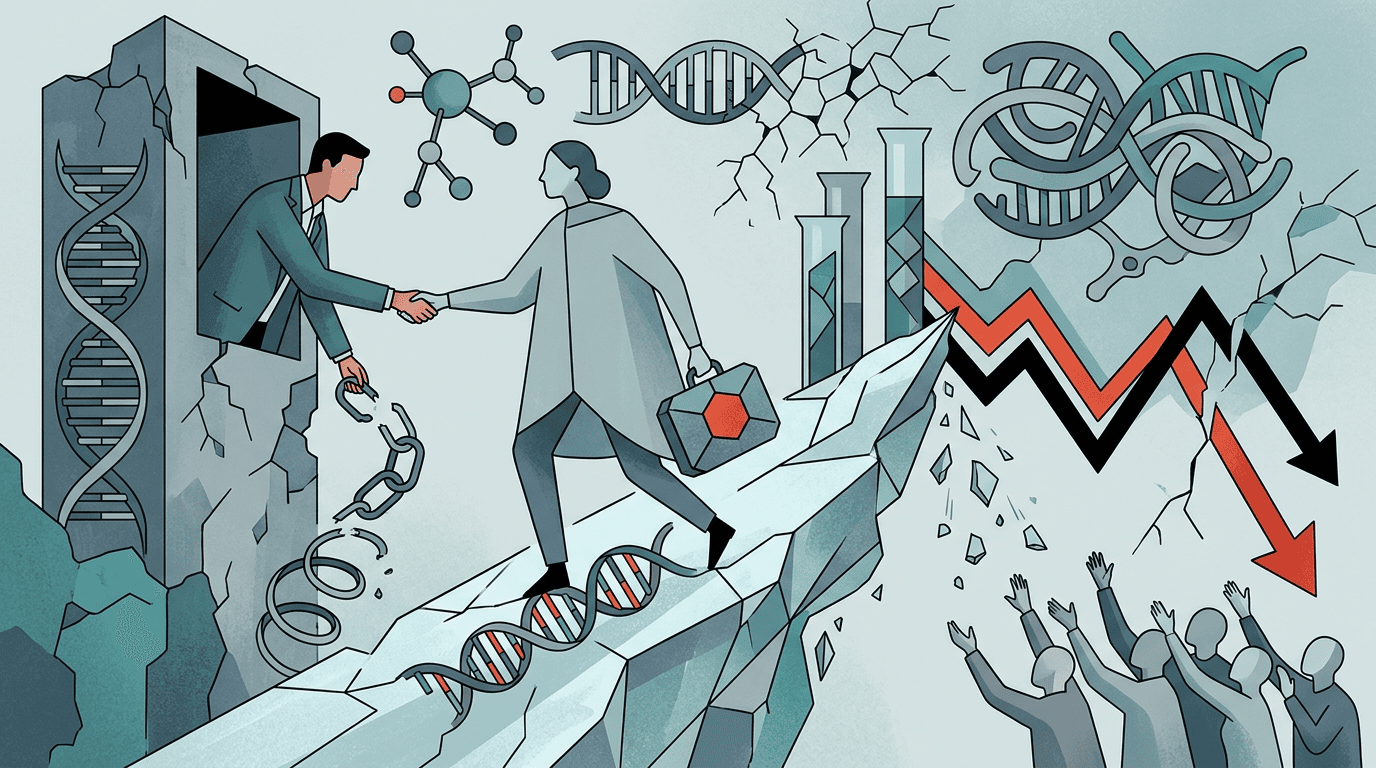

Helus Pharma's board fired its CEO just two months after hiring him, and they're not saying why. With Phase 3 data on a psychedelic-inspired depression treatment due later this year, the timing couldn't be worse.
Imagine starting a new job, finally figuring out where the good coffee is, and then getting a tap on the shoulder from the board: We need to talk. That's roughly what happened to Michael Cola, who stepped down as CEO of Helus Pharma (NASDAQ: HELP) on April 20, 2026. He'd been in the role for about two months.
The company's official language is telling. Cola didn't resign. He didn't "pursue other opportunities." He left "at the request of the Board of Directors." In corporate speak, that's as close to "you're fired" as a press release gets.
Co-founder and Executive Chairman Eric So has stepped back in as Interim CEO while the board searches for a permanent replacement. So previously held the interim role, which means Helus is now on its second lap of the same leadership carousel.
Cola wasn't some random LinkedIn connection. He brought 30 years of experience in neuroscience, rare disease, and specialty pharma. His résumé reads like a biotech highlight reel. As president of Shire's specialty pharmaceutical business (later acquired by Takeda), he helped grow the company, powered in part by the blockbuster ADHD drug Vyvanse.
More recently, he was CEO of Avalo Therapeutics, where he steered the company's pivot into rare disease and genomic medicine. Helus called his appointment a "pivotal moment" for the company. They weren't subtle about the ambition behind the hire.
So what went wrong? The company hasn't said. No public explanation beyond the board's request, no hints about strategic disagreements or performance concerns. That silence, frankly, is louder than any press release could be.
To understand why this matters, you need to know what Helus is trying to pull off. The company, formerly known as Cybin, rebranded in January 2026 and is developing psychedelic-inspired treatments for mental health conditions. Think psilocybin and DMT, but engineered into precise, clinical-grade medicines.

Regeneron was the 17th and final major drugmaker to cut a pricing deal with the White House's Most Favored Nation initiative. The agreement includes a 58% price cut on Praluent, a free gene therapy for rare childhood deafness, and nearly $10 billion in domestic manufacturing pledges. With 86% of the branded drug market now covered, the real question is what these deals actually mean for patients at the pharmacy counter.


Join thousands of biotech professionals who start their day with our free, daily briefing.

Their lead candidate, HLP003, is a deuterated version of psilocin (the active compound in magic mushrooms) currently in Phase 3 trials for major depressive disorder. The FDA gave it Breakthrough Therapy Designation, which is essentially the agency saying, "This looks promising enough that we'll fast-track it." Topline data from the APPROACH trial is expected in Q4 2026.
Behind that sits HLP004, a deuterated DMT being tested in Phase 2 for generalized anxiety disorder. Enrollment is complete, with data expected soon. The company also holds more than 350 patents, over 100 of which have been granted, extending protection through 2041.
This isn't a one-compound startup. Helus has a real pipeline, real intellectual property, and a real shot at bringing novel mental health treatments to market. Which makes the CEO revolving door even more puzzling.
If you're looking for signs of a company in crisis, Helus sends mixed signals. In the weeks before Cola's exit, the company was aggressively building out its leadership team:
That's not a company winding down. That's a company gearing up. You don't recruit a former Pfizer CMO to your advisory board if you're planning to fold. But you also don't fire your CEO after two months if everything is going according to plan.
The most generous interpretation: the board realized quickly that Cola wasn't the right cultural or strategic fit for what's ahead, and they acted decisively. The less generous interpretation: something is messy behind the scenes, and investors are being kept in the dark.
Helus stock was already under pressure before this. Shares traded around $5.77 after the announcement, down approximately 26% year-to-date and sitting roughly 41% below the 52-week high.
Rapid CEO turnover at a clinical-stage biotech is like a restaurant changing head chefs two months after a grand reopening. Maybe the food will still be great. But you'd be forgiven for canceling your reservation.
For investors, the math is straightforward. Helus has Phase 3 data coming in Q4. That's the most important catalyst on the calendar, and it's arriving while the company operates under interim leadership. Clinical trials don't pause because the C-suite is in flux, but execution risk just went up. Recruitment, regulatory strategy, and investor communication all depend on stable leadership, and right now, Helus is asking people to trust a placeholder.
Helus isn't the only biotech dealing with leadership whiplash. Across the industry, boards have become quicker to pull the trigger on CEO changes. Novo Nordisk replaced its longtime chief in mid-2025 after a guidance cut. AbbVie transitioned leadership in 2024 as Humira's patent protection eroded.
But those were billion-dollar companies with deep management benches. For a clinical-stage biotech with a market cap measured in the hundreds of millions, losing a CEO after two months carries disproportionate weight. Every month of leadership uncertainty is a month closer to a data readout that will define the company's future.
Eric So knows the company better than anyone; he co-founded it. His two decades of experience in corporate strategy and finance make him a reasonable caretaker. But interim CEOs are, by definition, temporary. The board needs to find someone permanent, and they need to do it before Q4 data arrives.
The real question isn't just who comes next. It's whether the board can explain what happened with Cola. Investors, analysts, and potential hires are all watching. Silence might feel safe in the short term, but it breeds the one thing clinical-stage biotechs can't afford: doubt.
Helus has the science. It has the pipeline. It has the FDA's attention. What it doesn't have, at least not right now, is a story that inspires confidence in the people running the show. And in biotech, the people matter almost as much as the molecules.
Avalyn Pharma wants $200M+ to prove that two blockbuster lung drugs work better as a mist than a pill. Their IPO lands in a market that's suddenly hungry for exactly this kind of bet.