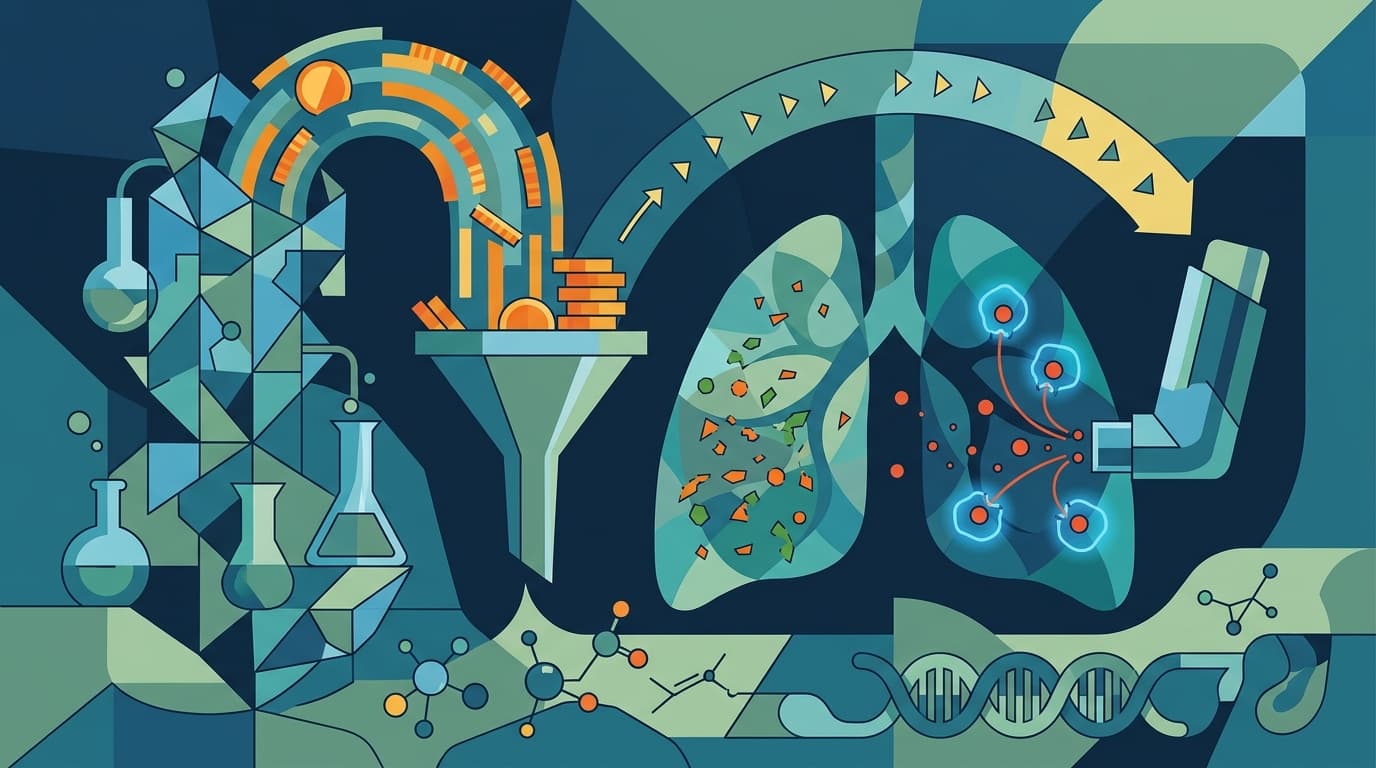

Avalyn Pharma wants $200M+ to prove that two blockbuster lung drugs work better as a mist than a pill. Their IPO lands in a market that's suddenly hungry for exactly this kind of bet.
Pirfenidone and nintedanib are two of the most important drugs for pulmonary fibrosis, a brutal lung disease that slowly turns your lungs into scar tissue. They've been on the market for years. They work. But there's a catch: you swallow them as pills, which means the medicine has to travel through your entire body just to reach your lungs.
That's a bit like watering your garden by flooding the whole neighborhood. Sure, the flowers get wet. But so does everything else, and the side effects (nausea, diarrhea, liver problems) make a lot of patients quit treatment entirely.
Avalyn Pharma thinks there's a better way. And Wall Street is about to write them a very large check to prove it.
The Boston-based biotech just set terms for its IPO, offering 11.8 million shares at $16 to $18 each. That puts the raise somewhere between $201 million and $212 million, a significant jump from the $100 million placeholder in its original S-1 filing. Shares are expected to start trading on Nasdaq under the ticker AVLN.
Avalyn's thesis is deceptively simple: take drugs that already work and deliver them directly where they're needed. Instead of pills that flood your bloodstream, the company uses a specialized nebulizer (a device that turns liquid medicine into a fine mist you inhale) to send the drug straight into lung tissue. Think of it as switching from a sprinkler system to a precision drip line.
The result, at least in early data, is striking. Their lead candidate, AP01 (inhaled pirfenidone), delivers therapeutic levels to the lungs at doses that produce roughly 15 times less systemic exposure than the oral version. Less drug in your blood means fewer side effects. Fewer side effects means patients actually stay on treatment.
Avalyn isn't a one-trick pony. The company has three programs, all following the same reformulation playbook.
AP01, the inhaled version of pirfenidone, is the furthest along. A Phase 1b study called ATLAS showed near-stabilization of lung function over 48 weeks with good tolerability. The Phase 2b trial, called MIST, is currently enrolling patients with progressive pulmonary fibrosis (PPF), a broader category that includes multiple types of scarring lung disease. IPO proceeds will fund this trial through topline data and into Phase 3.

Regeneron was the 17th and final major drugmaker to cut a pricing deal with the White House's Most Favored Nation initiative. The agreement includes a 58% price cut on Praluent, a free gene therapy for rare childhood deafness, and nearly $10 billion in domestic manufacturing pledges. With 86% of the branded drug market now covered, the real question is what these deals actually mean for patients at the pharmacy counter.


Join thousands of biotech professionals who start their day with our free, daily briefing.

AP02 takes the same approach with nintedanib, the other major oral antifibrotic. Preclinical data showed it could match the lung concentrations of oral dosing while delivering lower overall body exposure. The Phase 2 AURA trial dosed its first patient in March 2026, and the money from this offering will push AP02 toward its own Phase 3.
Then there's AP03, a combination of both drugs in a single inhaled dose. It's still preclinical, but the logic is compelling: if each drug works better when inhaled alone, combining them could offer the best of both worlds with a fraction of the side effects patients experience when taking two oral pills. Phase 1 is on the roadmap.
Originally called Genoa Pharmaceuticals, the company has been quietly building since 2011. CEO Lyn Baranowski joined in October 2022, bringing a résumé that reads like a highlight reel of respiratory biotech exits.
Before this IPO, Avalyn raised over $310 million from private investors, including a $100 million Series D in July 2025 backed by Novo Holdings, Suvretta Capital, and SR One. The company entered 2026 with $138 million in cash on hand. Combined with IPO proceeds, that's a serious war chest.
Avalyn's offering isn't happening in a vacuum. After a dismal 2025, 2026 has roared back. By mid-April, eight biotech companies had already gone public, raising a combined $2.47 billion. Aktis Oncology pulled in $318 million in January. Generate:Biomedicines raised $400 million in February. Analysts are now projecting 30 to 35 biotech IPOs for the full year.
The common thread? Investors want clinical-stage companies with de-risked assets and clear paths to pivotal data. Speculative, preclinical-stage stories are still struggling. But companies like Avalyn, which are reformulating proven drugs and heading into late-stage trials, fit the current appetite perfectly.
Truist Securities' Michael Allwin expressed hope that 2026 activity would normalize to levels resembling 2019 rather than the frothy peaks of 2020 and 2021. So far, the trajectory looks healthy.
You might expect the inhaled pulmonary fibrosis space to be crowded. It isn't. The most notable inhaled competitor is Rein Therapeutics' LTI-03, a caveolin-1 peptide in Phase 2 for IPF with interim data expected in late 2026. United Therapeutics' inhaled treprostinil (Tyvaso) hit its Phase 3 endpoint in IPF in its TETON-1 trial in March 2026, but that drug targets a different mechanism.
The biggest recent approval in the space was Boehringer Ingelheim's nerandomilast (brand name Jascayd), an oral PDE4 inhibitor that became the first new IPF therapy in over a decade when it won FDA approval in 2025. But it's still a pill, which means it still comes with the systemic exposure problem Avalyn is trying to solve.
No one else is running late-stage trials with inhaled versions of pirfenidone or nintedanib. If Avalyn's approach works in Phase 3, they'd essentially own a category.
Avalyn's bet is that the best new lung drugs might be the old lung drugs, just delivered smarter. It's not the flashiest pitch in biotech; there's no gene therapy, no AI-designed molecule, no platform with twelve indications. It's a company saying: "These drugs already work. Patients just can't tolerate them. Let us fix that."
With over $200 million in fresh capital and a competitive landscape with remarkably little traffic, Avalyn has a real shot at building something significant. The risk, of course, is that Phase 3 trials are unforgiving. Plenty of good Phase 2 data has evaporated in pivotal studies.
But if you're going to bet on a reformulation story, betting on one where patients are literally quitting their medication because of side effects is a pretty good place to start.
Pfizer tapped NFL Draft prospect Fernando Mendoza as the face of its cancer screening campaign, and it's not just a feel-good play. Behind the football metaphors is a $43 billion oncology strategy that needs a bigger funnel.