GSK Just Lit $700 Million on Fire in the Neuroscience Graveyard
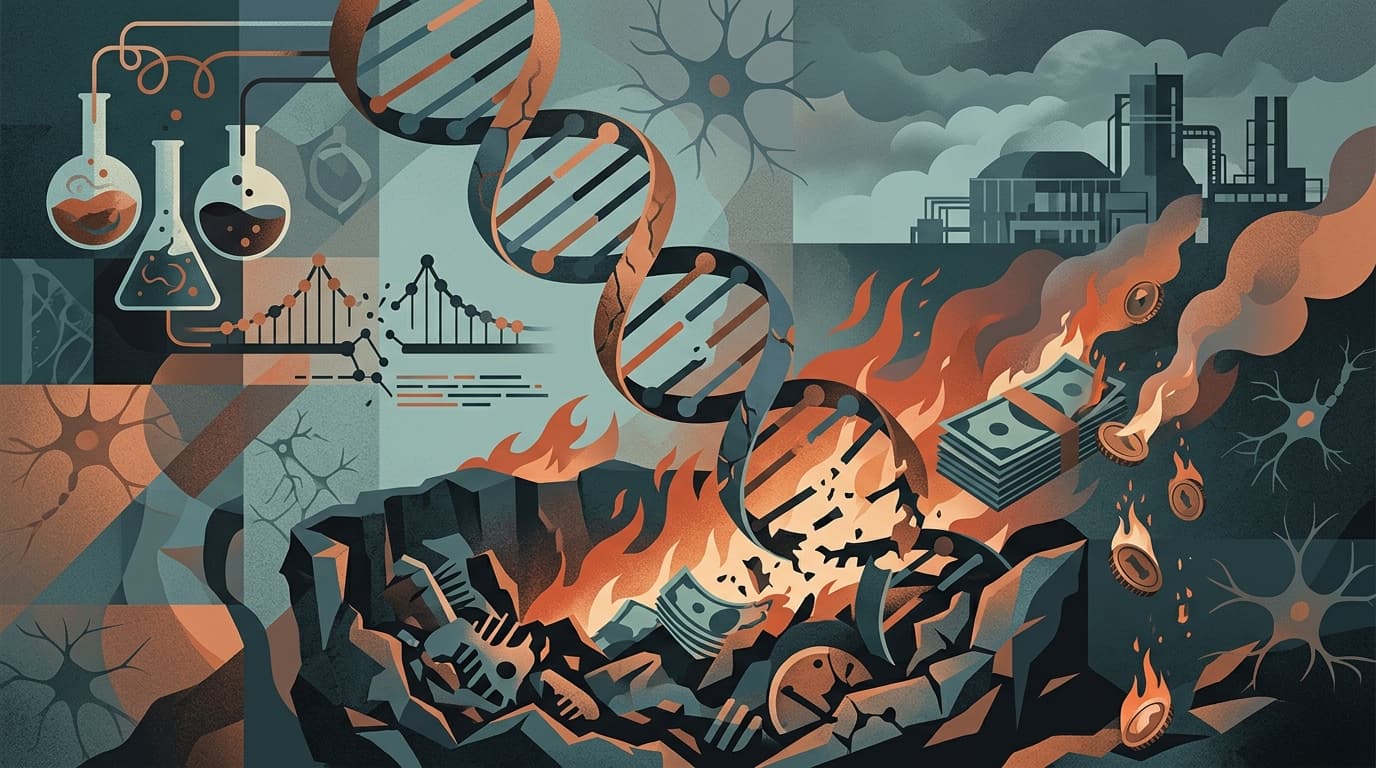
GSK walked away from a $2.2 billion neuroscience deal with Alector after both antibody drugs flopped in clinical trials. The $700 million already spent is gone, and the wreckage says a lot about why brain diseases remain pharma's hardest problem.
The Most Expensive Breakup in Neuro This Year
Imagine paying $700 million for a date and not even getting a second one. That's essentially what happened to GSK.
On July 6, the British pharma giant sent Alector a breakup letter. The message: we're done. GSK formally terminated its entire neuroscience collaboration with the San Francisco biotech, walking away from a deal once valued at up to $2.2 billion. The reason? Both drugs they'd been working on together flopped in clinical trials. Not one. Both.
The 180-day notice means the partnership officially dies on January 2, 2027. But let's be honest: it was already dead.
Two Swings, Two Misses
The collaboration, signed in 2021, centered on two antibody drugs designed to boost levels of a protein called progranulin in the brain. Think of progranulin as a kind of neural maintenance worker. When you don't have enough of it (due to genetic mutations), brain cells start degenerating. The idea was elegant: give patients an antibody that raises progranulin levels, and maybe you slow the disease.
The first drug, latozinemab, targeted a rare form of dementia called FTD-GRN (frontotemporal dementia caused by a progranulin gene mutation). It made it all the way to Phase 3, the final and most expensive stage of testing. In October 2025, the results came in from a trial called INFRONT-3. The drug successfully raised progranulin levels in patients' blood. But on the thing that actually mattered, slowing disease progression, it failed. Secondary measures like brain imaging showed nothing either. The biology worked on paper; it just didn't help patients.
That failure alone forced Alector to cut nearly half its workforce, roughly 116 jobs.
The second drug, nivisnebart, was aimed at a much bigger target: early Alzheimer's disease. It used the same progranulin-boosting approach. A Phase 2 trial called PROGRESS-AD was underway when an independent safety board reviewed the interim data in April 2026. Their conclusion was blunt: continuing the trial would be pointless. There was no sign the drug was working. The trial was stopped for futility, which is the clinical equivalent of a referee calling the fight early.
Get tomorrow's biotech intelligence before your competitors.
Join thousands of biotech professionals who start their day with our free, daily briefing.
With both assets clinically dead, GSK had zero reason to stay.
$700 Million, Gone
Let's talk about the money, because it's staggering.
GSK paid Alector $500 million in 2021 and another $200 million in January 2022, completing a $700 million upfront commitment. On top of that, the deal included up to $1.5 billion in milestone payments tied to development progress, regulatory approvals, and commercial launches. None of those milestones will ever be reached now.
The structure also called for GSK to cover 60% of late-stage development costs, with equal profit sharing in the U.S. and exclusive commercialization rights outside America. It was a massive bet on progranulin biology. And progranulin biology, at least as a therapeutic strategy, has now struck out twice in a row.
Alector's stock tells the story. The company trades around $1.66 to $2.16, depending on the day, with a market cap hovering near $184 million to $240 million. That's less than a third of what GSK paid upfront for the privilege of collaborating. The 52-week range stretches from $0.87 to $3.40, and the stock is pinned near the bottom.
The Neuroscience Graveyard Gets Another Headstone
This isn't just an Alector story. It's a neuroscience story.
Drug development in neurodegeneration is, statistically, one of the worst bets in all of pharma. Across all diseases, roughly 10 to 15% of drugs that enter clinical trials eventually make it to market. For CNS drugs? The FDA approval rate drops to about 6.2%, roughly half the rate of non-CNS drugs. And for Alzheimer's specifically, the carnage is almost comical: a review of around 2,700 AD trials found a success rate of approximately 2% at Phase 2 and Phase 3 since 2003.
The pattern is painfully familiar. A drug hits its biomarker target beautifully but fails to change how patients actually feel or function. It's like building a car engine that revs perfectly on the test bench but won't move the car. The translation from molecular mechanism to clinical benefit remains neuroscience's great unsolved problem.
Alector's third antibody program, AL002 (partnered with AbbVie, targeting a different brain receptor called TREM2), already failed its Phase 2 trial in Alzheimer's back in 2024. That means three for three: every major Alector antibody program in neurodegeneration has now missed its mark.
What GSK Does Next
Interestingly, GSK isn't abandoning the brain entirely. The company has been quietly assembling a new, more cautious neuroscience playbook built almost entirely through partnerships.
In early 2025, GSK struck a deal with ABL Bio to access a technology platform called Grabody-B, which is designed to shuttle drugs across the blood-brain barrier (the biological bouncer that keeps most drugs out of the brain). They've also partnered with Muna Therapeutics on Alzheimer's target discovery using spatial transcriptomics, and launched a collaboration with the UK Dementia Research Institute.
The strategy is clear: invest selectively, use other people's technology, and build in exit ramps. Neuroscience isn't a core pillar for GSK the way oncology or respiratory medicine are. It's more like a side project with a very long leash.
The Bigger Picture for Biotech
The GSK/Alector collapse should make every neuroscience investor a little more cautious. When a top-five pharma company writes off $700 million and walks away from an entire collaboration, it sends a signal. The bar for neuro assets is rising. The patience for Phase 2 misses is shrinking.
Large pharma companies are increasingly structuring neuroscience deals with milestone-heavy, back-loaded economics and aggressive termination rights. They want clear proof of efficacy before committing serious capital. The era of billion-dollar upfronts based on promising preclinical biology is fading, at least in this therapeutic area.
For Alector, the path forward is narrow. Analysts remain oddly split: consensus price targets range from roughly $3.63 to $5.67 (implying 100%+ upside), but the ratings are a grab bag of Buys, Holds, and Sells. That kind of dispersion usually means one thing: nobody really knows what happens next.
And in neuroscience, that's been the default setting for decades.
Funding & Financings5 min read
$715 Million in 48 Hours: The Two Bets Reshaping Biotech
Two of 2026's largest biotech venture rounds landed on back-to-back days: $400 million for AI drug designer Chai Discovery and $315 million for radiopharmaceutical developer AdvanCell. The $715 million blitz reveals exactly where smart money thinks the future of drug development is headed.