
Two of 2026's largest biotech venture rounds landed on back-to-back days: $400 million for AI drug designer Chai Discovery and $315 million for radiopharmaceutical developer AdvanCell. The $715 million blitz reveals exactly where smart money thinks the future of drug development is headed.
Imagine walking into a Vegas casino and watching someone drop $400 million on one table, then turning around to see another player slide $315 million across the felt at the next table over. Now imagine it all happened in 48 hours.
That's essentially what went down in biotech venture capital last week. Chai Discovery, an AI drug design startup, closed a $400 million Series C. The very next day, AdvanCell, a radiopharmaceutical company building cancer-killing alpha therapies, locked up a $315 million Series D. Combined, that's $715 million in back-to-back mega-rounds, making it one of the most concentrated 48-hour stretches of private biotech funding in 2026.
The message from investors? Two themes are worth betting the house on: AI-designed drugs and radioactive cancer treatments.
Chai Discovery is only two years old. Founded in 2024 by a team with roots at OpenAI, Meta's AI research lab, and Stripe, the San Francisco company builds generative AI models that design antibodies from scratch. Think of it like an architect's CAD software, except instead of designing buildings, it designs molecules at the atomic level.
The company's flagship model, Chai-2, works in what's called "zero-shot" mode. You give it a target (say, a protein on a cancer cell) and it generates candidate antibodies without needing custom training data for that specific problem. Early results show roughly a 20% hit rate for viable antibodies, which Chai says is about 100 times better than previous computational methods.
Investors clearly believe the hype is real. Index Ventures led the $400 million round, with Kleiner Perkins, Sequoia Capital, and Dimension joining. The round values Chai at $3.8 billion, triple the $1.3 billion valuation it commanded just seven months earlier during its Series B. Total funding now sits around $630 million.
But what separates Chai from the graveyard of overpromising AI-bio startups? Revenue traction. The company has already signed platform licensing deals with , two of the world's biggest drugmakers. These aren't speculative research partnerships; pharma teams are actively using Chai's tools across their discovery pipelines. That transforms Chai from a "cool science project" into something closer to an enterprise software company that happens to operate in biology.

Europe just greenlit the world's first combined flu-COVID vaccine, and it's not just a convenience play. Moderna's mCOMBRIAX could reshape seasonal vaccination, plug a dangerous coverage gap in older adults, and throw the company a financial lifeline it desperately needs.


Join thousands of biotech professionals who start their day with our free, daily briefing.
The round was reportedly heavily oversubscribed. New investors included Bain Capital Ventures, Battery Ventures, and Baillie Gifford, while existing backers like OpenAI and Thrive Capital doubled down. When both tech VCs and life science specialists are fighting for allocation, it tells you something about where the market thinks this company is headed.
If Chai represents biotech's software layer, AdvanCell represents something far more physical: building tiny radioactive missiles that hunt down cancer cells.
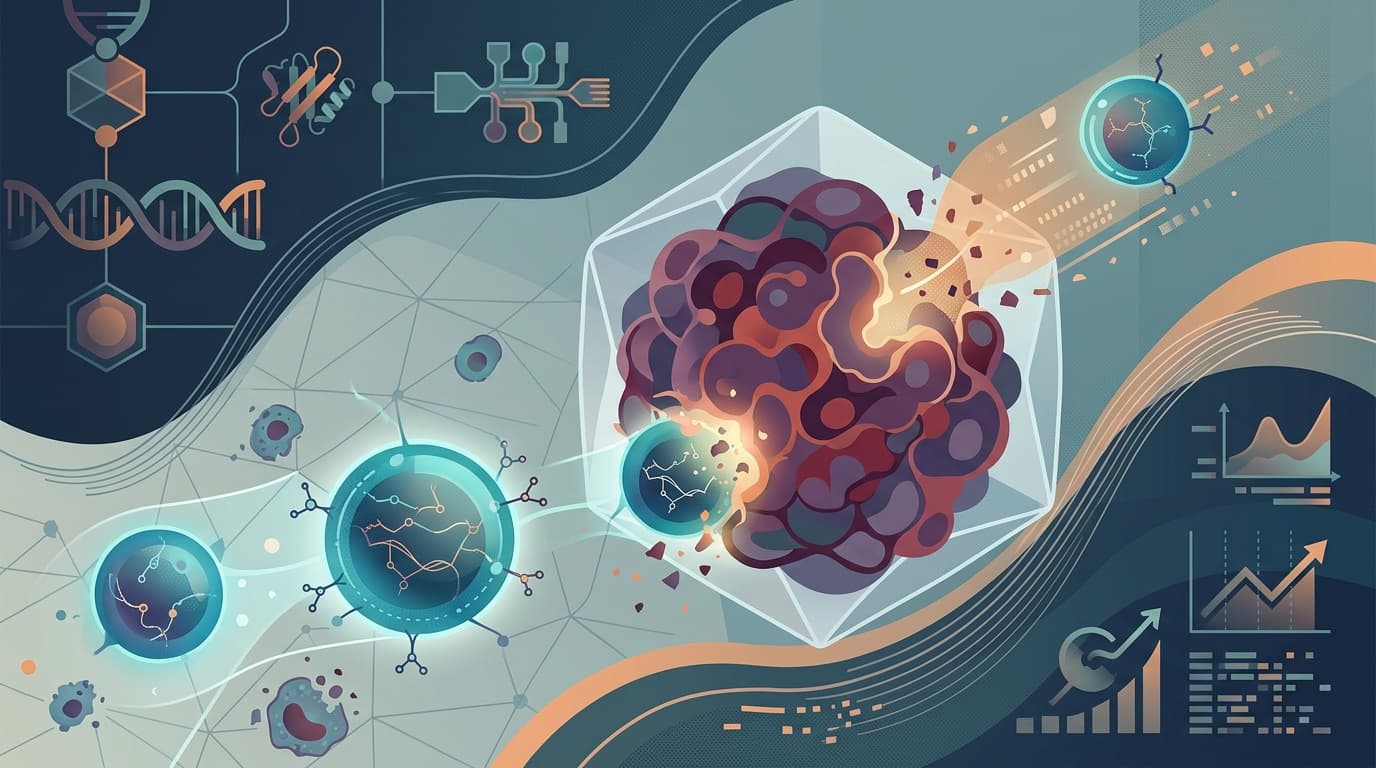
AdvanCell develops targeted alpha therapies (TATs), a next-generation form of radiopharmaceutical. The basic idea is elegant. You attach a radioactive isotope to a molecule that seeks out cancer cells, and when it arrives, the isotope releases alpha particles that shred the tumor's DNA. It's like a guided missile versus a carpet bomb; the radiation goes exactly where you want it.
AdvanCell's secret weapon is Lead-212 (Pb-212), an isotope with a short half-life of about 10.6 hours. That's long enough to do damage to tumors but short enough to limit collateral harm to healthy tissue. The company's lead drug, ADVC001, targets PSMA-positive metastatic prostate cancer and is currently in Phase 2 trials, with the new funding earmarked to push it toward Phase 3.
The $315 million Series D was co-led by Ally Bridge Group and Alpha Wave Global. But the names that really matter are the strategic investors: Eli Lilly and Sanofi Ventures both participated. When two of the world's largest pharma companies invest in your private round, it's not just capital; it's a signal that they might want to buy what you're building someday.
AdvanCell also has a collaboration with Lilly to co-develop additional alpha therapies across multiple cancer types, further cementing the strategic relationship.
Beyond ADVC001, the company has five assets in discovery and two in preclinical development, all built on the same Pb-212 platform. Critically, AdvanCell is vertically integrated: it controls its own isotope supply chain and manufacturing infrastructure, with facilities in Australia and expanding capacity in the U.S. In a world where isotope shortages are the biggest bottleneck for radiopharmaceutical development, owning your supply chain is like owning the oil refinery, not just the gas station.
Zoom out and these two rounds paint a clear picture of 2026's venture capital landscape.
First, capital is concentrating, not disappearing. At least 68 biotech companies raised over $9.1 billion in the first half of 2026, but roughly 76% of that capital flowed into rounds of $100 million or more. The rich are getting richer. If you're a category leader with real data or real revenue, money is abundant. If you're not, good luck.
Second, AI-biotech valuations have entered a new tier. Isomorphic Labs (backed by Alphabet) raised a staggering $2.1 billion Series B earlier this year, the largest single private financing round in AI drug discovery history. Chai's $400 million at a $3.8 billion valuation fits the pattern. The premium for AI-biotech is real, and investors are paying it willingly.
Third, radiopharmaceuticals are no longer a niche. The modality has graduated from academic curiosity to a core oncology investment thesis. Alpha-emitting therapies like AdvanCell's represent a potential leap beyond the beta-emitting radiotherapeutics (think Novartis's Pluvicto) that opened the category. Investors see isotope supply as the key moat, which is why AdvanCell's vertical integration story resonates so strongly.
Finally, notice who's showing up in these syndicates. Crossover funds like Baillie Gifford and T. Rowe Price are writing large checks alongside traditional biotech VCs. Strategic pharma investors (Lilly, Sanofi, OpenAI in a different context) are using equity positions to secure access to platforms they may eventually want to acquire or expand partnerships with. The line between venture investing and business development has never been blurrier.
The optimistic read: these rounds validate that AI drug design and targeted radiotherapies are maturing from "promising" to "proven." Chai has paying customers at the biggest pharma companies on earth. AdvanCell has clinical data and strategic partners lining up.
The cautious read: tripling your valuation in seven months (Chai) or raising $315 million for a Phase 2 asset (AdvanCell) requires everything to go right. AI-designed molecules still need to prove they improve clinical success rates, not just speed up early discovery. And manufacturing radioactive isotopes at commercial scale is an engineering challenge that money alone can't solve.
But for now, investors are voting with their checkbooks. Two mega-rounds, two days, $715 million, and a very clear signal about where biotech's next chapter is being written.
GSK walked away from a $2.2 billion neuroscience deal with Alector after both antibody drugs flopped in clinical trials. The $700 million already spent is gone, and the wreckage says a lot about why brain diseases remain pharma's hardest problem.