Gilead Just Spent $5 Billion on a German Startup You've Never Heard Of
Gilead Sciences is paying up to $5 billion for Tubulis, a German ADC startup most people have never heard of. The deal reveals a deliberate "date first, propose later" strategy and marks Gilead's biggest bet yet on the technology reshaping cancer treatment.
The Date Before the Diamond Ring
Back in December 2024, Gilead Sciences took a German biotech called Tubulis out for coffee. The bill? A modest $20 million upfront for a collaboration deal that could eventually be worth $465 million. It was the biotech equivalent of "let's see where this goes."
Eighteen months later, Gilead proposed. And the ring cost up to $5 billion.
The pharma giant announced it would acquire Tubulis GmbH, a Munich-based antibody-drug conjugate (ADC) company, for $3.15 billion in cash upfront plus another $1.85 billion in milestone payments. The deal closed in Q2 2026, and Tubulis' team will stay in Munich as Gilead's new ADC Innovation Center.
This isn't just another cancer-drug acquisition. It's the latest signal that Big Pharma is treating ADCs like the most important weapon in oncology, and Gilead is willing to pay a massive premium to stay in the arms race.
What Tubulis Actually Does (and Why It's Worth Billions)
If you haven't heard of Tubulis, you're not alone. The company spun out of German academic research in 2019 and raised $575 million across four private funding rounds before Gilead came knocking. Its last raise, a $361 million Series C in October 2025, was the largest Series C in European biotech history.
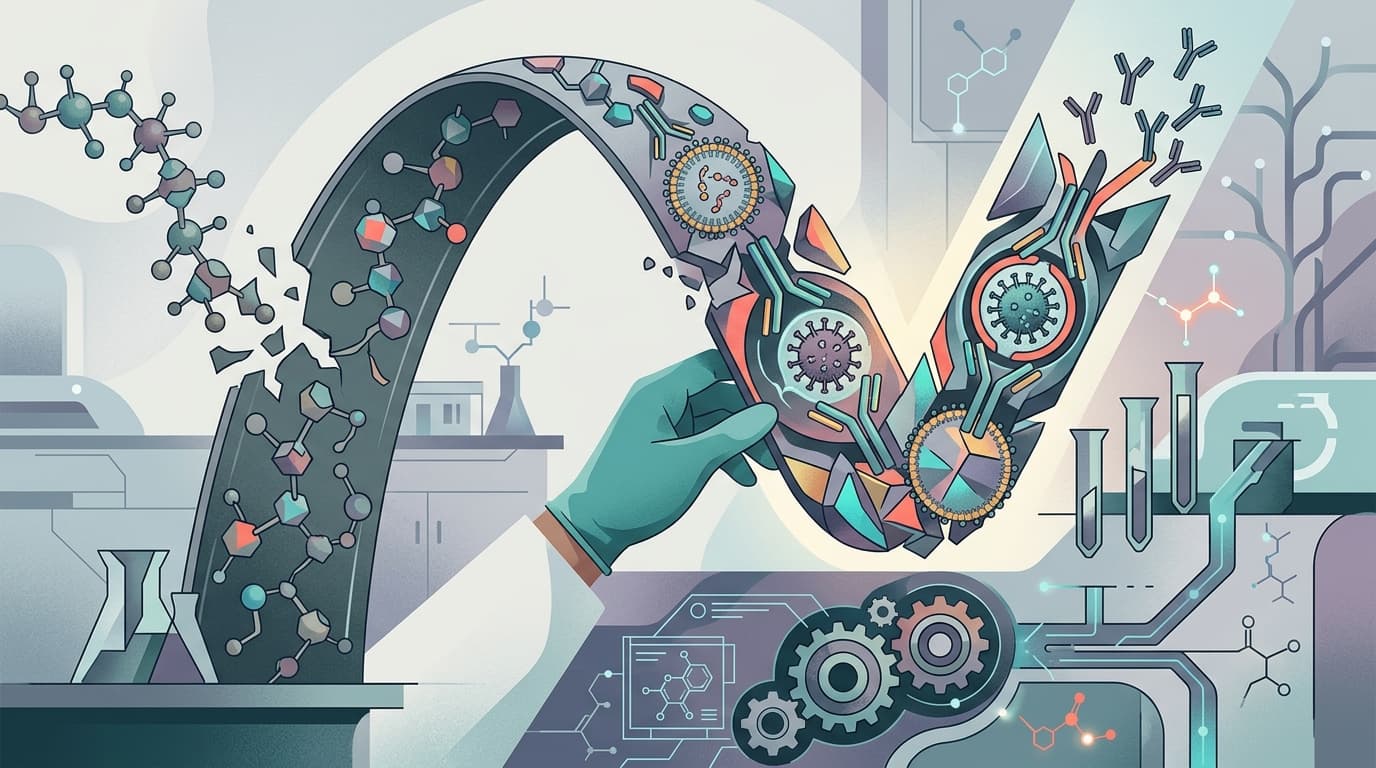
So what does Tubulis make? Antibody-drug conjugates, which are basically guided missiles for cancer. Think of a regular chemotherapy drug as a grenade: it blows up cancer cells, but it also damages everything nearby. An ADC attaches that same toxic payload to an antibody that hunts for a specific protein on tumor cells. The drug gets delivered directly to the cancer, sparing healthy tissue.
The concept has been around for years, but the engineering is fiendishly hard. The toxic payload can detach too early (poisoning the patient) or too late (never reaching the tumor). Tubulis built proprietary conjugation and linker technology designed to make ADCs far more stable, which opens the door to targets and payloads that previous approaches couldn't handle.
Get tomorrow's biotech intelligence before your competitors.
Join thousands of biotech professionals who start their day with our free, daily briefing.
The company has two clinical-stage programs. TUB-040 is in a Phase 1b/2 trial for platinum-resistant ovarian cancer and non-small cell lung cancer. TUB-030, targeting a protein called 5T4, is in Phase I/IIa for advanced solid tumors. Behind those sit a handful of discovery-stage programs that could eventually feed Gilead's pipeline for years.
Gilead's ADC Playbook: Try Before You Buy
Gilead didn't stumble into this deal. The company has been running a deliberate partner-then-acquire strategy in oncology, and Tubulis fits the pattern perfectly.
The playbook started in 2020 when Gilead paid a staggering $21 billion for Immunomedics, the company behind Trodelvy, an approved ADC for certain breast cancers. That deal planted Gilead's flag in solid-tumor oncology and gave it firsthand experience with how ADCs work commercially.
Then came the Tubulis collaboration in late 2024: a low-risk way to kick the tires on the platform before committing billions. When Gilead liked what it saw, it moved to full ownership. It's the same logic behind test-driving a car before buying it, except the car costs $5 billion and treats cancer.
RBC Capital Markets called the acquisition "a strategically sound bolt-on" that secures differentiated next-generation ADC platform capabilities. The key word there is "platform." Gilead isn't just buying two drugs. It's buying the technology to build many more.
The $80 Billion ADC Gold Rush
Gilead's move makes a lot more sense when you zoom out and look at the broader ADC feeding frenzy.
Pfizer set the ceiling in 2023 with its jaw-dropping $43 billion acquisition of Seagen. AbbVie followed with a $10.1 billion buyout of ImmunoGen to grab Elahere and its ADC pipeline. In 2024 alone, ADC-related cancer M&A totaled roughly $20.4 billion across deals involving J&J, AstraZeneca, Genmab, and others.
The math driving all this dealmaking is simple: ADCs are one of the fastest-growing segments in oncology, and Big Pharma companies that don't have a strong ADC platform risk getting left behind. It's like the streaming wars of the late 2010s; every studio needed a platform, and those that waited too long paid more (or missed out entirely).
Gilead's $5 billion price tag looks downright reasonable compared to what Pfizer and AbbVie spent. Of course, those companies bought approved, revenue-generating drugs. Tubulis' lead assets are still in early-to-mid-stage trials, which means the risk is higher. But the potential payoff from owning the underlying platform, not just a single product, could be enormous.
Wall Street Shrugged (for Now)
Investors didn't panic. Gilead shares dipped less than 1% in premarket trading after the deal was announced, which suggests the market sees this as a sensible bet rather than a reckless splurge.
Analysts are broadly supportive but measured. The consensus view is that Tubulis gives Gilead meaningful exposure to next-generation ADC technology while complementing Trodelvy's existing commercial footprint. The ovarian cancer and lung cancer programs address large, high-need markets where better treatments are desperately needed.
The risk? Clinical-stage drugs are still clinical-stage drugs. The path from a Phase 1 trial to a marketed product is long, expensive, and littered with failures. Gilead structured the deal accordingly: $1.85 billion of the total value only gets paid if Tubulis' programs hit specific development and regulatory milestones. That's a built-in insurance policy.
The Bigger Picture
What's fascinating about this deal isn't just the dollar amount. It's what it says about where oncology is heading.
ADCs represent a shift from brute-force chemotherapy toward precision weapons that can target tumors with surgical accuracy. The technology is maturing fast, and the companies building the best platforms (better linkers, more stable conjugates, novel payloads) will likely define the next decade of cancer treatment.
Gilead is betting that Tubulis' engineering gives it an edge. The Munich team stays intact, the platform stays independent, and Gilead gets a pipeline factory instead of a single product.
For a company that built its empire on HIV and hepatitis drugs, that's a bold transformation. But in a world where ADC technology is reshaping oncology, standing still might be the riskiest move of all.
5 min read
The Flu Shot Just Got Its Biggest Upgrade in Decades
The FDA just approved the first-ever mRNA flu vaccine, and it beat traditional shots in a 41,000-person trial. Moderna's mFlusiva won't make much money this year, but it might reshape a $9 billion market.