The Drug That Treats Narcolepsy by Actually Fixing What's Broken
Takeda just got FDA approval for the first drug that actually restores the broken brain signal behind narcolepsy type 1, and it took a spectacular failure and 26 years of science to get here. The orexin era of sleep medicine has officially arrived.
The 26-Year Wait
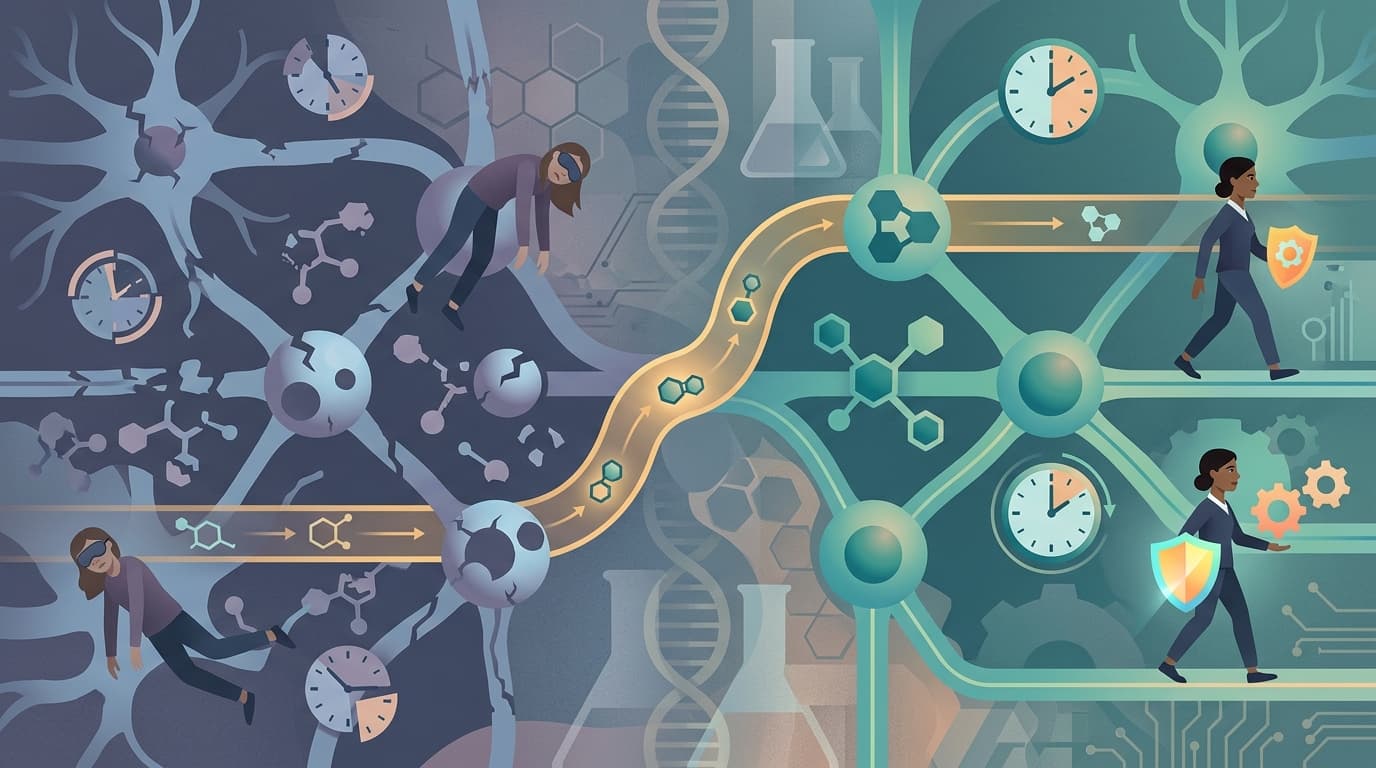
Imagine your brain has a light switch for wakefulness, and someone ripped out the wiring. That's essentially what happens in narcolepsy type 1. The neurons that produce orexin, a chemical signal that keeps you awake and stable, are destroyed. Every treatment on the market has been duct tape: stimulants to force alertness, sedatives to consolidate sleep, antidepressants to suppress cataplexy (sudden muscle collapse triggered by emotions). None of them actually restore the missing signal.
Until now.
On August 5, the FDA approved Orzeyful (oveporexton), a Takeda drug that does something no approved narcolepsy medicine has done before. It turns the orexin system back on. And the path to get here was anything but smooth.
A Quick Neuroscience Detour (Worth It, Promise)
Back in 1998, scientists discovered orexin, a pair of neuropeptides produced by a small cluster of neurons deep in the hypothalamus. These neurons act like a broadcast tower for wakefulness, sending signals across the brain to keep you alert and to prevent REM sleep from barging in at random moments.
By 2000, researchers confirmed the devastating connection: people with narcolepsy type 1 had lost most of their orexin-producing neurons, likely due to an autoimmune attack. The wake-sleep system without orexin is like a thermostat with no sensor. It can't regulate itself, so you get sudden sleep attacks, hallucinations, and cataplexy, where strong emotions cause your muscles to go limp.
The logical fix seemed obvious. If orexin is missing, replace it. Simple in theory; brutally hard in practice.
The First Attempt Crashed and Burned
Takeda's first oral orexin agonist, TAK-994, looked incredible in early trials. It reduced cataplexy and improved wakefulness in ways that got the sleep medicine community genuinely excited. A phase 2 study published in the New England Journal of Medicine provided the first strong human evidence that flipping the orexin switch back on could actually work.
Then the liver toxicity showed up. Dose-dependent liver damage forced Takeda to pull the plug on TAK-994 entirely. Years of work, gone.
Get tomorrow's biotech intelligence before your competitors.
Join thousands of biotech professionals who start their day with our free, daily briefing.
But Takeda didn't abandon the approach. They went back to the lab and designed TAK-861 (oveporexton), a next-generation version engineered to keep the efficacy while ditching the liver problem. Think of it as version 2.0: same blueprint, better safety profile.
The Trials That Sealed the Deal
Orzeyful's approval rests on two pivotal phase 3 studies with names that sound like fantasy novels: FirstLight and RadiantLight. Both trials enrolled adults with narcolepsy type 1 and tested oveporexton against placebo over 12 weeks.
The results were striking. Both studies hit all primary and secondary endpoints with p-values below 0.001 across doses. The primary measure was the Maintenance Wakefulness Test (basically: can you stay awake in a dark, quiet room?). Patients also showed significant improvements on the Epworth Sleepiness Scale, a standard questionnaire for daytime drowsiness, and their weekly cataplexy attacks dropped meaningfully.
But the data that really stood out came from secondary and exploratory measures. About 70% of patients across doses reported no significant cognitive difficulties, compared to roughly 15% on placebo. That's not just staying awake; that's thinking clearly. Sleep quality improved. Daily functioning improved across all six domains measured. For a disease that robs people of normal life, those numbers matter.
On safety, oveporexton was generally well tolerated with no serious treatment-related adverse events. The main side effects were insomnia (somewhat ironic for a wakefulness drug), frequent urination, urinary urgency, and excess saliva. Insomnia was the most notable side effect, which makes pharmacological sense when you're cranking up the brain's arousal system.
Why "First-in-Class" Actually Means Something Here
Pharma loves slapping "first-in-class" on everything. Sometimes it's marketing fluff. Not this time.
Orzeyful is the first approved medicine that directly targets the orexin pathway in narcolepsy. The FDA specifically recognized it as the first drug approved for narcolepsy type 1 "as a complete disorder," not just for individual symptoms. That distinction is important because it reframes the disease itself, from a collection of symptoms to be managed separately into a unified condition with a single underlying cause.
Jefferies analysts called it a potential paradigm shift, noting that its abuse potential appears manageable, which could lead to a Schedule IV controlled substance designation (the least restrictive category for controlled drugs). Truist Securities zeroed in on the FDA's framing, calling Orzeyful the "first mechanistically differentiated entrant" in the sleep market. Translation: Wall Street sees this as genuinely new, not a me-too drug with better marketing.
The Fine Print Before the Celebration
A few caveats are worth noting. First, the approval is limited to adults with narcolepsy type 1. That's the subset with confirmed orexin deficiency and cataplexy. It doesn't cover narcolepsy type 2 or other hypersomnia disorders (yet). Second, you can't walk into a pharmacy and get it tomorrow. Orzeyful needs to go through the DEA scheduling process, which typically takes up to 90 days. Until that's complete, Takeda can't ship the drug.
Takeda itself signaled tempered near-term expectations, saying the approval isn't expected to significantly impact its fiscal year 2027 forecast. Revenue will ramp slowly, not overnight.
Pricing hasn't been publicly announced either. As a first-in-class therapy for a rare disease with no mechanistic competitors on the market, expect it to carry a specialty-drug price tag. How payers respond will shape adoption more than clinical data alone.
The Race Behind Orzeyful
Takeda has a head start, but it won't be alone for long. Harmony Biosciences started a first-in-human study of its own OX2R agonist (BP1.15205) for narcolepsy and a related condition called idiopathic hypersomnia. Other companies, including Centessa, have been linked to orexin agonist programs, though specific timelines remain unclear.
Researchers are also exploring dual orexin receptor agonists that activate both OX1 and OX2 receptors, which could broaden the approach beyond narcolepsy into other conditions involving excessive sleepiness. The orexin pipeline is small today, but the FDA's approval of Orzeyful just validated the entire therapeutic concept. Expect that pipeline to grow fast.
The Bigger Picture
For 26 years, scientists knew what was broken in narcolepsy type 1. They knew orexin neurons were destroyed. They knew replacement therapy was the right idea. But turning that knowledge into a pill patients could swallow safely took two and a half decades of chemistry, one spectacular failure with TAK-994, and two successful phase 3 programs.
Orzeyful isn't a cure. It doesn't regrow the lost neurons. But it does something no other narcolepsy drug has managed: it directly addresses the root cause rather than papering over symptoms. For the estimated tens of thousands of Americans living with NT1 (a rare, widely underdiagnosed disorder), that's not just a new option. It's a fundamentally different kind of option.
5 min read
The Flu Shot Just Got Its Biggest Upgrade in Decades
The FDA just approved the first-ever mRNA flu vaccine, and it beat traditional shots in a 41,000-person trial. Moderna's mFlusiva won't make much money this year, but it might reshape a $9 billion market.