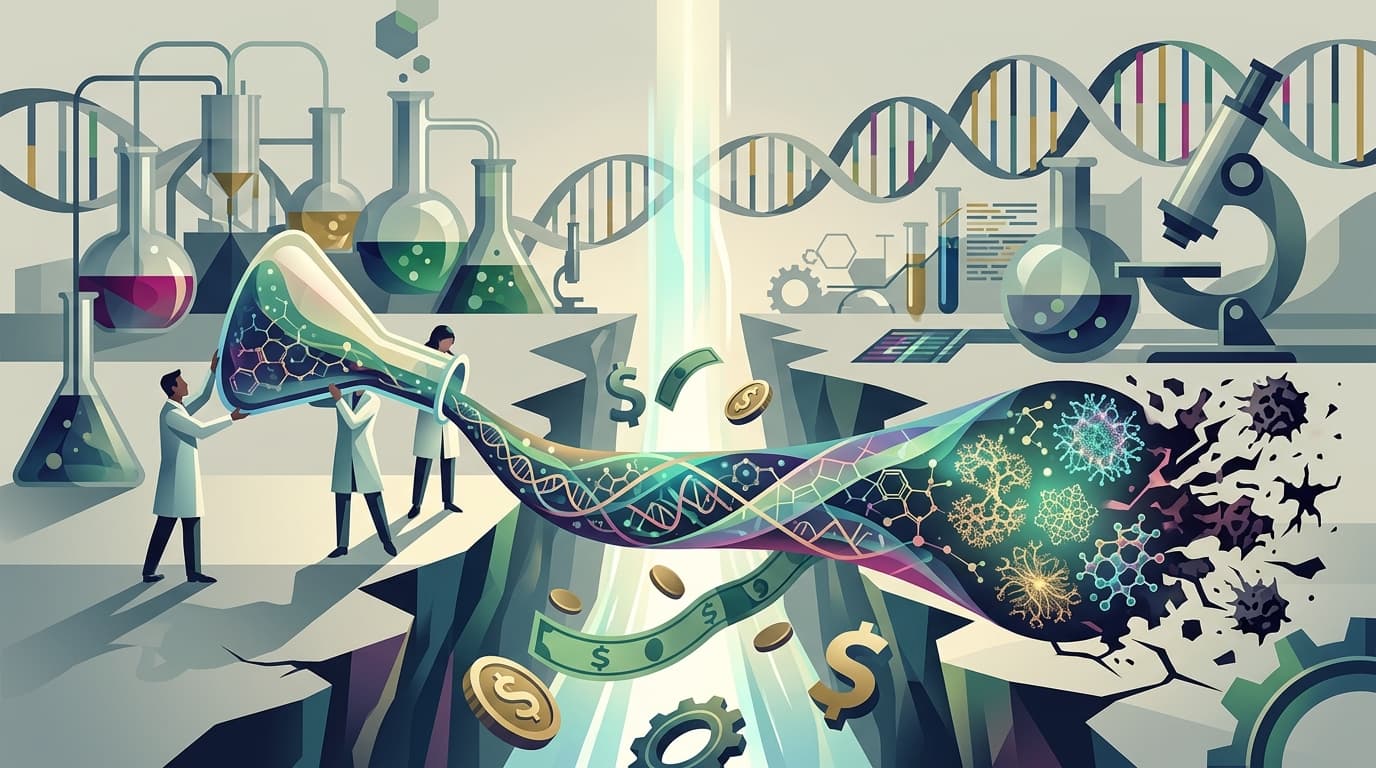

Gilead just paid $45 million to license a cancer drug that doesn't block bad proteins; it destroys them entirely. The Kymera Therapeutics deal could be worth up to $750 million, and it's part of a much bigger bet on protein degradation reshaping oncology.
Most cancer drugs work like putting a padlock on a door. They block a protein from doing its job, but the protein is still there, hanging around, sometimes finding a way to wiggle free.
Kymera Therapeutics thinks that's not good enough. Instead of locking the door, why not demolish the entire building?
On April 9, Gilead Sciences paid $45 million to exercise its option on KT-200, a first-in-class oral drug from Kymera that doesn't just block a cancer-driving protein called CDK2. It destroys it completely. And if the science holds up, this could reshape how we treat some of the hardest cancers out there.
To understand why this deal matters, you need to understand the difference between inhibiting a protein and degrading one.
Traditional cancer drugs are inhibitors. They attach to a problematic protein and try to shut it down, like slapping a "closed" sign on a store entrance. The problem? The store is still standing. Customers (in this case, cancer-promoting signals) sometimes find a back door.
Protein degraders take a radically different approach. They hijack the cell's own recycling system to tag a target protein for disposal. The cell then chews it up and spits out the pieces. No protein, no problem. Think of it less like a security guard and more like calling in the wrecking ball.
KT-200 is what's called a molecular glue degrader. It essentially glues CDK2, a protein that drives tumor growth in certain cancers, to the cell's garbage disposal machinery. In preclinical studies, KT-200 destroyed CDK2 at very low concentrations (low-nanomolar, for the science nerds), showed strong activity in cancer cell lines, penetrated the brain, and appeared safe.
The key advantage: KT-200 selectively targets CDK2 while sparing its close relatives in the CDK family. That selectivity could mean fewer side effects, which is the holy grail for any cancer treatment.
The $45 million Gilead paid isn't just a nice payday for Kymera. It's a signal flare.

Novo Nordisk launched a higher-dose Wegovy at $399 per month, undercutting Eli Lilly's Zepbound by 40% and igniting an all-out pricing war in the obesity drug market. With subscription plans as low as $249/month and 20.7% weight loss in trials, the GLP-1 landscape is being rewritten in real time.


Join thousands of biotech professionals who start their day with our free, daily briefing.

This deal actually started back in June 2025, when the two companies signed an exclusive option and license agreement focused on CDK2-targeted molecular glue degraders. With this option exercise, Kymera could collect up to $85 million total from Gilead in upfront and option exercise payments.
But the real number to watch? $750 million. That's the total Kymera could earn if KT-200 hits every development and commercial milestone. On top of that, Kymera would receive tiered royalties ranging from high single-digits to mid-teens on net product sales.
Gilead now holds global rights to develop, manufacture, and commercialize KT-200. Next up: IND-enabling studies (the final preclinical work needed before testing in humans), with Gilead targeting an IND filing in 2027.
For Kymera, the timing is nice. The company ended 2025 with a fortress-like $1.6 billion in cash and investments, enough runway to fund operations into 2029. Its stock closed at $85.40 on April 2, 2026, with a market cap of approximately $6.44 billion. This is no longer a scrappy startup; it's a platform company that big pharma keeps calling.
This isn't Gilead's first foray into protein degradation. Not even close.
The company has been quietly assembling a degrader portfolio through a web of partnerships. There's the ongoing collaboration with Nurix Therapeutics, originally signed in 2019 and extended by two years in April 2024, which has already produced a clinical candidate called GS-6791/NX-0479 for inflammatory diseases. In 2024, Gilead also partnered with Genesis Therapeutics to use AI for discovering new small molecule therapies across multiple targets.
Now add the Kymera deal, and a pattern emerges: Gilead is building its degrader pipeline entirely through partnerships, not acquisitions. It's a deliberate strategy that lets the company tap into cutting-edge platforms without betting billions on a single buyout. Think of it as renting access to the best kitchens in town instead of buying the whole restaurant.
Gilead EVP Flavius Martin has emphasized that degraders offer a selective mechanism to kill cancer cells while sparing healthy tissue, which fits neatly into the company's broader oncology ambitions.
Gilead isn't alone in its enthusiasm. The protein degradation space has become one of the hottest corners of drug development.
Patent filings tell the story: there were more U.S. and international publications in Q1 2026 alone than in all of 2020. The market for targeted protein degraders is projected to reach roughly $1 billion by 2026, with growth estimates ranging from 10% to 20% annually through the end of the decade.
Major deals are stacking up across the industry. C4 Therapeutics has a discovery collaboration with Merck KGaA. Arvinas and Pfizer, who have been co-developing the PROTAC estrogen receptor degrader vepdegestrant since 2021, jointly decided in September 2025 to out-license commercialization rights to a third party. Vertex signed a deal with Orum Therapeutics for degrader antibody conjugates. And competitors like Monte Rosa are also chasing CDK2, the same target Kymera and Gilead are going after.
Analysts have taken note of the growing momentum in the space, with degraders increasingly seen as having the potential for superior targeting compared to traditional small-molecule inhibitors.
Let's pump the brakes for a second. KT-200 is still preclinical. It hasn't been tested in a single human being yet, and the IND filing is at least a year away.
Protein degradation, for all its promise, faces real challenges. E3 ligase resistance (where cells stop responding to the degradation signal) remains a concern. Development costs are high. And the dense patent landscape means freedom-to-operate issues could slow things down.
Kymera itself is burning cash at an accelerating rate, posting a net loss of $311 million in 2025, up from $224 million the year before. That $1.6 billion war chest is reassuring, but clinical programs are expensive. The company just launched a $500 million at-the-market stock offering in early April 2026, suggesting it wants even more cushion.
Analyst sentiment is mixed: RBC Capital has a $103 price target with an Outperform rating, while Wolfe Research recently downgraded the stock to Peerperform, citing limited near-term catalysts.
Gilead's $45 million payment for KT-200 is a relatively modest check by big pharma standards. But it represents something bigger: a strategic bet that the future of cancer treatment lies not in blocking bad proteins, but in eliminating them entirely.
The science is compelling. The competitive landscape is heating up. And the financial commitment, with up to $750 million on the table, shows this isn't a casual flirtation.
Whether KT-200 ultimately delivers is years away from being answered. But the direction of travel is clear: protein degradation has graduated from academic curiosity to pharmaceutical priority. And Gilead wants to be there when the wrecking ball swings.
Roche just committed over $1 billion in potential milestones to co-develop cancer-killing "guided missiles" with C4 Therapeutics. The same week, Gilead made its own protein degradation bet. When two pharma giants pile into the same modality within 24 hours, it's worth paying attention.