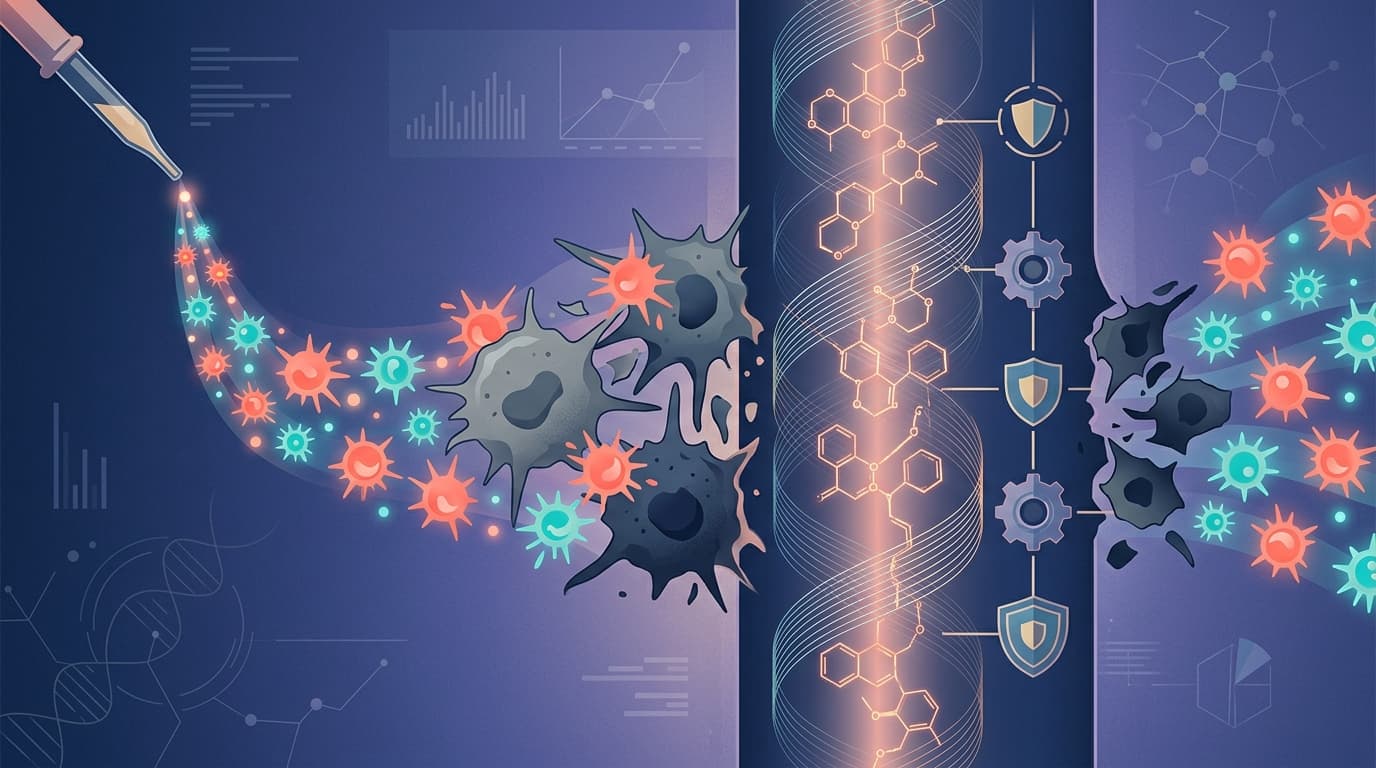

The FDA just approved the first-ever PROTAC drug, a molecule that tricks cancer cells into destroying their own growth machinery. It's a modest commercial story but a massive scientific milestone, and it could reshape how we think about making medicines.
For 25 years, scientists have been chasing a wild idea: what if, instead of blocking a disease-causing protein, you could trick a cell into eating it? On May 1, 2026, that idea stopped being theoretical. The FDA approved vepdegestrant (brand name Veppanu), making it the first-ever PROTAC drug to reach patients. It arrived more than a month ahead of its June 5 deadline, which in FDA terms is the equivalent of turning in your final exam early and acing it.
The drug, developed by Arvinas and Pfizer, treats a specific type of advanced breast cancer. But the real story here isn't just about one cancer drug. It's about an entirely new way of making medicines.
Most drugs work like a bouncer at a nightclub: they stand in front of a protein's active site and block whatever's trying to get in. The problem? Some proteins don't have a good spot to block. And even when a drug does park itself on a target, the protein is still there, loitering around the cell like a guest who won't leave the party.
PROTACs (proteolysis-targeting chimeras) take a completely different approach. Think of them as molecular matchmakers. One end of the molecule grabs the disease-causing protein. The other end grabs a cellular cleanup crew called an E3 ubiquitin ligase. When both ends connect, the cell's recycling machinery tags the bad protein for destruction and shreds it into pieces.
The concept was first described in 2001 by Craig Crews, Ray Deshaies, and Kathleen Sakamoto. Arvinas licensed the technology from Yale around 2013 and entered the clinic in 2019. That's over two decades from whiteboard sketch to FDA approval.
Vepdegestrant is approved for adults with ER-positive, HER2-negative breast cancer that carries a specific genetic change called an ESR1 mutation. To understand why this matters, you need a quick detour into how breast cancer evolves.
Many breast cancers grow because estrogen fuels them through the estrogen receptor (ER). Standard treatments, called endocrine therapies, try to cut off that fuel supply. They work well at first. But tumors are clever. Roughly of patients with metastatic ER-positive breast cancer develop ESR1 mutations after treatment with aromatase inhibitors, the most common first-line hormonal therapy. These mutations let the estrogen receptor fire without estrogen; it's like the engine learning to run without gas.

Moderna and Merck's personalized mRNA cancer vaccine just posted three-year data in melanoma that are turning heads across oncology. The benefit isn't fading; it's getting stronger, and the phase 3 is fully enrolled.


Join thousands of biotech professionals who start their day with our free, daily briefing.
The existing go-to for these patients is fulvestrant, an injectable drug that degrades the estrogen receptor. But outcomes remain modest, and an oral alternative called elacestrant (Orserdu) only recently entered the picture. There's real room for improvement.
The phase 3 VERITAC-2 trial tested vepdegestrant head-to-head against fulvestrant in patients with ESR1-mutated, ER-positive/HER2-negative advanced breast cancer. The primary scorecard: progression-free survival, or how long patients lived without their cancer getting worse.
Vepdegestrant patients had a median PFS of 5.0 months, compared to 2.1 months for fulvestrant. That's more than double. The hazard ratio was 0.57 (meaning roughly a 43% reduction in the risk of disease progression), with a highly significant p-value of 0.0001. At the six-month mark, 45.2% of vepdegestrant patients hadn't progressed, versus just 22.7% on fulvestrant.
The safety profile was clean: no new safety signals, and fewer patients needed dose reductions or had to stop treatment compared to fulvestrant.
One important caveat, though. In the overall trial population (patients without confirmed ESR1 mutations), the drug did not hit statistical significance. The win was confined to the biomarker-selected group. That's why the approved label requires an FDA-authorized test to confirm the ESR1 mutation before prescribing.
If you're wondering why champagne corks aren't flying on Wall Street, it comes down to market size. Early in the Arvinas-Pfizer partnership, some investors dreamed of $3 to $5 billion in peak sales, imagining vepdegestrant as a broad standard of care across all ER-positive breast cancer.
The narrower label changed that math considerably. Jefferies cut its peak sales forecast to about $434 million. A consensus of analyst models now clusters around $533 million in a conservative scenario, potentially reaching $1.6 billion if the label expands over time. BMO analyst Evan Seigerman is more bullish, estimating roughly $2.9 billion, but that's an outlier.
The partnership economics tell their own story. Pfizer paid $650 million upfront plus a $350 million equity investment back in 2021 to lock in a 50/50 global deal. Fast forward to 2026, and the two companies licensed global rights to Rigel Pharmaceuticals for just $70 million upfront, plus potential milestones and royalties. That's quite a markdown from the original blockbuster vision.
Set the commercial debate aside for a moment. The bigger picture is genuinely exciting. Vepdegestrant is proof that targeted protein degradation works in a real clinical setting, with FDA's stamp on it. That's a green light for dozens of other PROTAC programs in development across oncology, neurology, and beyond.
Arvinas itself has programs targeting Parkinson's disease and other conditions with its degrader platform. Several analysts now believe the company's long-term value may hinge more on these next-generation programs than on vepdegestrant's sales numbers alone.
For patients, the near-term impact is tangible. The NCCN added vepdegestrant to its 2026 breast cancer guidelines as a Category 2A recommendation. That means oncologists now have a new, oral option for a population with genuinely limited choices. And critically, it puts a spotlight on ESR1 testing: real-world data show that only about half of eligible patients currently get tested for these mutations. An approved, mutation-specific drug could be the push that closes that testing gap.
Vepdegestrant isn't going to be the biggest-selling cancer drug of the decade. Its niche is real, and its competition (hello, elacestrant) isn't sitting still. But calling it a disappointment misses the forest for the trees.
This is the first drug from an entirely new class of medicine. The first proof that you can hijack a cell's own garbage disposal to treat disease. Twenty-five years ago, it was a concept in a chemistry lab. Today, it's a prescription.
Every drug modality has to start somewhere. Antibodies started with one awkward, mouse-derived product before becoming a market worth over $270 billion. PROTACs just got their foot in the door. What comes next could be a lot more interesting than what's here today.
A Chinese pharma company just got FDA approval for a novel anesthetic that could chip away at propofol's 35-year reign. It's the first China-originated IV anesthetic to crack the U.S. market, and the implications go way beyond the operating room.