Moderna and Merck's personalized mRNA cancer vaccine just posted three-year data in melanoma that are turning heads across oncology. The benefit isn't fading; it's getting stronger, and the phase 3 is fully enrolled.
A Vaccine Built for One Person at a Time
Imagine getting a vaccine that was designed exclusively for you. Not your demographic. Not your age group. You. Your tumor's unique genetic fingerprint, translated into a custom mRNA shot that teaches your immune system exactly what to hunt.
That's what Moderna and Merck have been testing in melanoma patients for the past several years. And the latest data suggest it's working better than almost anyone expected.
The two pharma giants just reported three-year follow-up results from their phase 2b trial of mRNA-4157 (also called V940 or intismeran autogene), a personalized mRNA cancer vaccine given alongside Merck's blockbuster immunotherapy Keytruda. The combo cut the risk of melanoma coming back or killing patients by 49% compared to Keytruda alone. That's not a marginal improvement layered on top of an already strong drug. That's a seismic shift in what "adjuvant therapy" (treatment after surgery to prevent recurrence) can look like.
And the signal isn't fading. It's getting stronger.
The Numbers That Have Wall Street Paying Attention
Let's rewind a bit. When Moderna and Merck first shared 18-month data from the KEYNOTE-942 trial back in 2023, the results were promising but statistically shaky. The risk reduction was about 44%, but the p-value (the statistical measure of whether results could be due to chance) came in at 0.053. In clinical trial world, that's like losing the game by one point. Close, but not a win.
The three-year update changed the math. The hazard ratio dropped to 0.510, which translates to that 49% risk reduction. More importantly, the p-value tightened to 0.019, crossing well into "statistically significant" territory. The benefit didn't just hold up over time; it deepened.
The distant metastasis results were even more striking. Patients who got the vaccine-Keytruda combo had a 62% lower risk of their cancer spreading to distant organs or dying, compared to Keytruda alone. For melanoma patients who've had their tumors surgically removed, distant spread is the nightmare scenario. Cutting that risk by nearly two-thirds is a big deal.
Get tomorrow's biotech intelligence before your competitors.
Join thousands of biotech professionals who start their day with our free, daily briefing.
At two and a half years, about 74.8% of patients in the combo arm remained cancer-free, versus roughly 55.6% on Keytruda alone. That's a 19-point gap, and it stayed open the entire time researchers were watching.
How You Build a Vaccine for One Person
The science behind mRNA-4157 reads like something from a sci-fi novel, except it's happening in actual hospitals right now.
The process starts when a surgeon removes a patient's tumor. Scientists then sequence the tumor's DNA alongside normal tissue from the same patient, looking for mutations unique to the cancer. Think of it like comparing a typo-riddled document to the clean original. Every typo is a potential target.
A proprietary algorithm then ranks those mutations, picking up to 34 of the best candidates (called neoantigens) based on how likely they are to provoke a strong immune response. Those neoantigens get encoded into a single strand of synthetic mRNA, wrapped in lipid nanoparticles (the same fatty delivery bubbles that made COVID vaccines work), and injected into the patient's arm.
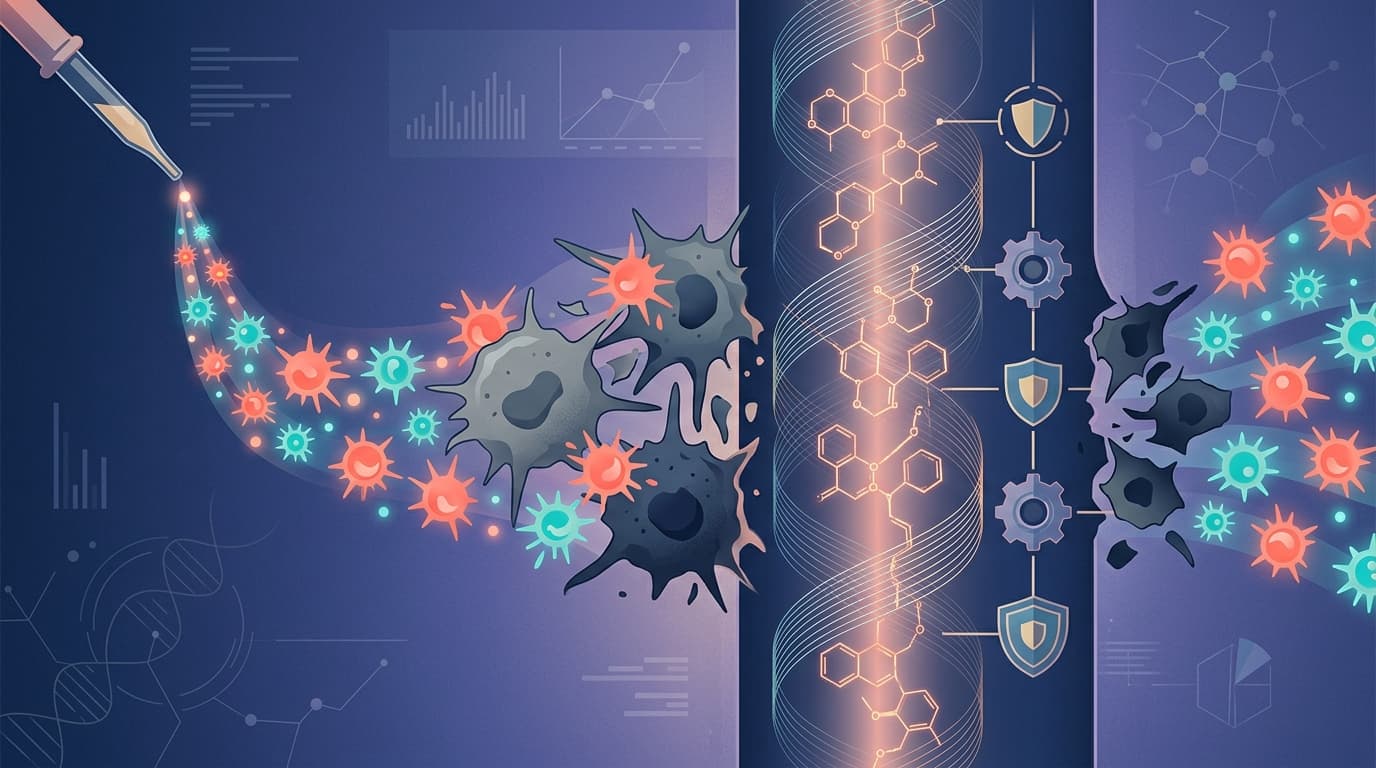
Once inside the body, immune cells called dendritic cells gobble up the mRNA and start displaying those neoantigen fragments on their surface, like posting wanted posters in a police station. Killer T-cells see the posters, learn what to look for, and go hunting. Meanwhile, Keytruda removes a molecular "brake" that tumors use to shut down those same T-cells.
It's a one-two punch: the vaccine tells the immune system what to attack, and Keytruda makes sure the immune system can attack.
Why Three Years Matters More Than You Think
In oncology, short-term results are like first dates. They might look great, but you don't really know what you've got until time passes. Cancer has an ugly habit of coming back, sometimes years after treatment ends. That's especially true for high-risk melanoma, where recurrence rates remain stubbornly high even with the best available therapies.
The fact that this vaccine's benefit is durable and, according to investigators, still deepening at three years is exactly the kind of proof regulators and oncologists need to see. It suggests the vaccine is creating lasting immune memory, not just a temporary boost. The immune system appears to remember its targets long after the last injection.
For context, median recurrence-free survival in the Keytruda-only arm was about 42.5 months. In the combination arm? Researchers couldn't even calculate it because too few patients had relapsed. When statisticians literally can't measure how long your benefit lasts because not enough bad things have happened, that's a good sign.
The Road to Approval: Close but Not There Yet
Before anyone starts popping champagne, there's a critical caveat. KEYNOTE-942 was a phase 2b trial with only 157 patients. That's enough to generate excitement, not enough to get a drug approved.
The real test is INTerpath-001, the phase 3 confirmatory trial that's now fully enrolled with roughly 1,000 to 1,100 patients. This larger study broadens the patient population to include earlier-stage melanoma (stages IIB through IV, compared to the phase 2b's stages III through IV) and carries overall survival as a secondary endpoint. Results are expected sometime in 2026, with the readout depending on how quickly recurrence events accumulate.
Both the FDA and EMA have already given the program express-lane designations: Breakthrough Therapy in the U.S. and PRIME status in Europe. But Merck's head of global clinical development, Eliav Barr, has been clear that regulators will want phase 3 data before accepting a filing. This is a first-in-class therapy, and it will be "scrutinized quite carefully," in his words.
If the phase 3 delivers, analysts at Jefferies project commercial entry around 2027, with more meaningful revenue flowing by 2028 under Moderna and Merck's 50-50 profit-sharing deal. They're calling adjuvant melanoma alone a "multi-billion dollar peak sales" opportunity.
The Competition Is Watching
Moderna and Merck aren't the only ones chasing personalized cancer vaccines, but they're clearly in the lead.
BioNTech (the company behind the Pfizer COVID vaccine) is the closest large-cap competitor. Their individualized neoantigen vaccine, autogene cevumeran, partnered with Genentech/Roche, reported phase 2 data in advanced melanoma with pembrolizumab in early 2026, though the trial did not meet its primary endpoint of progression-free survival improvement. They're also testing in colorectal and pancreatic cancers. But they haven't reached phase 3 yet in any indication, putting them at least a full step behind.
Gritstone is taking a different approach, targeting microsatellite-stable colorectal cancer, a tumor type that barely responds to immunotherapy. It's a bold bet in a brutally difficult setting, with phase 2 data still maturing.
Transgene, working with NEC Corporation's AI platform, is focused on head and neck cancer and showed strong immune responses in 2024 data. But they're earlier stage and smaller scale.
The bottom line: nobody else has three years of randomized data showing a personalized cancer vaccine works on top of the standard of care. That's a significant moat.
What This Means for the Future of Cancer Treatment
Zoom out from the melanoma data, and the implications get even bigger. Moderna already has eight phase 2 and phase 3 trials running for mRNA-4157 across melanoma, lung cancer, kidney cancer, and bladder cancer. If the melanoma phase 3 confirms what the phase 2b showed, it won't just validate one product. It'll validate an entire approach to treating cancer.
The idea that you can sequence a patient's tumor, design a custom vaccine in weeks, and train their immune system to hunt down residual cancer cells has been a dream in oncology for decades. Previous attempts at therapeutic cancer vaccines mostly flopped. The running joke among oncologists was that cancer vaccines were "always five years away."
This time feels different. The data are real, the benefit is durable, and the phase 3 is fully enrolled. Morningstar analyst Karen Andersen noted that if the risk reduction holds up in the phase 3 trial, it bodes well for not only commercialization in melanoma but also prospects in other tumors like kidney, bladder, and lung cancer.
We're not at the finish line yet. Phase 3 results could disappoint; the effect size could shrink in a broader population; manufacturing personalized vaccines at commercial scale remains an untested logistical challenge. Each patient's vaccine is a custom product, which means scaling from hundreds of patients to tens of thousands is a fundamentally different problem than making a one-size-fits-all pill.
But after three years of follow-up, the story being told by this data is remarkably consistent: a personalized mRNA cancer vaccine, layered on top of the world's best-selling cancer drug, is keeping more melanoma patients cancer-free for longer. And the curves aren't converging.
For an industry that's been burned by cancer vaccine hype before, that durability might be the most important number of all.
Clinical & Regulatory
4 min read
The FDA Just Told Gene Therapy Companies to Stop Reinventing the Wheel
The FDA just told gene therapy developers they can stop rebuilding the same data packages from scratch. Two new draft guidances could reshape how genome-editing therapies and cancer biologics reach patients, but the real winners might surprise you.