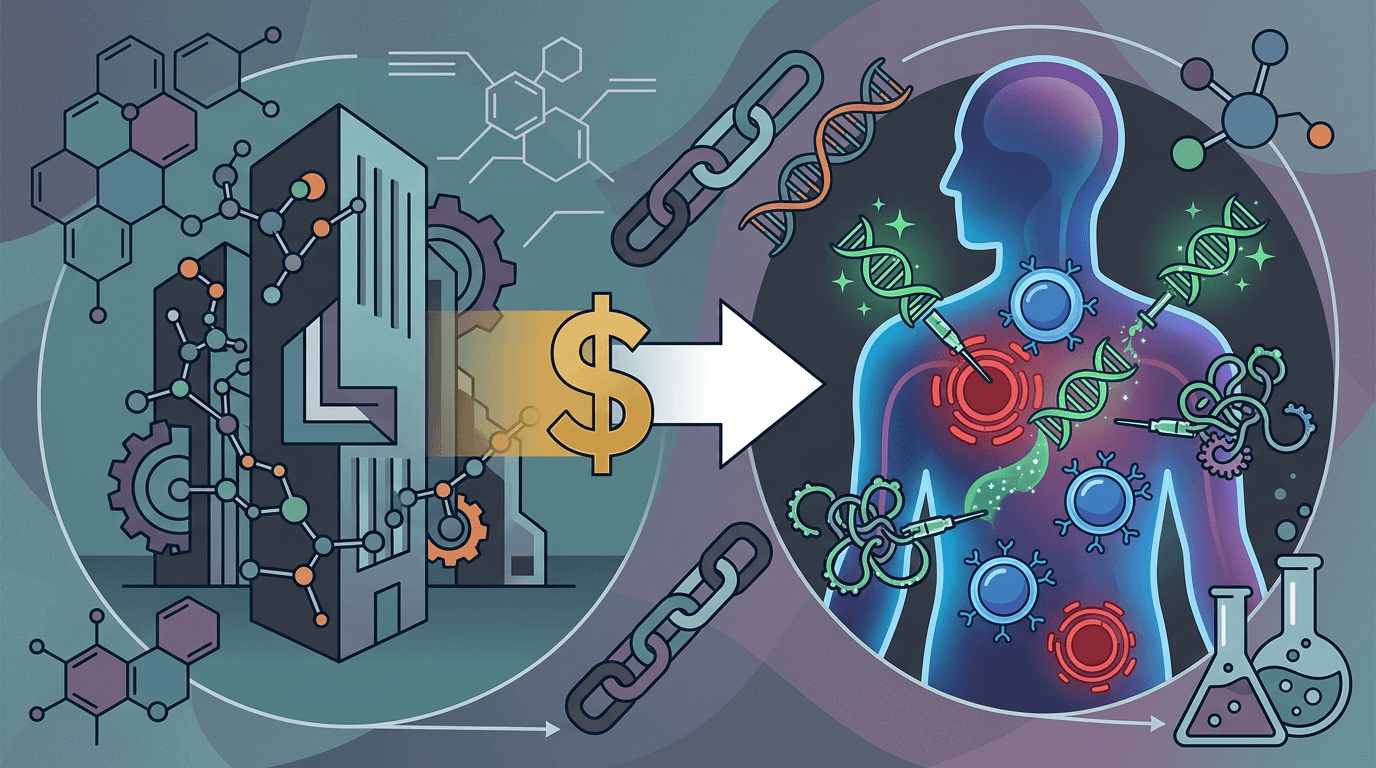

After 25 years in the making, the FDA just approved the first-ever PROTAC drug: a pill that tricks cancer cells into destroying their own proteins. Veppanu's modest clinical results mask a potentially massive shift in how we think about treating disease.
In 2001, a Yale chemist named Craig Crews had a wild idea: instead of blocking a disease-causing protein, what if you could trick the body into eating it?
That idea sat in academic labs for over a decade. It survived skepticism from Big Pharma, the "undruggable" label slapped on countless targets, and the long slog from test tube to human trial. On May 1, 2026, the FDA finally said yes. Veppanu (vepdegestrant), developed by Arvinas and Pfizer, became the first drug of its kind ever approved. And the implications stretch far beyond one breast cancer pill.
Most cancer drugs work like a bouncer at a club: they block a troublemaker protein from doing its job. But the protein is still there, loitering and sometimes finding a way back inside. PROTACs (proteolysis targeting chimeras) take a completely different approach. Think of them less like a bouncer and more like a tow truck.
A PROTAC molecule grabs the disease-causing protein with one hand and a cellular cleanup crew (called an E3 ubiquitin ligase) with the other. Then it forces an introduction. The cleanup crew tags the protein for destruction, and the cell's recycling system shreds it. The PROTAC itself walks away unscathed, ready to repeat the process.
For breast cancer driven by the estrogen receptor, this distinction matters enormously. Traditional drugs block the receptor, but cancer cells can mutate their way around the blockade. Veppanu doesn't just block, it destroys the receptor entirely. That's a much harder obstacle for cancer to outsmart.
Veppanu's approval targets a specific, tough-to-treat group: adults with ER-positive, HER2-negative breast cancer that carries a mutation in the ESR1 gene. This is the most common subtype of metastatic breast cancer, and roughly half of patients on hormone therapy eventually develop ESR1 mutations as their tumors learn to resist treatment.
These patients have already been through at least one round of endocrine therapy. Their cancer adapted. Their options narrowed. Until now, the main targeted alternative was elacestrant (Orserdu), an oral drug approved a few years ago. It helped, but the bar was painfully low: median progression-free survival (PFS, or the time before cancer starts growing again) was just with elacestrant versus 1.9 months for standard hormone therapy.

Eli Lilly is paying up to $7 billion for a tiny biotech that wants to reprogram your immune cells without ever taking them out of your body. It's the boldest bet yet in the race to make CAR-T therapy as simple as an IV drip.


Join thousands of biotech professionals who start their day with our free, daily briefing.

The VERITAC-2 trial compared Veppanu head-to-head against fulvestrant, a standard injectable hormone therapy, in patients with ER-positive, HER2-negative advanced breast cancer. In the ESR1-mutant group (270 patients), Veppanu delivered a median PFS of 5.0 months compared to just 2.1 months for fulvestrant.
That translates to a 43% reduction in the risk of disease progression or death (hazard ratio: 0.57, p=0.0001). The objective response rate told a similar story: 18.6% of Veppanu patients saw their tumors shrink meaningfully, versus only 4% on fulvestrant.
Now, let's be honest. Five months of progression-free survival isn't going to make anyone pop champagne. But context matters here. These patients had already failed prior therapy, and the comparison arm (fulvestrant) held them for barely two months. Overall survival data is still maturing, so the full picture isn't in yet.
One important caveat: in the broader, all-comers population (not just ESR1-mutant patients), the trial did not hit statistical significance. PFS was 3.7 months versus 3.6 months, with a p-value of 0.07. The drug's magic, at least for now, is confined to ESR1-mutant disease. That's why the FDA approved it with a companion diagnostic (Guardant360 CDx) to test for the mutation.
Analysts aren't exactly modeling Veppanu as a blockbuster. The ESR1-mutant population is a slice of a slice of breast cancer, and the commercial rights have been licensed to Rigel Pharmaceuticals, with Arvinas and Pfizer collecting milestones and royalties rather than selling the drug themselves.
With Arvinas burning roughly $285 million per year on R&D, Veppanu's royalty stream alone won't turn the company profitable. The consensus? Veppanu is a proof of concept, not a profit engine.
The real value is validation. Before May 1, the biggest question hanging over every PROTAC program on the planet was simple: can this stuff actually get approved? Now that question has an answer.
And there are a lot of programs waiting behind that gate. Arvinas itself has bavdegalutamide (ARV-110) in Phase I/II for prostate cancer, targeting the androgen receptor. Nurix Therapeutics is pushing BTK degraders for blood cancers. Kymera Therapeutics has IRAK4 and STAT6 degraders aimed at inflammatory diseases like atopic dermatitis. C4 Therapeutics is chasing BRAF and EGFR mutations in solid tumors. BMS inherited a molecular glue empire from Celgene and is building its own PROTAC portfolio alongside it.
The competitive landscape reads like a land grab. BeiGene, Astellas, Novartis, Roche, AstraZeneca, and Bayer are all building protein degradation programs. The theoretical appeal is irresistible: PROTACs could potentially target proteins that traditional drugs simply can't reach (transcription factors, scaffolding proteins, and other "undruggable" targets that make up a huge chunk of disease biology).
The 25-year journey from Crews's first chimeric molecule to a pill with an FDA label is, in many ways, the biotech equivalent of the Wright Brothers' 12-second flight. Nobody's crossing the Atlantic yet. Five months of PFS in a narrow patient population is a modest clinical result by any standard.
But what it proves is transformational. The human body's own protein disposal system can be hijacked, reliably and safely enough, to treat disease. The side effects were mostly mild (Grade 1-2), with QT interval prolongation on heart monitoring and liver enzyme changes flagged as key warnings on the label.
The modality works. The regulators are on board. And dozens of companies are now racing to prove it works against harder targets, in bigger populations, with even better results.
Twenty-five years ago, the idea of tricking a cell into destroying its own broken parts sounded like science fiction. Today, it's a prescription you can fill at a pharmacy. The first chapter of protein degradation is officially written. The interesting ones are just beginning.
Gilead just agreed to pay up to $2.2 billion for Ouro Medicines, a startup that's barely a year old. The deal centers on an "immune reset" drug that could reshape how we treat autoimmune diseases, and Gilead isn't even paying the full tab.