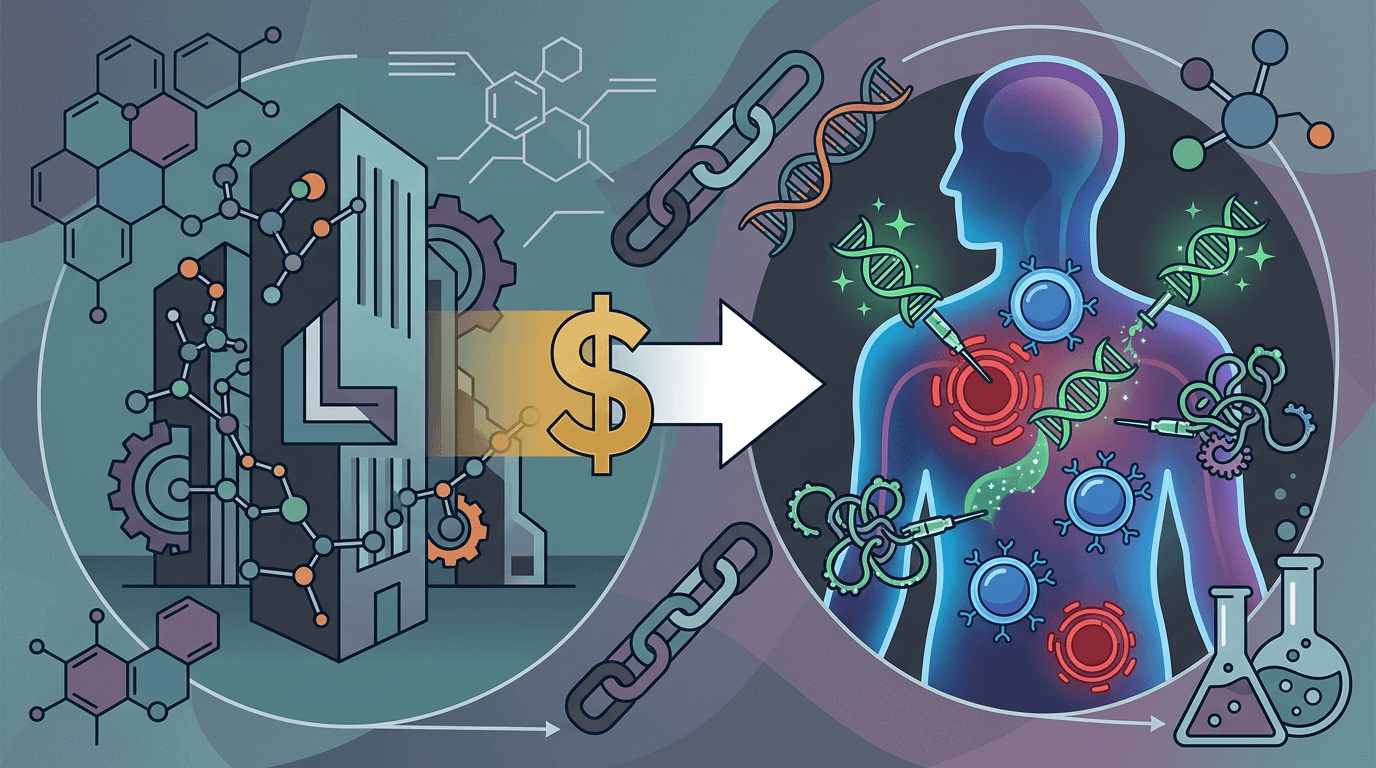
Lilly Just Bet $7 Billion on a CAR-T Therapy That Skips the Factory
Eli Lilly is paying up to $7 billion for a tiny biotech that wants to reprogram your immune cells without ever taking them out of your body. It's the boldest bet yet in the race to make CAR-T therapy as simple as an IV drip.
The Most Expensive Science Experiment You've Never Heard Of
Imagine you need a custom suit. Normally, a tailor takes your measurements, ships the fabric to a factory, sews everything together over several weeks, and then ships it back. That's how CAR-T cell therapy works today: doctors extract your immune cells, send them to a lab, genetically reprogram them to fight cancer, grow a whole army of them, and infuse them back into your body. It's brilliant. It also takes weeks, costs a fortune, and requires specialized treatment centers that most patients can't easily access.
Now imagine a tailor who could alter the suit while you're still wearing it. That's roughly what Kelonia Therapeutics is trying to do with cancer treatment. And Eli Lilly just agreed to pay up to $7 billion in cash to own that technology.
The deal, announced on April 20, 2026, includes $3.25 billion upfront at closing plus up to $3.75 billion in milestone payments tied to clinical, regulatory, and commercial achievements. It's Lilly's biggest single-asset bet of the year, and it signals something important: big pharma thinks the future of cell therapy doesn't involve a factory at all.
What Kelonia Actually Does
Kelonia Therapeutics is a clinical-stage biotech, founded by Kevin Friedman, PhD, and incubated by the venture capital firm Venrock. The company is tiny (roughly 10 to 50 employees) and based in Massachusetts, but its technology has an outsized ambition.
The company built something called the iGPS platform, which stands for in vivo Gene Placement System. In plain English: it's an engineered lentiviral vector (a modified virus particle) designed to find T cells inside your bloodstream and deliver new genetic instructions to them. Those instructions tell your T cells to produce a CAR, or chimeric antigen receptor, which is essentially a targeting device that helps them recognize and kill cancer cells.
The key word is in vivo, meaning "inside the living body." Traditional CAR-T is , meaning the engineering happens outside the body in a lab. Kelonia's approach could theoretically work as a : one IV bag, one dose, and your own immune system starts building cancer-fighting cells on its own.
Get tomorrow's biotech intelligence before your competitors.
Join thousands of biotech professionals who start their day with our free, daily briefing.
ex vivo
single intravenous infusion
Their lead candidate, KLN-1010, targets a protein called BCMA that sits on the surface of malignant plasma cells. It's being tested in a Phase 1 trial (called inMMyCAR) for patients with relapsed or refractory multiple myeloma, which means their cancer came back or didn't respond to prior treatment.
Why This Matters More Than the Price Tag Suggests
Let's be honest: $7 billion for a Phase 1 asset raised some eyebrows on Wall Street. And rightfully so. KLN-1010 is early. Really early. The kind of early where you're still checking whether the drug is safe, let alone whether it works well enough to get approved.
But Lilly isn't just buying a drug. They're buying a platform.
The iGPS system is designed to be modular. Swap out the targeting molecule on the viral particle, and you can theoretically redirect it to different cell types or deliver different genetic payloads. That means Kelonia's technology could eventually extend beyond blood cancers into solid tumors and possibly even autoimmune diseases. It's less like buying a single lottery ticket and more like buying the lottery machine.
Analysts have described the deal as a "venture-style bet" that looks large in absolute terms but is manageable relative to Lilly's enormous cash flows from its obesity and diabetes franchises. Think of it this way: Lilly's oncology business alone generated $9.4 billion in sales in 2025. The $3.25 billion upfront is a significant check, but it's not a bet-the-company move.
Still, the stock barely budged on the news. Shares traded flat to slightly lower as investors weighed the early-stage risk. The market's message was clear: prove it works first, then we'll get excited.
Lilly's Quiet Oncology Overhaul
The Kelonia deal doesn't exist in a vacuum. It's the latest move in what's becoming a systematic rebuild of Lilly's entire cancer portfolio.
In 2026 alone, Lilly has announced at least six M&A deals, with three focused on oncology. Earlier in the year, they acquired Orna Therapeutics (up to roughly $2.4 billion) for its circular RNA platform, which also has in vivo CAR-T applications. They picked up Ajax Therapeutics (up to $2.3 billion) for next-generation JAK inhibitors targeting blood cancers called myeloproliferative neoplasms. And that's on top of the 2024 acquisition of Morphic Therapeutic for $3.2 billion, which brought in an oral drug for inflammatory bowel disease.
The pattern is unmistakable. Lilly is converting its GLP-1 cash (from blockbusters like Mounjaro and Zepbound) into a diversified pipeline across oncology, immunology, and genetic medicine. Jake Van Naarden, who came over from Loxo Oncology, has been tasked with overhauling Lilly's cancer business. That overhaul apparently includes terminating legacy programs and placing bigger, more concentrated bets on differentiated science.
Kelonia is arguably the boldest of those bets.
The Race to Make CAR-T as Simple as an IV Drip
Kelonia isn't alone in trying to crack in vivo CAR-T. The field is crowded with well-funded startups, including Umoja Biopharma, Capstan Therapeutics, Interius BioTherapeutics, and several others working on different delivery technologies (lipid nanoparticles, non-viral vectors, engineered viral capsids).
The strategic logic is compelling. Today's approved CAR-T therapies are medical marvels, but they're also logistical nightmares. A patient needs to visit a specialized center, undergo a blood draw called leukapheresis, wait weeks for their cells to be manufactured, receive lymphodepleting chemotherapy to make room for the new cells, and then get the infusion. The whole process is expensive, time-consuming, and available only at major academic medical centers.
In vivo CAR-T promises to compress all of that into something closer to a standard infusion. No cell collection. No factory. No weeks of waiting. If it works, it could bring CAR-T therapy to community hospitals and clinics that currently can't offer it.
That "if" is doing a lot of heavy lifting, though.
The Risks Nobody Should Ignore
In vivo gene delivery is genuinely hard. When you inject viral particles into a person's bloodstream, you need them to find the right cells (T cells) and only those cells. Transducing the wrong cell type could cause unpredictable problems. There's also the risk of insertional mutagenesis, where the viral vector integrates its genetic cargo into a dangerous spot in the genome, potentially triggering new cancers.
Dose control is another headache. With ex vivo CAR-T, you know exactly how many engineered cells you're putting back into the patient because you counted them in the lab. With in vivo delivery, you're relying on the body to do the manufacturing, and bodies are notoriously variable.
Then there's durability. Will a single IV dose generate enough CAR-T cells to provide lasting cancer control? Will those cells persist, or will the immune system clear them? First-in-human Phase 1 clinical data from Kelonia (highlighted at the 2025 ASH Annual Meeting) looked encouraging, but early clinical results have a long history of making things look easier than they turn out to be at scale.
The broader in vivo CAR-T field remains pre-commercial. No in vivo CAR-T product has been approved anywhere in the world. The entire category is still proving basic safety and feasibility in Phase 1 trials.
The Bigger Picture: Pharma Is Betting the Farm on Delivery
Zoom out, and the Kelonia deal reflects a broader trend across the industry. Large pharma companies are increasingly competing not just for drugs, but for delivery platforms that can serve as engines for multiple products.
Start-up financing in gene, cell, and RNA therapies surged in late 2025, with Q4 seeing 14 transactions worth $557 million, a 141% increase in value compared to the prior quarter. Capital is flowing toward fewer, higher-quality platform companies. The acquirers aren't buying one drug; they're buying the ability to make many.
The in vivo CAR-T market, while tiny today (estimated at roughly $368 million in 2024), is projected to grow at about 33% annually through 2034. If even a fraction of that forecast materializes, the companies that locked in platform access early will have a significant head start.
Lilly clearly believes that future is coming. With Kelonia and Orna in the fold, they now own two distinct in vivo cell therapy platforms (lentiviral and circular RNA), giving them multiple shots on goal across different delivery modalities.
So Is $7 Billion Worth It?
That depends entirely on whether in vivo CAR-T works in humans the way it works in mice. If KLN-1010 produces safe, durable responses in its Phase 1 trial, the deal will look like a steal. If the platform stumbles on safety signals or underwhelming efficacy, it'll look like Lilly overpaid for a science project.
The honest answer is that nobody knows yet. And that's exactly the point. Lilly is making a bet that the science will mature, that the platform will generalize, and that in vivo cell therapy will eventually become the default way to treat blood cancers (and maybe much more).
It's a $7 billion wager on a future that doesn't exist yet. But if you're sitting on a mountain of GLP-1 cash and watching your oncology competitors build next-generation platforms, standing still might be the riskiest move of all.
5 min read
One Shot to Kill Cholesterol Forever
Eli Lilly is pushing a gene-editing therapy into Phase 2 that could permanently slash cholesterol with a single infusion. It's the biggest bet yet that CRISPR-era medicine can tackle the world's leading killer, not just rare diseases.