Gilead Just Dropped $2.18 Billion on a Company You've Never Heard Of
Gilead just agreed to pay up to $2.2 billion for Ouro Medicines, a startup that's barely a year old. The deal centers on an "immune reset" drug that could reshape how we treat autoimmune diseases, and Gilead isn't even paying the full tab.
A Startup, a Giant, and a Very Large Check
Ouro Medicines launched in January 2025 with $120 million in venture funding. Roughly fourteen months later, Gilead Sciences agreed to buy it for up to $2.18 billion. That's an 18x return on the company's only funding round, and it tells you everything about where Big Pharma thinks the next blockbuster drugs are hiding.
The deal breaks down to $1.675 billion in cash upfront, plus up to $500 million in milestone payments tied to R&D and commercial progress. For Gilead, this isn't a moonshot bet. It's the latest piece in a very deliberate puzzle.
What Gilead Is Actually Buying
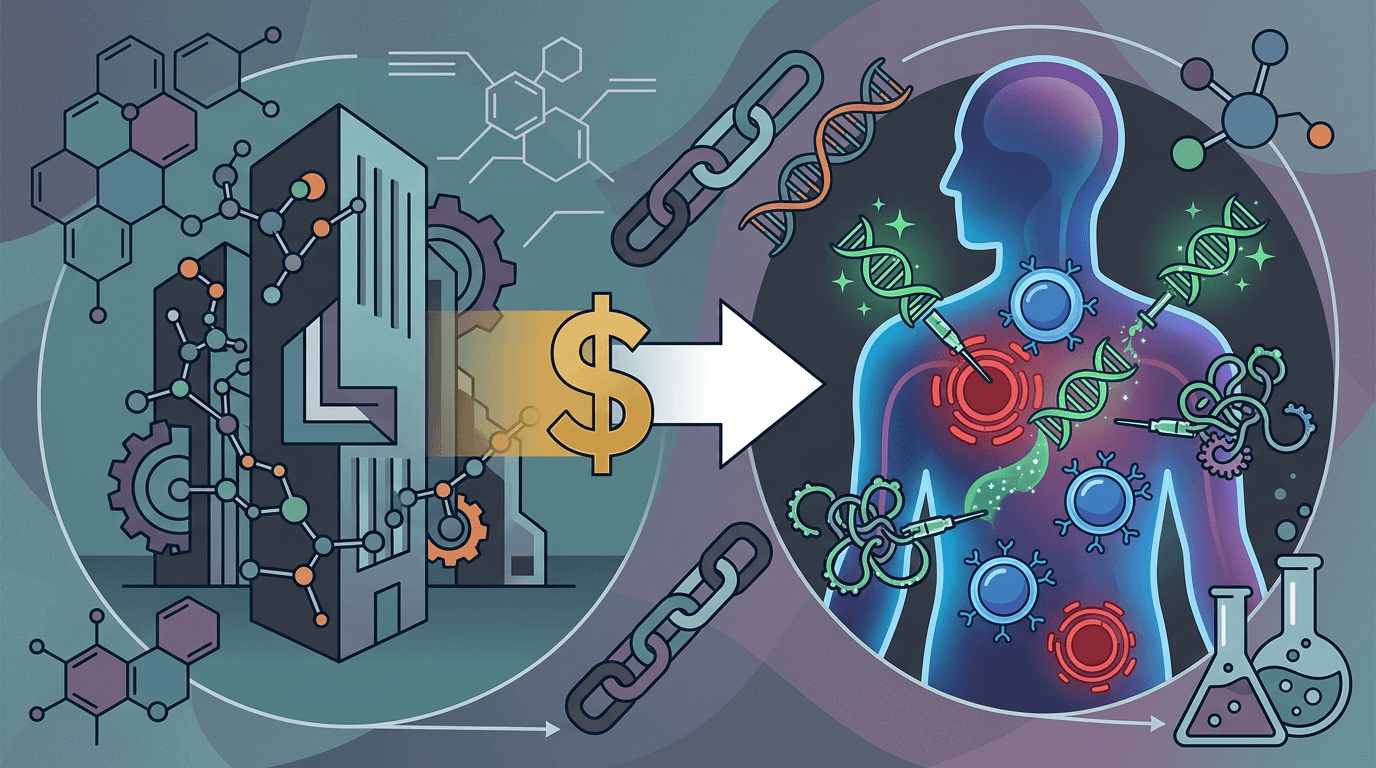
Ouro's crown jewel is a drug called OM336 (gamgertamig), and it works like a biological bounty hunter. It's a bispecific T-cell engager, which is a fancy way of saying it grabs your immune system's killer T-cells with one hand and points them at disease-causing B-cells with the other. Think of it as a molecular GPS that redirects your own immune soldiers to the right battlefield.
Specifically, OM336 targets BCMA (a protein found on B-cells and plasma cells) while simultaneously latching onto CD3 on T-cells. When those two connections click, the T-cells destroy the problematic B-cells. Researchers call this an "immune reset" because it wipes out the rogue immune cells causing the disease, then lets the body rebuild from scratch.
The drug is currently in Phase 1/2 trials for two rare blood disorders: autoimmune hemolytic anemia (AIHA), where your body destroys its own red blood cells, and immune thrombocytopenia (ITP), where it attacks your platelets. Both conditions have earned Orphan Drug and Fast Track designations from the FDA, which means faster regulatory review and market exclusivity.
Gilead expects to start registrational (approval-seeking) studies in 2027. There's also early work in Sjögren's disease and a broader pipeline targeting other autoimmune conditions.
Get tomorrow's biotech intelligence before your competitors.
Join thousands of biotech professionals who start their day with our free, daily briefing.
The Galapagos Safety Net
Here's where the deal gets clever. Gilead isn't footing the bill alone.
Under a parallel agreement with Galapagos, its longtime biotech partner, the two companies will split the cost of the acquisition 50/50. That means Galapagos effectively covers half of the $1.675 billion upfront and up to half of the $500 million in milestones. Even better for Gilead: Galapagos will fund all development costs for OM336 until registrational trials begin, at which point costs are shared equally.
In exchange, Galapagos gets tiered royalties of 20 to 23% on net sales and can earn up to $100 million in additional development milestones. Truist Securities reportedly called this co-funding structure something that "meaningfully de-risks Gilead's investment profile." It's hard to argue with that math.
Gilead keeps global commercialization rights (except Greater China, where Keymed Biosciences holds the license). So Gilead controls the revenue while sharing the risk. That's a pretty sweet arrangement.
Why Gilead Is on a Shopping Spree
Ouro isn't an isolated purchase. It's the third major acquisition Gilead announced in early 2026, following Arcellx (a $7.8 billion CAR-T cell therapy deal) and Tubulis (up to $5 billion for an antibody-drug conjugate platform). Combined, that's roughly $15 billion in deals closing in a single quarter.
The reason is straightforward: Gilead's legacy HIV and hepatitis C businesses are mature. HIV still generates massive revenue, but growth is plateauing. Hepatitis C, once a goldmine, has been declining for years as curative treatments shrink the patient pool. Gilead needs new engines.
The company's pipeline now contains more experimental drugs in cancer and inflammatory diseases than in infectious diseases, a historic shift for a company built on antiviral drugs. Management has been explicit about this pivot.
Think of it like a sports team that went on a free-agency spending spree. The roster is loaded with talent; now they need to make it work together.
Wall Street's Verdict: Cautiously Optimistic
Analysts have been mostly positive, though not without caveats. Gilead's stock edged higher on the Ouro announcement, a polite nod from the market that says "we like it, but prove it."
The bull case is clear: OM336 could become a franchise drug across multiple autoimmune diseases. If the immune reset approach works as well in larger trials as early data suggest (Gilead described "transformative efficacy" after a single treatment cycle), the addressable market is enormous.
The bear case centers on clinical risk. OM336 is still early-stage. Phase 1/2 data can look great and still fall apart in larger trials. And integrating three major acquisitions simultaneously is a logistical nightmare, even for a company Gilead's size.
There's also an accounting headache. Gilead warned that its 2026 effective tax rate could hit 140 to 190% (yes, you read that right) because of nondeductible charges from the Arcellx, Ouro, and Tubulis deals. That will make GAAP earnings look ugly this year, even as the underlying business is strong. Management raised its 2026 product sales guidance by $400 million, to a range of $30.0 to $30.4 billion, which helps offset the optics.
Among the roughly 30 analysts covering Gilead, none have a Sell rating.
The Bigger Picture: Autoimmune Is the New Oncology
Zoom out, and the Ouro deal reflects a broader industry trend. Autoimmune diseases are becoming pharma's hottest target, thanks to new biological tools (like T-cell engagers and CAR-T therapies) originally developed for cancer. The idea of an "immune reset," wiping out defective immune cells and letting the body rebuild, has moved from theoretical to clinical in just a few years.
Gilead now has a growing portfolio of inflammatory drugs in clinical trials, plus OM336. Combined with its oncology expansion through Arcellx and Tubulis, the company is betting its future on a simple thesis: the same modular immune-engineering platforms that revolutionized cancer treatment can do the same for autoimmune diseases.
For Ouro's investors (TPG, NEA, Norwest, GSK, and founding firm Monograph Capital), a $120 million bet turned into a potential $2.18 billion payday in just over a year. For Gilead, the real payoff won't come until 2027 and beyond, when pivotal trial data will determine whether gamgertamig is actually the immune reset drug the company believes it is.
Until then, Gilead's message to the market is unmistakable: the company that built an empire on antivirals is reinventing itself, one bolt-on acquisition at a time.
5 min read
One Shot to Kill Cholesterol Forever
Eli Lilly is pushing a gene-editing therapy into Phase 2 that could permanently slash cholesterol with a single infusion. It's the biggest bet yet that CRISPR-era medicine can tackle the world's leading killer, not just rare diseases.