The Fifth Drug for a Cancer That Hits 2% of Lung Patients
The FDA just approved a fifth targeted drug for ROS1-positive lung cancer, a rare mutation that hits only 1-2% of patients. Jideytro is built to work when the other four drugs have already failed, and its brain-penetration data might be the most impressive part.
Imagine you're playing a video game where the boss keeps evolving new defenses every time you find a weapon that works. You beat it once, and it mutates. You beat it again, and it grows armor. That's basically what happens inside the lungs of patients with ROS1-positive non-small cell lung cancer. And on July 22, 2026, the FDA handed oncologists a new weapon for one of the trickiest stages of that fight.
The agency approved Jideytro (zidesamtinib), a targeted pill for adults whose ROS1-positive lung cancer has already outsmarted at least one prior treatment. It's the fifth ROS1-directed drug to earn FDA approval in a decade, and it's specifically built for the patients who need it most: the ones running out of options.
A Tiny Slice of Lung Cancer With Outsized Complexity
ROS1-positive NSCLC is rare. Only about 1 to 2 percent of all lung cancers carry a ROS1 fusion, a genetic glitch that acts like a stuck accelerator pedal, telling cells to grow nonstop. Globally, that translates to roughly 20,000 to 50,000 new cases per year.
These patients don't look like your typical lung cancer demographic. They tend to be younger (often in their mid-40s), they're frequently never-smokers, and about 85% already have stage IV disease by the time they're diagnosed. To make matters worse, somewhere between 20 and 40 percent have cancer that's already spread to the brain at diagnosis.
The good news? Because ROS1 fusions are a clear molecular target, drugs can be designed to hit them with precision. The bad news? The cancer eventually learns to dodge those drugs.
A Decade of Whack-a-Mole
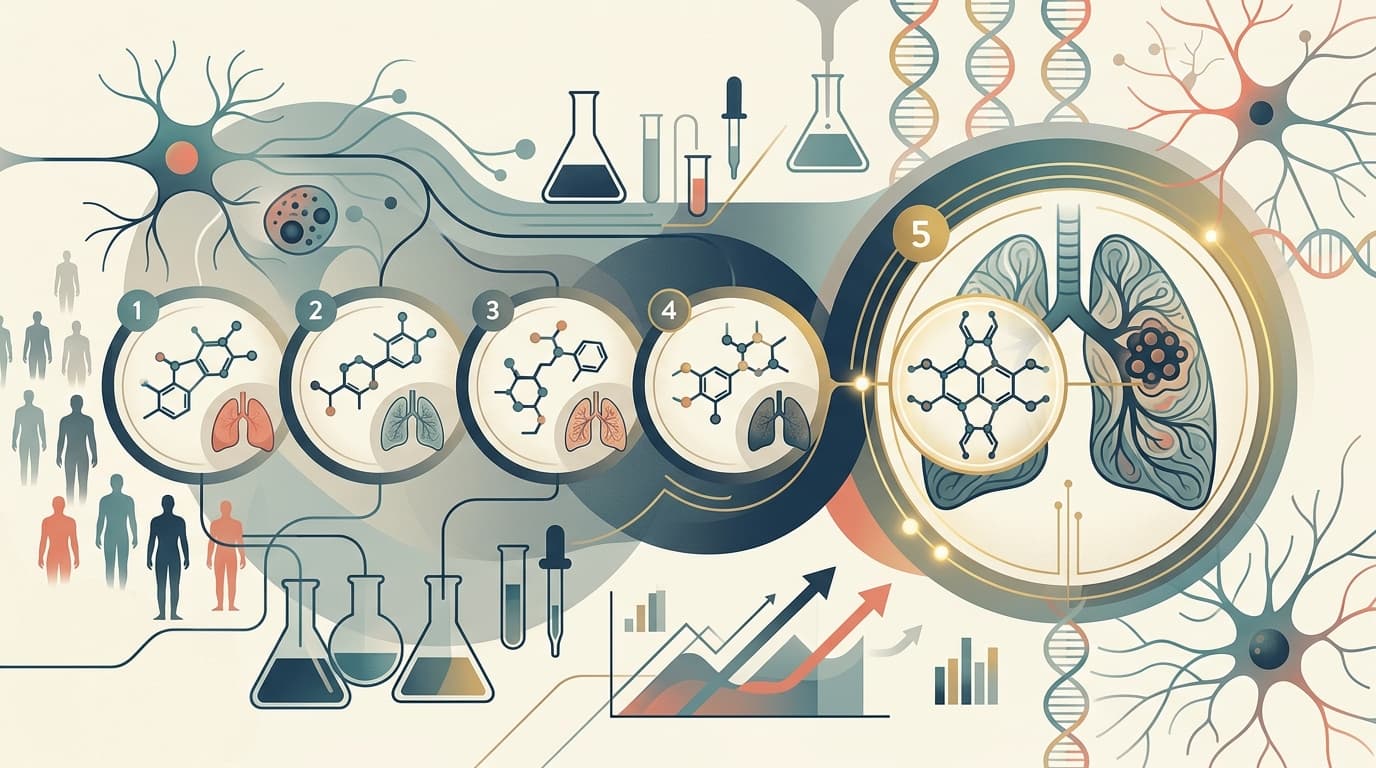
The history of ROS1-targeted therapy reads like an arms race. Crizotinib came first in 2016, proving that blocking ROS1 could shrink tumors in about 72% of patients. But crizotinib struggled to reach the brain, and tumors developed resistance mutations (think of them as genetic workarounds) that let the cancer keep growing.
Entrectinib arrived in 2019 with better brain penetration. Then repotrectinib in 2023 and in 2025 brought next-generation designs that could tackle some of those resistance mutations head-on. Each new drug extended the fight a little longer.
Get tomorrow's biotech intelligence before your competitors.
Join thousands of biotech professionals who start their day with our free, daily briefing.
taletrectinib
But here's the problem: when patients have already tried one or two of these drugs and their cancer has evolved past them, the remaining playbook gets thin. Chemotherapy is an option, but response rates drop and immunotherapy often disappoints in ROS1-positive tumors (they tend to have low tumor mutational burden, which means the immune system doesn't easily recognize them as threats).
That's the gap Jideytro is designed to fill.
What Makes Jideytro Different
Zidesamtinib came out of the labs at Nuvalent, a biotech focused on precision cancer drugs. GSK now owns the drug after acquiring Nuvalent, and the company describes it with three calling cards: ROS1 selectivity, broad resistance mutation coverage, and the ability to cross the blood-brain barrier.
Let's unpack that. Most earlier ROS1 drugs also hit other kinases (like ALK or TRK), which can cause side effects. Zidesamtinib was engineered to be picky, targeting ROS1 specifically. That selectivity is designed to keep the toxicity profile cleaner while maintaining firepower against the mutations that make cancer resistant to earlier treatments, including the notorious G2032R mutation, a solvent-front mutation that's one of the most common escape routes for ROS1-positive tumors.
The brain-penetrant angle matters too. When your cancer has a 20 to 40 percent chance of being in the brain at diagnosis, a drug that can actually reach those tumors is more than a nice feature; it's a necessity.
The Trial That Sealed the Deal
The approval rests on ARROS-1, a global phase 1/2 trial that enrolled patients with advanced ROS1-positive NSCLC. The pivotal group included 117 patients who had already been treated with at least one ROS1 inhibitor. These are the patients who'd already been through the first wave of targeted therapy and watched their cancer adapt.
The headline number: an objective response rate of 44%. That means nearly half of these previously treated patients saw their tumors shrink meaningfully. In oncology's refractory setting (where cancers have already resisted prior targeted drugs), that's a strong signal.
But the durability numbers are what really stand out. Among responders, 84% were still responding at six months, and 78% held their response at the one-year mark. For patients who'd only had one prior ROS1 drug (crizotinib or entrectinib), the numbers were even better: a 51% response rate and a stunning 93% of responders still going strong at 12 months.
The brain data? Remarkable. In patients with CNS disease who'd been previously treated, the intracranial response rate hit 48%, with complete brain responses and zero cases of CNS progression at the data cutoff. For a population where brain metastases are a constant threat, those numbers are meaningful.
A Side Effect Profile That Doesn't Scare Patients Away
No cancer drug is side-effect free, but zidesamtinib's tolerability looks favorable for a drug meant to be taken indefinitely. The safety data come from 432 patients across the trial.
The most common side effects (occurring in at least 15% of patients) were swelling, peripheral neuropathy, constipation, fatigue, and shortness of breath. None of those are trivial, but the dropout numbers tell a reassuring story: only 2% of patients stopped treatment because of side effects, and just 10% needed a dose reduction. For context, those are low numbers in oncology. The drug's TRK-sparing design (meaning it avoids hitting TRK receptors that other ROS1 drugs accidentally target) likely helps explain why the serious neurologic side effects seen with some competitors are minimized here.
Patients take 100 mg once daily by mouth. One pill, once a day, until the disease progresses or side effects become intolerable. Simplicity matters when you're asking someone to stay on a drug for months or years.
Where Jideytro Fits in the Lineup
Think of ROS1-positive NSCLC treatment like a baseball bullpen. Crizotinib and entrectinib are the veterans who get the start but tire out. Repotrectinib and taletrectinib are the middle relievers, handling the tricky resistance mutations. Jideytro is now the closer: the drug you bring in when the earlier options have been burned through.
The current FDA-approved label reflects that positioning. Jideytro is specifically for patients who've already received at least one prior ROS1 kinase inhibitor. Expert commentary suggests it may be strongest in the post-repotrectinib or post-taletrectinib setting, where the fewest alternatives remain.
But GSK isn't content with just the late-inning role. The ARROS-1 trial also tested zidesamtinib in treatment-naïve patients, where it posted an 89% response rate. A submission to expand the label into the first-line setting is planned for the second half of 2026. If approved, that would transform Jideytro from a specialist reliever into a potential starter, competing directly with repotrectinib and taletrectinib for the opening slot.
The Bigger Picture
Zoom out, and the ROS1 story is one of the clearest success stories in precision oncology. In just ten years, this tiny patient population went from having zero targeted options to having five FDA-approved drugs, each designed to outmaneuver the last generation's resistance patterns.
That progress comes with a caveat, though. ROS1 testing still isn't universal. Because the fusion only shows up in 1 to 2 percent of lung cancers, some patients in underserved regions never get tested, never get diagnosed, and never access these drugs. The best targeted therapy in the world doesn't help if nobody checks for the target.
For the patients who do get identified, the approval of Jideytro means something concrete: another card to play when the disease fights back. In a cancer that evolves relentlessly, having a fifth option isn't a luxury. It's a lifeline.
The Bottom Line
Jideytro's approval landed nearly two months ahead of its September 2026 deadline, which typically signals the FDA saw a clean package. The drug earned both Breakthrough Therapy and Orphan Drug designations on its way to approval, reflecting the agency's recognition of serious unmet need.
GSK plans an immediate U.S. launch. No pricing has been disclosed yet, but expect it to land in the range typical of targeted oral oncology drugs for rare molecular subsets. The commercial opportunity starts narrow (refractory ROS1-positive NSCLC is a small market), but a potential first-line expansion later this year could widen the aperture considerably.
For the roughly 20,000 to 50,000 patients diagnosed with ROS1-positive lung cancer each year worldwide, the message is simple: the options keep getting better, and the fight isn't over until the last drug is played.
Clinical & Regulatory4 min read
Zepbound Just Got a Secret Back Door to Cheaper Prices
Eli Lilly is now selling the highest doses of Zepbound in single-dose vials for $449 per month, roughly 60% cheaper than the standard auto-injector pens. It's a strategic play in a GLP-1 pricing war that's reshaping who can actually afford obesity drugs.