The FDA Ghosted a Biotech Company. It Didn't Survive.
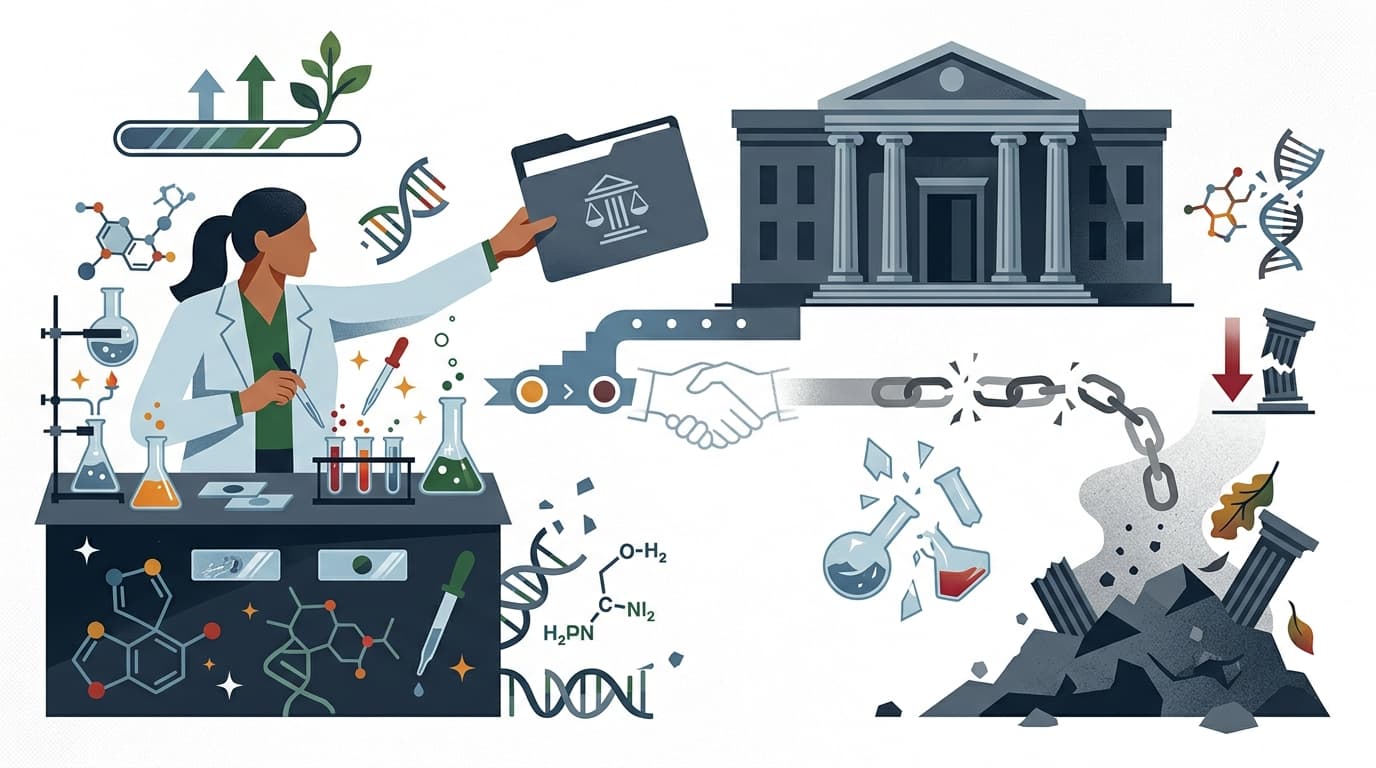
The FDA canceled a critical meeting with Kezar Life Sciences without explanation. Four months of silence later, the biotech was dead, its promising autoimmune hepatitis drug orphaned, and AIH patients left waiting for a treatment that may never come.
Imagine you're about to close on your dream house. The bank says the final meeting is next week. Then, without a word, they cancel. No explanation. No new date. Weeks turn into months. Your savings drain. The seller walks.
That's basically what happened to Kezar Life Sciences. Except the house was a promising drug for a disease with no good treatments, and the bank was the FDA.
A Drug That Actually Worked
Let's rewind. Kezar had a drug called zetomipzomib, a selective immunoproteasome inhibitor (think of it as a precision tool that dials down the immune system's overreaction without nuking the whole thing). They were testing it against autoimmune hepatitis, or AIH, a condition where your immune system attacks your own liver.
AIH is a rough ride for patients. Current treatment is basically steroids plus older immunosuppressants like azathioprine. About 70-80% of patients respond, which sounds decent until you realize that roughly 15% never fully respond and another 7-9% fail treatment entirely. Those who do respond often can't get off steroids, which bring their own carnival of side effects: weight gain, bone loss, diabetes. There are no FDA-approved targeted therapies for AIH. It's a disease stuck in a treatment time warp.
So when Kezar's Phase 2a trial (called PORTOLA) showed that 36% of patients achieved biochemical remission and tapered off steroids, compared to 0% on placebo, people paid attention. That's not a blockbuster number in a vacuum, but against a placebo rate of literally zero? In a disease with no modern drugs? That's a signal worth chasing.
The Meeting That Vanished
Buoyed by the data, Kezar did what any responsible drug company would do: they went to the FDA to plan the next step. They requested a Type C meeting for Q4 2024 (think of it as a strategic sit-down to align on how to design a registration trial, the final study you need before seeking approval).
The meeting was set for October 2024. Then the FDA canceled it.
Get tomorrow's biotech intelligence before your competitors.
Join thousands of biotech professionals who start their day with our free, daily briefing.
For a big pharma company with dozens of programs and billions in the bank, a four-month scheduling hiccup is annoying. For a small biotech with one lead drug and a finite pile of cash, it's an existential crisis. And that's exactly what it became.
Death by a Thousand Uncertainties
When the FDA did eventually communicate, the news wasn't great. The agency wanted Kezar to run a standalone pharmacokinetic study in patients with significant liver impairment before moving forward. In plain English: the FDA wanted to see how the drug behaves in patients with severely damaged livers, a study Kezar hadn't planned for because they intended to exclude those patients from their pivotal trial.
Kezar's leadership argued this was technically challenging and resource-prohibitive for a company their size. According to their estimates, the FDA's requirement would delay the entire AIH program by roughly two years.
Two years. For a company burning cash every quarter with no revenue. That math doesn't work.
By October 2025, Kezar had already started cutting. They laid off about 70% of their workforce. The layoffs alone cost $6 million. They held $90.2 million in cash as of September 30, 2025, which sounds like a lot until you realize that clinical-stage biotechs can burn through that in 18 months without breaking a sweat.
The company announced it was exploring "strategic alternatives," which is corporate-speak for "someone please buy us before the lights go out."
Four Months Late and a Dollar Short
The FDA meeting finally happened in February 2026, four months after it was originally supposed to occur. And here's the cruel irony: the meeting went well. The FDA and Kezar actually agreed on a Phase 2b trial design for zetomipzomib in AIH.
But by then, it didn't matter.
The prolonged uncertainty had done its damage. Investors, already skittish about a small-cap biotech with a complicated regulatory history (Kezar had previously discontinued a lupus program after patient deaths in an earlier trial), pulled their support. The four months of radio silence from the FDA had created a confidence vacuum that no positive meeting outcome could fill.
Kezar laid off most of its remaining staff. They auctioned equipment. And by early April 2026, the company announced its sale to Aurinia Pharmaceuticals, a Canadian biotech. Whether Aurinia will actually advance zetomipzomib, and on what timeline, remains an open question.
A drug that showed real promise in a disease with terrible options now sits in limbo because of a scheduling delay.
The Bigger Picture Is Uglier
Kezar's story isn't happening in isolation. It's a symptom of a much larger disease inside the FDA itself.
The agency has been hemorrhaging staff. Under HHS restructuring, the FDA has lost approximately 3,500 positions, a roughly 20% workforce cut. Senior reviewers with decades of institutional knowledge have walked out the door. The people left behind are drowning in larger workloads with fewer resources.
The consequences are showing up everywhere. Pre-IND meetings (the early conversations that help companies design their development programs) are getting delayed or replaced with written feedback. PDUFA dates, the statutory deadlines by which the FDA is supposed to make approval decisions, are being missed.
CEO Chris Kirk of Kezar himself pointed to FDA "volatility," including staff changes, as a driver of inconsistent decisions that disproportionately hammer small companies.
Why Small Biotechs Get Hit the Hardest
This is where the structural unfairness becomes impossible to ignore.
Big pharma can absorb a two-year delay. They have other drugs generating revenue, diversified pipelines, and access to capital markets whenever they need it. A scheduling snafu from the FDA is a line item in a quarterly earnings call; annoying, forgettable.
Small biotechs operate on a completely different playing field. They're essentially startups: pre-revenue, burning cash, and betting everything on one or two programs. Their entire business model depends on hitting regulatory milestones on a predictable timeline, because that's what keeps investors writing checks.
When the FDA introduces unpredictable delays, it doesn't just slow down the science. It breaks the financial model. Investors can tolerate a drug that fails in a clinical trial; that's the known risk they signed up for. What they can't tolerate is open-ended regulatory limbo with no explanation and no timeline. That's not risk; it's chaos. And capital doesn't stick around for chaos.
Kezar had $90 million in the bank and a drug that worked. They still couldn't survive a four-month scheduling delay. Let that sink in.
What Happens to the Patients?
This is the part that gets lost in the financial wreckage. AIH patients are still out there, still stuck on decades-old treatment regimens, still dealing with steroid side effects, still hoping for something better.
Zetomipzomib was that something better, or at least it had a real shot at becoming it. The Phase 2a data was genuinely encouraging. The mechanism of action (targeting the immunoproteasome specifically, rather than carpet-bombing the whole immune system) made scientific sense. The unmet need was enormous.
Now, instead of moving toward a pivotal trial under a focused, motivated team, the drug sits in the portfolio of an acquirer that hasn't committed to a development timeline. Best case: Aurinia picks it up and runs with it, adding maybe a year or two of transition time on top of the delays already incurred. Worst case: it gathers dust on a shelf.
Either way, AIH patients just lost years. Not because the science failed, but because a meeting got canceled and nobody bothered to explain why.
The Question Nobody at the FDA Is Answering
The most maddening part of this story is the silence. Why was the October meeting canceled? What internal process led to a four-month gap before it was rescheduled? Was it a staffing issue? A policy disagreement? Simple bureaucratic inertia?
We don't know, because the FDA hasn't said.
And that opacity is corrosive. If the agency had communicated clearly ("We need more time because of X, and we expect to reschedule by Y"), Kezar could have managed investor expectations. The company could have told its shareholders, "This is a defined delay with a known endpoint." That's survivable.
Instead, they got nothing. And nothing killed them.
The FDA exists to protect patients. But when its own dysfunction prevents promising drugs from reaching the people who need them, something has gone badly wrong. Kezar Life Sciences won't be the last small biotech to die this way. Unless something changes at the agency, it might not even be the most notable.
4 min read
An AI Just Designed an Opioid Addiction Drug. No Human Chemist Required.
A computer just designed a new opioid addiction drug that doesn't touch opioid receptors at all. GATC Health's AI-generated candidate is heading into human trials, and it could signal a turning point for a field that's been stuck for decades.