An AI Just Designed an Opioid Addiction Drug. No Human Chemist Required.
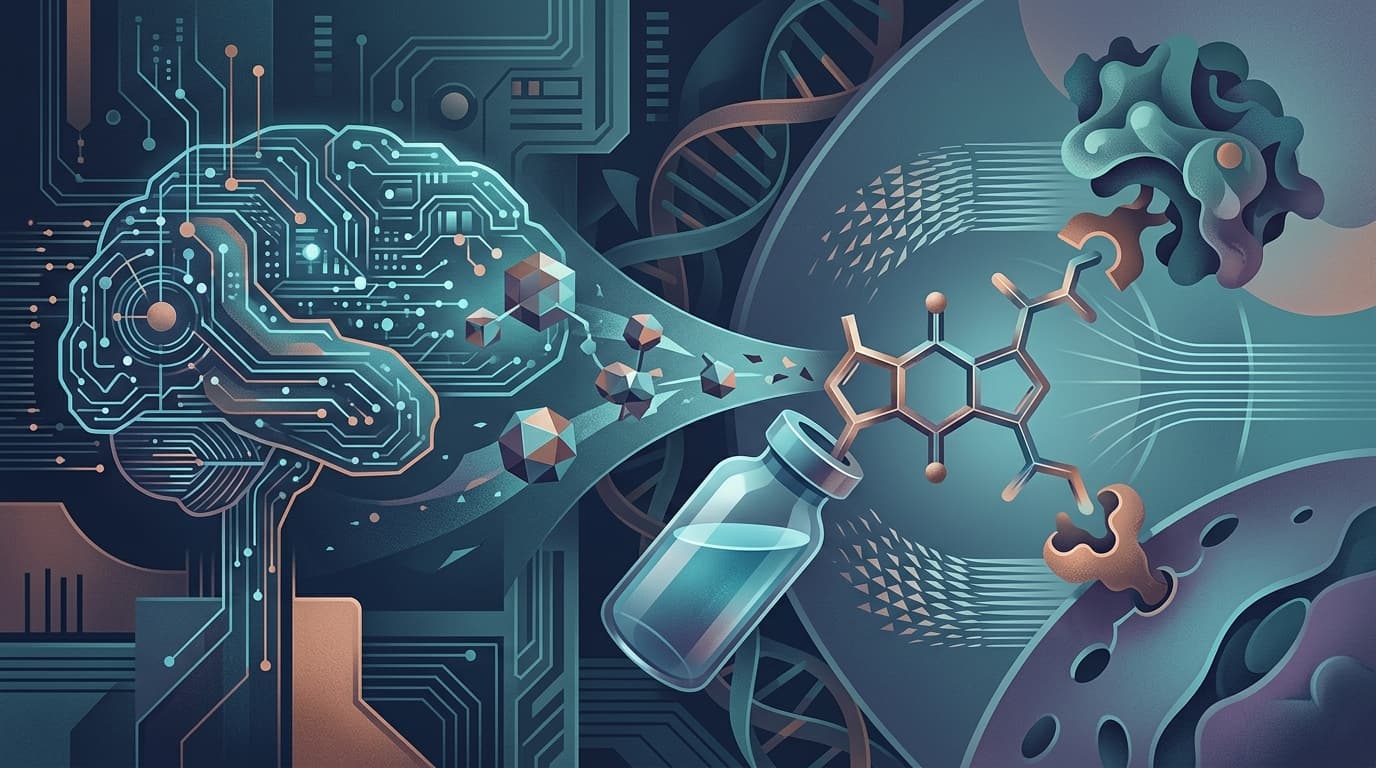
A computer just designed a new opioid addiction drug that doesn't touch opioid receptors at all. GATC Health's AI-generated candidate is heading into human trials, and it could signal a turning point for a field that's been stuck for decades.
Imagine asking a computer to invent a drug for one of America's deadliest crises, and it actually works. That's roughly what just happened.
GATC Health, a computational biology company, published research on a new drug candidate for opioid use disorder (OUD) that was designed almost entirely by artificial intelligence. The compound targets serotonin receptors, avoids the opioid pathway altogether, and has already shown striking results in animal studies: rats given the treatment significantly reduced their fentanyl self-administration and showed lower rates of relapse.
No human chemist sat at a bench sketching molecular structures on a whiteboard. An AI did the heavy lifting.
The Machine That Plays Chemist
GATC's secret sauce is something called the Multiomics Advanced Technology (MAT) platform. Think of it like a biological flight simulator. Instead of testing thousands of compounds one by one in a lab (the traditional approach, which takes a decade or more), MAT simulates the entire biological system computationally. It predicts how molecules will behave inside the body before anyone mixes a single solution.
The platform's track record is surprisingly strong. Independent validation by UC Irvine showed an 86% true positive rate and a 91% true negative rate, meaning the AI correctly identifies both hits and misses at a level most drug discovery teams would envy.
Traditional drug development is famously brutal: 10 to 15 years from concept to approval, north of $2 billion in costs, and a graveyard of failed compounds along the way. AI-driven approaches like GATC's promise to compress that timeline to three to six years while slashing costs by up to 70%. If those numbers hold up in practice, the economics of drug development could look radically different within a decade.
Why Serotonin, Not Opioids?
This is where the science gets interesting. Most current OUD treatments work directly on opioid receptors. Methadone is a full opioid agonist (it activates the same receptors as heroin). Buprenorphine is a partial agonist (it tickles those receptors gently). Naltrexone blocks them entirely.
Get tomorrow's biotech intelligence before your competitors.
Join thousands of biotech professionals who start their day with our free, daily briefing.
All three approaches are effective, but they come with baggage. Methadone requires daily clinic visits under strict regulations. Buprenorphine has a dose ceiling that limits its flexibility. Naltrexone demands patients go seven to ten days without any opioids before starting, which is like asking someone drowning to hold their breath a little longer before you throw the life preserver.
GATC's candidate takes a completely different route. By targeting serotonin receptors, it aims to fix the upstream problem: the dopamine imbalance that drives compulsive drug-seeking behavior. The company says the compound restores dopamine balance, reduces the obsessive mental loops (called rumination) that fuel relapse, and even enhances cognitive flexibility and mood.
In other words, instead of substituting one key for the same lock, this approach tries to change the lock entirely.
The Crisis That Won't Wait
The urgency here is hard to overstate. Fewer than one in five people with OUD currently receive any medication for it. The existing toolkit, while proven, clearly isn't reaching enough patients. Polysubstance overdoses (think fentanyl mixed with stimulants) are growing, and current reversal agents like naloxone weren't designed for those combinations.
GATC's serotonin-focused approach fits neatly into the broader vision of targeting new receptor systems for addiction treatment.
NIDA Director Nora D. Volkow has noted that AI tools can optimize workflows, reduce costs, and prioritize under-resourced addiction care, especially in hospitals where screening is often overlooked. The field is hungry for innovation, and it has been waiting a long time.
From Mouse to Human: The Hard Part
Before anyone pops champagne, a reality check. The preclinical results (presented at the Neuroscience 2025 conference in collaboration with UC Irvine) are promising, but rats are not people. Plenty of drugs that crush it in rodent models flame out in human trials.
GATC has partnered with Lisata Therapeutics to advance the candidate into Phase 1 clinical trials, which were slated to begin in early 2026. That first human study will answer the most basic questions: Is it safe? Does the body absorb it properly? How long does it last?
Phase 1 is just the starting line. Even with AI-accelerated timelines, the candidate likely faces years of additional testing before it could reach patients. And the 80-90% Phase 1 success rate that AI-designed drugs have reportedly achieved across the industry, while impressive compared to the traditional 40-65% range, still means roughly one in ten won't make it past the first hurdle.
Why This Matters Beyond One Drug
The bigger story isn't just about opioid addiction. It's about what happens when AI starts designing drugs for diseases that the pharmaceutical industry has historically ignored or underfunded.
Addiction medicine is a perfect example. The science is complex, the patient population is stigmatized, reimbursement is messy, and the profit incentives don't look like oncology. Big pharma has largely stayed on the sidelines. The current pipeline has a handful of late-stage candidates (like Opiant's intranasal naloxone formulation OX-124 and Indivior's INDV-6001), but breakthroughs have been rare.
AI could change that calculus. If a computer can screen millions of compounds in hours instead of years, the economics suddenly work for diseases that never attracted blockbuster-level investment. Mount Sinai launched an AI Small Molecule Drug Discovery Center in April 2025 focused on cancer, metabolic disorders, and neurodegenerative diseases. Companies like Mindstate Design Labs are using AI to design non-hallucinogenic compounds that promote brain plasticity for depression and PTSD, conditions that overlap heavily with substance use disorders.
The pattern is clear: AI is moving from theoretical promise to actual drug candidates. And it's heading straight for the therapeutic areas where traditional pharma feared to tread.
The Bottom Line
GATC Health's AI-designed OUD candidate is early-stage, unproven in humans, and years from any pharmacy shelf. That's the disclaimer. But the approach represents something genuinely new: a non-opioid treatment for opioid addiction, discovered by a machine, validated in preclinical models, and heading into human trials with a well-funded partner.
The opioid crisis has been a slow-motion catastrophe for over two decades. The treatment toolkit has barely changed. If AI can accelerate the search for better options, even incrementally, the impact could be measured in thousands of lives.
That's not hype. That's math.
4 min read
Biogen's Billion-Dollar Problem Has a Tiny, Twisted Solution
Biogen's newest deal isn't about a single drug; it's about fixing the delivery problem that's been holding back an entire class of genetic medicines. Alloy Therapeutics' shape-shifting ASO platform claims 50x better potency, and Sanofi already placed a $427M bet on it.